




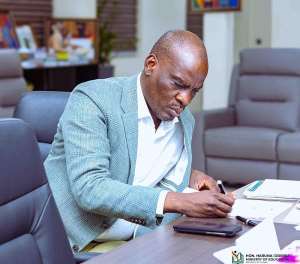
In societies that pride themselves on democracy and freedom of expression, one would expect truth telling to be celebrated, not punished. Yet, time and again, we see individuals vilified or silenced for daring to speak truth to power, especially when that truth challenges entrenched norms or exposes hypocrisy. But then, one must ask, what if those in power themselves speak, not from principle, but from prejudice? What happens when a minister’s statement, rather than fostering unity, reawakens old wounds rooted in colonial subjugation and cultural erasure?
The recent uproar surrounding comments by the education minister Mr. Haruna Iddrisu, reveals a deeper, festering issue in our national consciousness, one that goes beyond a mere policy disagreement. It touches the very soul of who we are as Africans, as Black people, and as a nation still struggling to free itself from the subtle chains of colonial mentality.
Let us imagine a scenario, what if, tomorrow, the Ghana Education Service (GES) were to declare that no Muslim girl should wear the hijab to school? Would the same minister rush to defend that directive with the same vigor? Or would he, the minister, suddenly find the language of “tolerance,” “inclusivity,” and “rights” convenient to preach? It would be the height of double standards because it is always easier to defend oppression when it aligns with one’s biases, but far harder to uphold fairness when it challenges one’s comfort.
Such hypocrisy exposes a dangerous moral inconsistency within our public institutions and leadership. It suggests that some rights are conditional, some freedoms negotiable, and that certain cultural or religious identities can be undermined with impunity while others are zealously protected. This selective outrage is not just unjust; it is the very definition of prejudice cloaked in authority.
When one hears a minister, an educated, presumably enlightened public servant, echoing sentiments that sound eerily colonial, it becomes not just disappointing but tragic. The colonial project was not merely about political domination; it was a psychological war aimed at reshaping how Black people see themselves. It demonized our customs, denigrated our appearances, and made us believe that proximity to European standards was a measure of civility.
So when today’s leaders still speak in ways that shame African features, cultures, or expressions, whether it’s natural hair, traditional attire, or religious symbols, they unconsciously revive those very colonial ghosts. It is as if we have learned nothing from history. We seem trapped in a cycle where the colonized have now become the enforcers of the colonizer’s mentality.
Do we see white children shaving their heads to fit into anyone’s idea of discipline or morality? Or do we see arab children shaving their heads to fit into anyone’s idea of discipline or morality? Of course not. Their individuality is protected under the guise of “freedom of expression and spirituality.” Yet, when Black children assert their identity through hair, hijab, or heritage, they are branded as rebellious or unfit for modern education. What hypocrisy! What a painful reminder that we still measure our progress through the lens of the oppressor.
It is unfortunate, indeed deeply regrettable, when a leader, who should know better, descends so low in public discourse. Leadership demands intellectual depth and moral courage, not shallow conformity to outdated notions of order or civilization. The minister’s comments represent not just a personal lapse but a collective failure in leadership that continues to plague postcolonial African societies.
We cannot continue to speak of “African renaissance” while still enslaved by the mental patterns of those who once sought to erase our essence. The true test of leadership in Africa today is not in economic rhetoric or political sloganeering; it is in the courage to decolonize our minds, our institutions, and our symbols of identity.
We must begin to ask ourselves hard questions, what does it mean to be truly independent? Have we replaced the white colonial master only to enthrone Black administrators of the same oppressive system? Until we dismantle these inherited mindsets, those that shame our culture, our faiths, our hair, our names, our identities, we will continue to speak of freedom without ever tasting it.
Speaking truth to power must never be treated as insubordination. It is, in fact, the most patriotic act a citizen can perform. But that truth must also cut both ways. Those who hold power must examine their own biases and guard against using their platforms to perpetuate prejudice. Ministers, educators, and leaders should be agents of liberation, not mouthpieces of mental colonialism.
Until then, every time a young African child is told to conform to Eurocentric standards of beauty, faith, or behavior, we betray the struggles of our forebears who fought for liberation. And every time a leader echoes the colonizer’s voice, we take one step backward on the long road toward self realization.
In the end, our greatest battle is not against foreign domination; it is against the colonial mentality still living within us.
Sulley Kone
+233244805619

 Don’t let speed of information become your judgement — Chief Justice tells new l...
 ‘Big Push’: Government assures contractors of prompt payments
 GES to develop plan to recover teaching time lost during teachers’ strike – Clem...
 Fire guts Kumasi Central Market near Aboabo Station
 'All human emotions': French astronaut Sophie Adenot's first words since returni...
 French astronaut recounts 'astonishing' emotions after return to Earth
 India's 'cockroach' movement chief detained ahead of major protest
 Strike suspended, but negotiations for teachers’ benefits not over — GNAT
 CSA rejects FBI claims, insists Ghana led cybercrime operation
 Govt suspends enforcement of ban on preaching in moving vehicles


