




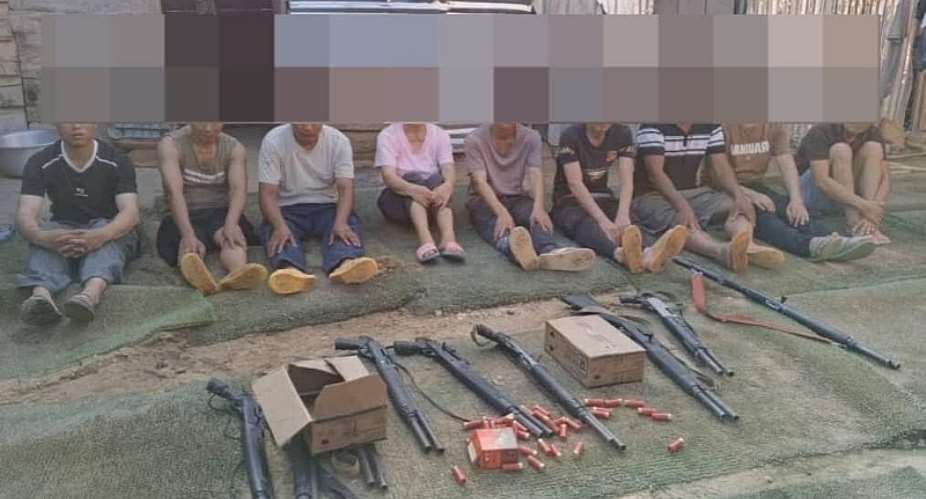
By all accounts, Ghana’s illegal mining problem known locally as "galamsey" has entered a dangerous new phase. What began as an environmental and economic concern is fast mutating into a national security emergency. The recent arrest of ten heavily armed Chinese illegal miners at Abusa in the Ashanti Region by the National Anti-Illegal Mining Operations Squad (NAIMOS) has cast a long, dark shadow over the country’s fight against galamsey.
During the operation, authorities recovered vehicles, refrigerators, pump-action guns, and more than 150 rounds of live ammunition. It was not merely an illegal mining site—it looked like a well-defended outpost. The question now confronting the nation is as urgent as it is unsettling: where are these guns coming from, and how did they end up in the hands of illegal miners?
A Crisis Beyond the Rivers
For years, Ghana’s battle against illegal mining has focused on the visible damage: poisoned rivers, ravaged forests, and lost farmlands. But beneath the surface, a more insidious threat has been taking root—the militarization of galamsey operations. From the Western Region to the Upper East, there are credible reports that illegal miners, both local and foreign, are arming themselves.
Security agencies have confiscated weapons during several anti-galamsey raids, but the Abusa arrests have exposed something far more alarming. Multiple sources claim that some of these weapons may be smuggled into Ghana concealed inside imported heavy machinery, especially excavators. Allegedly, arms are hidden within the booms or hydraulic arms of these machines—an almost undetectable method of trafficking.
If this is true, it represents a Trojan Horse scenario: under the guise of mining, Ghana may be importing tools of violence and instability.
The Big Questions
This moment calls for honesty and accountability. Who is inspecting these machines at our ports? Are customs officials equipped and empowered to detect concealed arms in imported machinery? How are firearms being distributed to foreign miners deep in the hinterlands? Who grants the licenses, and who looks the other way?
These are not abstract questions—they are matters of national survival. Ghana cannot afford a future where mining towns become fortified zones controlled by armed foreign interests. The state’s monopoly on the use of force must never be surrendered to criminal enterprises hiding behind gold dust.
A Threat to Peace and Governance
The infiltration of arms into mining communities risks igniting violent confrontations, not only between miners and security forces but also among rival mining gangs. In regions already burdened by unemployment and political discontent, the introduction of weapons could transform economic grievances into armed conflict.
Moreover, there are governance implications. The presence of heavily armed foreign actors in Ghana’s mining sector undermines sovereignty, exposes institutional weaknesses, and raises suspicions of high-level complicity in illegal mining networks.
What Must Be Done
The Abusa incident must mark a turning point—a moment when Ghana confronts the uncomfortable truths of its galamsey crisis and redefines its approach. The following steps are urgent:
1. Comprehensive Security Audit: A full-scale investigation into how weapons are entering illegal mining zones and who facilitates their movement.
2. Port Surveillance Reform: Deployment of advanced scanning and tracking systems to inspect heavy machinery imports, especially excavators and bulldozers.
3. Intelligence-Driven Enforcement: Coordination among the Ministry of National Security, the Ghana Armed Forces, the Ghana Police Service, and Customs to dismantle smuggling networks.
4. Stricter Regulation of Foreign Miners: Immediate review and enforcement of small-scale mining regulations to prevent foreign exploitation and illegal participation.
5. Community Vigilance and Protection: Empowering residents to report suspicious activity while ensuring their safety through state-backed protection and whistleblower systems.
6. Transparency and Accountability: Publication of seized weapons data, arrests, and prosecution outcomes to rebuild public trust in the fight against galamsey.
A Defining Moment
Ghana stands at a crossroads. The fight against illegal mining is no longer only about restoring rivers or saving forests—it is about protecting national peace, territorial integrity, and public confidence in the rule of law.
The Abusa arrests should not be treated as an isolated victory but as a national warning. If the state fails to act decisively, the illegal mining industry could evolve into a full-blown security crisis—an underground war fought not just over gold, but over control of Ghana’s land and future.
The choice before Ghana is stark: confront the threat now with courage and coordination, or allow the gold rush to become a gun rush.
— Centre for Research and Education Policy, CREP


 Government targets GH¢15.38bn domestic financing in Q4 to support 2027 bond buyb...
 Obuasi SHTS sex scandal: GES to ban teachers from inviting students to bungalows...
 Adwoa Safo to contest Dome-Kwabenya parliamentary seat again
 UG directs students with CGPA below 1.00 to go home
 Uganda Revenue Authority delegation visits TOR to understudy Ghana’s oil refinin...
 Attorney-General appeals ruling halting trial of former Buffer Stock CEO, wife
 NAIMOS destroys 1,970 changfans, 863 Illegal mining structures in three months —...
 Let's see how Asiedu Nketia becomes NDC flagbearer with same people he conspired...
 Obuasi SHTS sexual abuse: 'GES must distant itself, allow the law to work' — For...
 Upper East: Fear grips nine Kusaug communities over mysterious fish deaths in da...


