




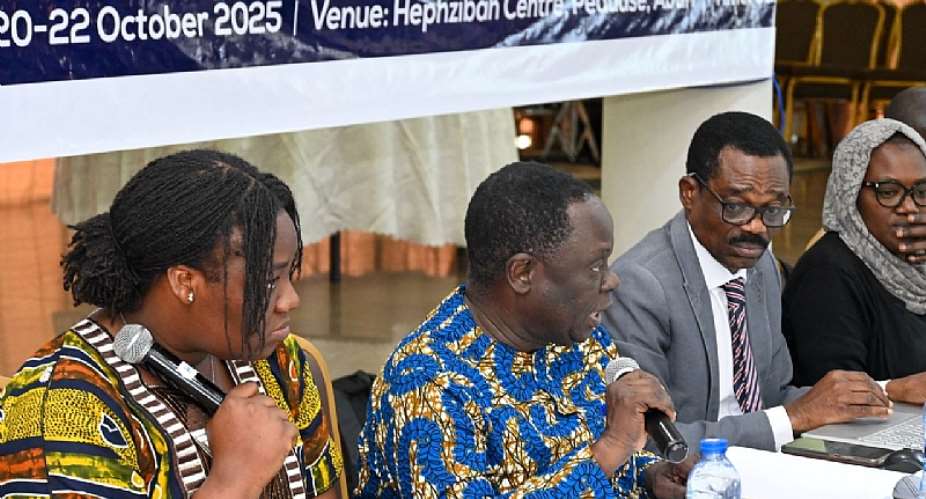
Ghana has officially validated its National Marine Spatial Planning (MSP) Framework following a three-day workshop organised by the Fisheries Committee for the West Central Gulf of Guinea (FCWC) in collaboration with the Fisheries Commission, under the auspices of the Ministry of Fisheries and Aquaculture Development (MoFAD).
The workshop, held from October 20 to 22, 2025, in Aburi, was themed “Restitution and Validation of the Institutional and Legal Framework and Stakeholder Mapping.” It brought together representatives from government agencies, academia, civil society, and the private sector to reach a national consensus on Ghana’s approach to sustainable management of marine and coastal resources.
The MSP Framework serves as a strategic roadmap for managing how different sectors, including fisheries, energy, shipping, and tourism, use Ghana’s ocean space in a coordinated and sustainable manner. It aims to balance economic growth with environmental protection and community livelihoods.
The event formed part of the MarEcoPlan Project, a three-year initiative (2024–2027) implemented by the FCWC and the International Union for Conservation of Nature (IUCN) with funding support from the Global Environment Facility (GEF). The project promotes sustainable use and conservation of marine and coastal ecosystems across Ghana, Côte d’Ivoire, and Togo.
In his remarks, Dr Gaston Djihinto, Secretary-General of the FCWC, emphasised the need for collective action and evidence-based decision-making in ocean governance. He commended Ghana for its continued leadership and commitment to sustainable fisheries and marine conservation.
Kossi Ahoedo, Project Coordinator for MarEcoPlan, highlighted the inclusive nature of the MSP process, describing it as “a collaborative effort among multiple ocean users from fisheries and energy to industry, transport, and recreation designed to guide informed and coordinated decisions on the use of marine resources.”
The Executive Director of the Fisheries Commission, Professor Benjamin Campion, lauded the strong institutional cooperation demonstrated during the process and pledged the Commission’s full support to ensure the successful implementation of the Marine Spatial Plan.
Participants at the workshop reviewed Ghana’s marine governance framework, identified institutional gaps, and discussed strategies to enhance coordination among fisheries, transport, energy, and environmental agencies. The session culminated in the official validation of the MSP Framework, marking a major milestone in Ghana’s efforts to build resilient marine ecosystems and protect the livelihoods of coastal communities.
About the FCWC
Established in 2007, the Fisheries Committee for the West Central Gulf of Guinea (FCWC) promotes regional cooperation in fisheries management among its six member states Benin, Côte d’Ivoire, Ghana, Liberia, Nigeria, and Togo. The organisation works to ensure sustainable fisheries, combat illegal, unreported, and unregulated (IUU) fishing, and support blue economy initiatives across the West Central Gulf of Guinea.

 Abronye loses again as Court of Appeal dismisses bid to halt Samson Anyenini’s d...
 Over 30 women feared trapped in prostitution in Savannah as GIS arrests traffick...
 Govt pays GH¢24.8bn to statutory funds since January — Ato Forson
 Seven missing Axim fishing canoe crew located in Togo’s waters — Western Regiona...
 Health Ministry assures Ghanaians of readiness to manage Ebola cases
 FDA shuts down Arcan Bitters factory again over illegal production in Ashanti Re...
 PAC chair praises NPA CEO Edudzi Tameklo’s performance at committee hearing
 Ghanaian jailed nine months in US for using relative’s social security number to...
 Ukraine war: I'm going to Russia to convince President Putin to ceasefire — Maha...
 'Prof. Jane Naana is Vice President of Ghana; not for women and girls' — Victori...


