




Introduction
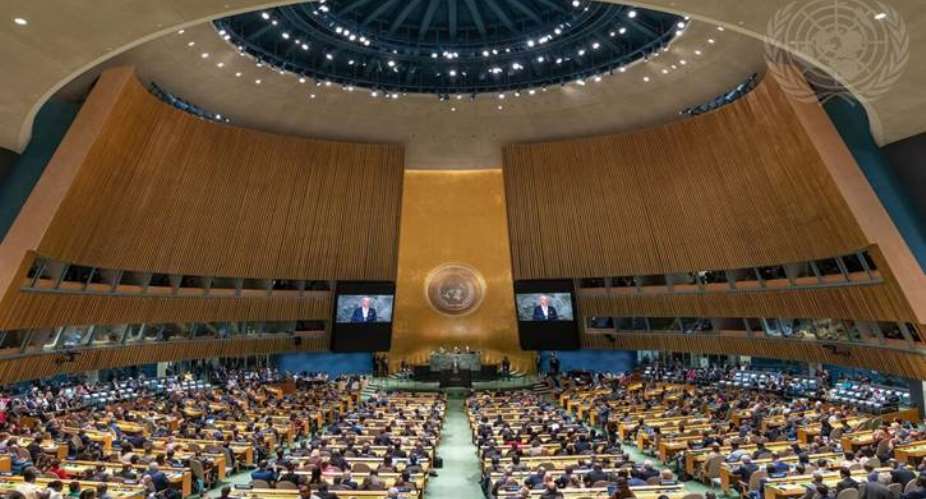
24 October is celebrated as the United Nations (UN) Day, an annual commemorative day, reflecting the official creation of the United Nations (UN) on the 24th of October 1945. Thus, this year, 2025, (UN) turns 80. It is a day meant for global celebrations for the survival of this international organization meant to be a vehicle for global peace, justice , inclusion unity and development. But for Africa, its a day more of reckoning rather than celebrating.This was very much evident throughout the deliberations at United Nations General Assembly (UNGA80). Leaders, activists, innovators took turns to repeatedly point out that any conversation about the world’s future peace, unity and partnership that excludes Africa misses the point entirely. Unfortunately the current (UN) at 80, still continues to miss the point by its continued marginalization and exclusion (of Africa from the most important and powerful organ of (UN) , the United Nations Security Council (UNSC). This has meant that Africa has ever since to date remained on the periphery, marginalised, discriminated.This has not only tarnished the credibility but also disadvantaged the capacity of (UN) to holistically deal with world problems in general and African problems in particular.Indeed,a continued injustice and unfairness to mother continent of Africa.
Theme for 2025 UN International Day
The theme for this year's celebration is: "United Nations Day 2025: *Promoting Peace, Unity, and Global Partnerships. But the reality no sustainable peace and unity can be achieved as long as the same unity continues to dish out unfairness and injustice to Africa. Real mutual partnerships ought to be founded on mutuality, fairness and inclusion. But as the world celebrate the 80th anniversary of UN, the African continent continues to be the only continent excluded from the most important and powerful organ of United Nations, that is, the Security Council.
Ezwulini Consensus 2005- A Call For A More Democratic & Transparent UNSC
Ezwulni consensus is an international relations position adopted by the African Union (AU) in February of 2005.This international relations position was named after Ezulwini, a place (valley) in central Eswatini (then known as Swaziland), where the agreement was made in February of 2005.This AU position calls for calling for Africa to have two (2) permanent seats with veto power and five (5) non-permanent seats to correct historical underrepresentation.Observers and analysts alike argue that Africa should not be a mere spectator when decisions that directly affect its people are being made. African leaders are and have been demanding a permanent voice at the table, advocating for at least two permanent seats with veto power.
Is UN Being Fair To Africa?
Now 80 years after the establishment of the United Nations, Africa has yet to be granted a permanent seat on its most powerful organ, the Security Council. This institutional discrimination against African countries is both *legally indefensible* and *politically untenable*. Africa is the only continent without a permanent seat on the Security Council, which is the most powerful decision-making body within the (UN).The result is clear, decisions about global peace,security, and development which even affect Africa itself is made without Africa's full perspective and voice. Excluding 54 states representing over a billion people is not only unfair but unjust.
"But, let’s be clear: deep injustices are denying Africa’s rightful place on the world stage. These injustices share a common root: a global system designed without African voices; maintained without African participation; and perpetuated despite African protests".
(UN)Secretary-General António Guterres’ remarks to Parliament of Lesotho,12 December, 2024.
"Excluding Africa is not only unacceptable, unfair, and grossly unjust, it undermines the very credibility of this organization. Africa dominates much of the Security Council's agenda, provides some of the largest contingents of UN peacekeepers,and bears the heaviest costs of instability.Yet,we remain they continent without a permanent seat", William Ruto, Kenyan President.
Many have argued that the (UN)is unfair to Africa, particularly due to exclusion of Africa from permanent membership in the (UN) Security Council (UNSC). Even the current UN Secretary General questioned exclusion of Africa from UNSC;
"How can we accept that Africa still lacks a single Permanent Member in the Security Council?” , Guterres wrote on X.
Undemocratic power imbalance
The structure of the Security Council is seen as undemocratic, with power concentrated in the hands of a few weeks permanent members who hold veto power. An undemocratic structure that perpetuates colonial-era power dynamics and undermines the continent's ability to influence decisions that affect it directly.This imbalance is viewed as a continuation of historical power dynamics rather than a reflection of the current global landscape.
"You cannot claim to be the United Nations while disregarding the voices of fifty-four nations, it is impossible. Africa will no longer remain on the margins of global governance while decisions on peace, security, and development are made without our perspectives or voice", William Ruto , Kenyan President.
Neo-colonial dynamics
The current structure is seen by some as a remnant of an era when Africa was under the colonial yoke, everything dictacted to her by colonial powers.Here we are, Africa has no say or power to make decisions even on issues affecting her.
"This hurts Africa, but it also hurts the Security Council — its effectiveness , its legitimacy and its credibility.From Sudan to the Sahel, conflicts rage and communities suffer".
These crises demand not just global attention, they demand African leadership.Yet, Africa has no permanent voice when the world decides on matters of war and peace… in Africa, through the Security Council. That is unacceptable — and it must change. But we must also act to correct the injustices across many other fronts ", Kenyan President William Ruto.
Need of a more reflective & relevant UN
"At this moment of turbulence, when we most need a strong United Nations, the organisation faces its deepest crisis in credibility and capacity. We must make it fit for purpose, reform its structures, strengthen its mandate, and ensure its decisions reflect today’s realities rather than the geopolitical map of a bygone era", President William Ruto of Kenya.
Indeed, the current (UN) represents the world of 1945 and does little to reflect on the current global realities. Surely, Africa is a growing giant economically and demographically. But the (UN) power structure still refuses to acknowledge and instead continues to rob Africa of voice and power of decision making in the (UN) machinery.This is a fundamental mistake.If UN is to continue to be relevant in today's world politics something should give in (in form of reforms).
“Institutions must reflect today’s world, not that of 80 years ago. There is need for global governance reforms & rebuild trust,” , Guterres, (UN) Secretary General.
A more democratic, inclusive & transparent (UN) would be a better fit in today's global politics.
"A UN fit for today's purpose must be "more representative , more transparent , and more aligned with the realities of our world_ _-_One can see clearly that the Security Council in its current composition no longer reflects the geopolitical balance of our world. Thus, the urgent need to reform it, not in theory, but in practice”, President Denis Sassou Nguesso of Congo.
“The role of Africa within the global community must be acknowledged. We seek sovereignty instead of subordination, partnership instead of exploitation”, charged Faustin Archange Touadera, Head of State of the Central African Republic.
Such sentiments expressed by a number of leaders current and others before. Strongly repeated by activists and innovators at (UNGA80)underscores a long-standing grievance that Africa, a continent of 54 nations, lacks a permanent seat on the world’s most powerful diplomatic body, the UNSC.
UN Reform; Looking More Like An Impossible Dream
Demand for reform has fallen on deaf ears, year in year out as various African leaders take to the podium in New York.The AU adopted Ezwlini Consensus in 2005, exactly twenty (20) years ago but the UN reform has not been forthcoming. Africa has pleaded for a permanent seat in the powerful Security Council. But The 54 African nations have been time and again told to "wait", to "negotiate", to "find consensus" meanwhile conflicts are raging on the continent without Africa's inputs only with dictacted interventions from outside.
Should Africa Continue To Cry For A Seat On The Table?
Africa has been crying, calling for inclusion in the (UN) power structure but to no avail.Other school of thought has suggested that, the more Africa cries for inclusion the more the narrative of Africa's weakness and dependency is reinforced at the global stage. Instead, Africa should stop crying for a seat on a table which by all means is not theirs, (UNSC). So then, what should Africa do?
What should be done?
Africa should strengthen the African Union (AU). Refocus and redirect energy, time and resources towards a stronger, viable and resilient (AU). AU ought to be the bedrock of a united, powerful and self-reliant Africa. Yet, at the moment (AU) is largely underfunded, politically fragmented, and heavily dependent on external donors (almost all of whom have their own agendas). Furthermore, sadly, Africa continues to treat (AU)as a symbolic club instead as a vehicle for continental emancipation, sovereignty and development. Africa's obsession with (UN) reform reflects an ingrained, deeper psychological challenge. A colonial mindset that seeks validation from outside powers by constantly *demanding inclusion in a global structure never designed for Africa in the first place.The fact is that the (UN) Security Council is or was designed to preserve dominance of five victorious powers after world war two in 1945, that is, United States of America (US), United Kingdom (UK), France, Russia and China each with a Veto power.The structure was never meant to be democratic or fair. It is an exclusive club that thrives on inequality and imbalance. This (UN) reform which many African leaders are clamouring for is not happening and will not happen because those who benefit from the status quo will never willingly dilute or surrender power. Africa must therefore, stop asking for a seat at someone else's table and instead build own table, the (AU).
Conclusion
For too long, Africa has been a spectator, a mere observer and sometimes a helpless victim in global affairs, merely reacting to decisions made elsewhere. It is time for Africa to rise & take centre stage. The obstacles are obvious; Africa's very leaders & their technocrats in charge of institutions of governance & development. Thanks to their corruption, colonial mentality, their mypoia, their inefficiency. Such leaders have maintained a weakened and subservient Africa to any and every foreign nation (Chinese , Americans, Europeans, Russians etc) just to serve their selfish, greedy interests (amassing wealth, looting, clinging to power etc).These African leaders taking to the podium at (UN) headquarters in New York pontificating about (UN) reforms and Africa's place in the Security Council need to be told point blank or to be made to realize that they are serving no purpose other than reinforcing the narrative of a weak, depended Africa. Wasting their time and dignity of Africa.These African leaders need to ignore, pack up, walk away from (UN) and focus on (AU) & the African people.
F. Madondo (African Teacher) [email protected]

 'I couldn’t have refused an order' – Major Adjei-Ampofo explains why he took par...
 'Some NDC members are working with NPP to get your GoldBod job' – Kevin Taylor w...
 'It is too early for you to take this political heat' – Kevin Taylor cautions Ay...
 NPP knows GoldBod is our strength, that is why they want to bring it down – Suhu...
 Stop using radio airtime for greetings, talk about Mahama’s economy – Suhuyini t...
 IEA proposes binding long term national development plan to stop successive gove...
 Health Minister moves to prevent stockouts of HIV, TB and Malaria commodities
 IEA wants MPs, ministers barred from serving on State-Owned Enterprise boards
 Constitutional review: IEA warns against changes that could turn judiciary into ...
 Eastern Regional Minister orders temporary closure of two SHSs after violent stu...

