




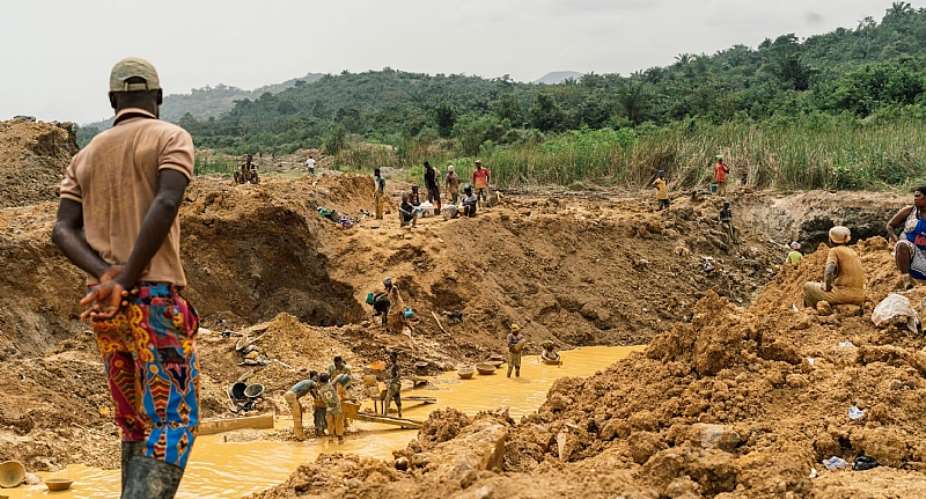
A country rich in natural resources, once called the Gold Coast by colonial masters, is now transforming its gold sites into graveyards.
Galamsey remains one of the most cancerous activities with brutal ramifications. We have seen how these activities have affected various sectors of the economy. The agriculture sector is struggling to keep crops alive in hotspots regions, and land is being lost to galamsey, risking food security. The water bodies are being polluted, and the aquatic ecosystem has been disrupted. Infrastructure and energy are at risk, with major gas pipelines being at risk. Today, water treatment and supply are costly, and the workforce and health of the citizens are dwindling. Thanks to Galamsey.
According to the Forestry Commission of Ghana, in 2023, thirty-four (34) major forests were severely impacted by the activities of illegal small-scale mining. This amounts to 4,726.2 hectares of forest degraded for galamsey activities.
The Water Research Institute’s 2024 assessment emphasised that 60% of water bodies are being polluted due to illegal small-scale mining. A further 16 major water bodies have been affected with mercury, cyanide, arsenic, and suspended solids, leading to an increase in water-borne diseases. This comes with a long-term risk of Ghana importing water by 2030 due to the galamsey activities.
Today, children in mining communities have dropped out of school and are heavily involved in the galamsey with the hope of making a living. This trajectory is risking the future workforce. Unfortunate education is traded for quick money.
Notwithstanding this, the deep roots of galamsey are tempering the foundation and the future of the country. I must acknowledge the important efforts from the Governments. The reforms of policy governing mining, the task forces on site, the Adumawura Programme, the 24-hour economy, the deployment of technology, and remote sensing to identify and trace sites are laudable. However, there is a need to treat this menace with a sense of urgency.
A country with a minimum wage of GHC 19.97 per day in 2025 clearly illustrates the significant forces operating in the shadows behind this issue. Most successive governments have lacked the political will to address this "big elephant in the room."
But to what extent are we going to keep adding to the statistics from the Research from the Ghana Medical Association (2025), which identified a rise in preterm births (before 37 weeks) and low birth weight (<2.5 kg) in galamsey-striken regions like Ashanti and Western, where mercury levels in maternal blood exceed WHO safe limits (5.8 µg/L).
How long will we watch farmers sell their cocoa lands or exchange them for galamsey? Simply because galamsey is more lucrative, and most of the lands and waterbodies are polluted and can not support their crops. Cocoa remains one of the key pillars of the economy. COCOBOD revealed that 2% of Ghana’s 1.9 million hectares of cocoa land (38,000 hectares) has been sold or converted for galamsey since 2015, with an additional 5,000 hectares lost annually (2024-2025).
The grave sin of it all is that the birth of children is being affected; the youth who are supposed to be empowered and developed to shape the country are trading their development for galamsey due to poverty. Even more painful is that Galamsey employs a range of 1-3 million Ghanaians, with 70% of them earning GHC 2,000/ month. Though most are impoverished, they resort to drugs to help cope with tedious work on sites. NACOC’s 2024 report identified galamsey sites as a viable ground for drug trafficking, and most of the youth are exposed to drugs in the mining areas.
There is a pressing need for bold leadership that will declare a state of emergency, mobilize law enforcement agencies, punish offenders, trace the cartels, and prosecute them. Additionally, it is essential to empower the youth with alternative livelihoods. Our land is being destroyed, and our water bodies are deteriorating. Meanwhile, many young people are jeopardizing their futures through drug use. However, a leadership that brings about disruption and transformation can restore what has been broken.
A country with a large youth population must prioritize the protection of its young people and their future. Can we, for the final time, visit the gold sites that have now become graveyards and carry out a final act of restoration? Let us put our beloved country first, setting aside any political affiliations.
The writer is a dynamic leadership facilitator and the founder of Nalike Africa. He is also a published author, having written ‘Life Beyond the Ordinary’ and ‘Minerals for the Mind’. As a dedicated start-up mentor and board advisor, he is committed to empowering individuals and organizations to achieve their potential. Tsifodze is an alumnus of Anant National University in India and Kwame Nkrumah University of Science and Technology in Ghana. Additionally, he furthered his studies at Harvard Business School, where he completed a Certificate Course in Power and Influence for Positive Impact. For inquiries, you can reach him at: [email protected]


 Obuasi SHTS alleged sexual abuse: Kwasi Kwarteng criticises Education Minister o...
 ECOWAS’ $250,000 flood relief donation arrives in Ghana – Ablakwa
 Kennedy Agyapong has not resigned from NPP – Kwasi Kwarteng
 State failure, not GoldBod, driving galamsey – Daryl Bosu
 A Rocha Ghana raises alarm over human rights abuses in mining communities
 ECOWAS, AfDB discuss ways to advance West Africa’s development priorities
 October 16: Cedi gains against dollar, sells at GHS12.25 on forex market, GHS11....
 Galamsey: Ghana’s rivers now run chocolate and milk colour — Sam Jonah
 A nation of job-seekers will always be poor — Sir Sam Jonah
 “If you attack us with pepper spray, we’ll fight back” — NDC Yakubu Tony Aidoo w...


