




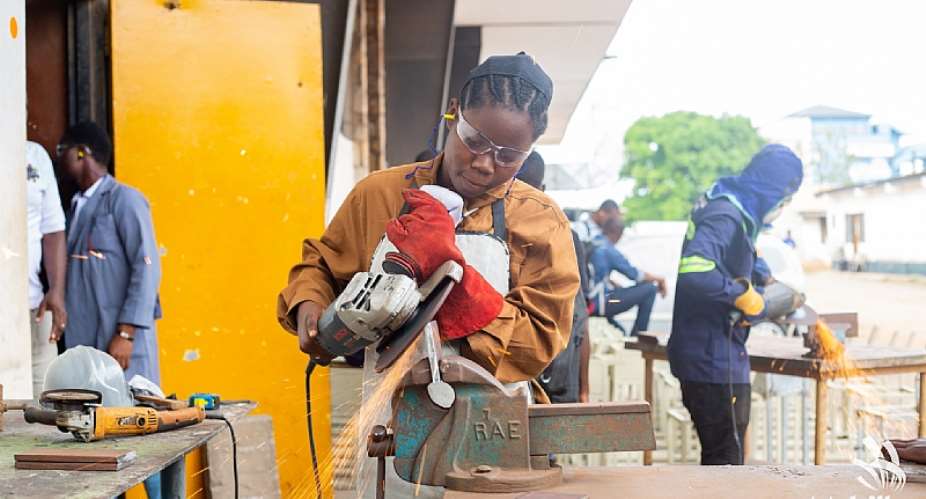
When China embarked on its meteoric rise from a poor agrarian state to a global manufacturing hub, the strategy was not built solely on skyscrapers and high-speed rail. At its heart was a deliberate investment in skills development, powered by reliable data. Singapore, too, transformed from a struggling trading post into one of the world’s most competitive economies by relentlessly aligning education, particularly technical and vocational education, with industry demands, guided by precise labor market intelligence.
Ghana today stands at a similar crossroads. The recent Stakeholders Workshop on Technical and Vocational Education and Training (TVET) Data organized by the Commission for TVET made one point abundantly clear: without accurate, timely, and harmonized data, Ghana’s TVET reforms risk being an ambitious policy on paper rather than a transformative reality.
The Case for Data in TVET
Technical and Vocational Education and Training is no longer the “second-choice” pathway; it is the backbone of modern industrial economies. But to truly make TVET a driver of development, Ghana must answer fundamental questions with data:
What sectors need skilled labor the most?
Are graduates finding jobs in fields they trained for?
How effective are apprenticeship programs in the informal sector?
How much is industry investing in upskilling workers?
At the workshop, speakers from the Ministry of Education to UNICEF, stressed that “data is not just technical, it is the foundation for equity, accountability, and efficiency.” In plain terms: if Ghana cannot see its skills landscape clearly, it cannot plan effectively.
Lessons from the Asian Miracle
Consider Singapore. In the 1960s, facing mass unemployment and a fragile economy, the government invested in a centralized manpower planning system. Every industrial strategy was accompanied by a rigorous assessment of skills needs. Data guided the creation of the Institute of Technical Education (ITE), now globally recognized as a model. Today, Singapore boasts one of the highest employment rates among graduates, because training is directly matched with market demand.
China’s experience is equally instructive. The government introduced a National Graduate Employment Survey and extensive labor market forecasting. The result? A steady stream of skilled technicians, welders, and engineers who powered China’s rise as the “world’s factory.” Importantly, China used data to continuously adjust TVET curricula to global trends, ensuring that skills supplied matched the evolving needs of industries.
Ghana’s Opportunity
Ghana has already laid some foundations. The Education Management Information System (EMIS) tracks basic indicators, while initiatives like the Mobile School Report Card and the National TVET Qualifications Framework (NTVETQF) are advancing accountability. Yet, gaps remain. Informal apprenticeship training, estimated to account for 80% of skills acquisition, remains poorly documented. Graduate tracer studies are irregular. Private sector contributions are not systematically captured.
Imagine if Ghana had real-time data showing that the automotive sector would require 50,000 skilled workers in the next five years. Training institutions could pivot, curricula could be revised, and investments in facilities could be targeted. The result? A pipeline of industry-ready graduates and fewer mismatches between supply and demand.
The Payoff: Data-Driven Development
Reliable TVET data would do more than just fix unemployment. It could:
Boost industrialization: By aligning training with Ghana’s “One District One Factory” agenda.
Reduce inequality: By identifying underserved regions and directing resources accordingly.
Enhance global competitiveness: By positioning Ghana as a hub for skilled labor in West Africa.
Build investor confidence: Multinational companies are more likely to invest where the workforce is visibly skilled and adaptable.
In short, data is the bridge between policy ambition and developmental reality.
A Call to Action
The workshop ended with a sobering reminder that Ghana’s TVET data system is still fragmented. But the momentum is here. By building an integrated TVET management information system, expanding coverage to include informal training, and fostering closer collaboration with industry, Ghana can emulate the success stories of Singapore and China.
The lesson from Asia is simple but profound: skills without data are like ships without navigation. Ghana has the ships, there are millions of young people eager to learn. Now it must build the compass.


 Bolgatanga: Man found dead by roadside in Sumbrungu as police investigate
 Ghana concludes cocoa freight negotiations for 2026/27 season
 Blakk Rasta accuses Gushegu NPP MP Alhassan Tampuli of funding Ghana Jollof atta...
 €225m Cocaine Shipment: Court to rule on bail application of six accused in 3.9-...
 BoG pilots cedi-based payment system for Ghana-China trade
 2026 BECE: Ten schools score zero percent in Adaklu as girls outperformed boys
 Gold shipments resume as Ghana rebuilds foreign exchange reserves — BoG governor
 ECG unions to stage nationwide protest over proposed private sector participatio...
 ‘That penalty is a joke’ — Queiroz rejects referee decision in Ghana’s loss to C...
 'Sceptics, naysayers, alarmists should be aware US ready to work with Ghana on r...


