




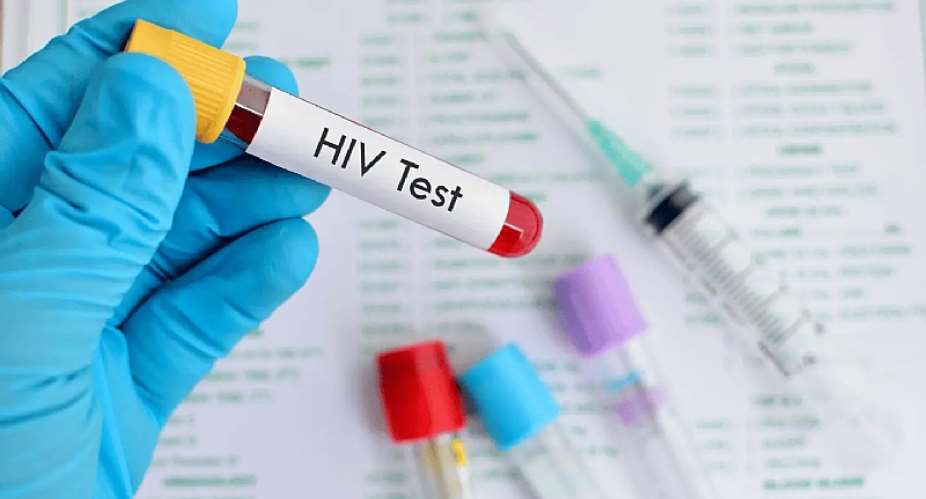
The Ghana AIDS Commission (GAC) has attributed the higher prevalence of HIV among women in the country to biological factors and differences in health-seeking behaviour between men and women.
The explanation follows the release of the Commission's 2025 National HIV Estimates, which indicate that women account for a significantly larger proportion of people living with HIV in Ghana.
According to the report, an estimated 337,435 people are living with HIV in Ghana in 2025. The Commission said that for every 100 males living with the virus, there are more than three times as many females.
Explaining the disparity, the Director of Technical Services at the Ghana AIDS Commission, Dr Fred Nana Poku, said women are biologically more vulnerable to HIV infection during sexual intercourse.
“There are biological and physiological factors that make ladies more susceptible and easily affected by HIV,” he said.
Dr Poku noted that sexual transmission remains the leading mode of HIV infection in Ghana, accounting for about 80 per cent of all cases.
“Eighty per cent of all HIV infections is through sexual transmission – so there's sexual intercourse. Now, during sexual intercourse, the ladies are more susceptible because of the nature of their external genitalia – their vagina,” he explained.
“It's a broad-surface organ, with a large mucosa. When you spread the mucosa out, it's a very large surface area, and the transmission or exchange of the virus occurs across the mucosa – the lining – and it has a bigger lining compared to the male's.”
The Director-General of the Ghana AIDS Commission, Dr Kharmacelle Prosper Akanbong, also pointed to biological differences between men and women as a key reason for the higher infection rate among females.
“The vagina is a receptacle which receives all the volume of sperms with all the viruses. So there's no escape route,” he said.
“For the male, he needs some cuts, pulmonary tract infections, other mucosal bridges to be able to get the infection.”
Beyond biological factors, the Commission said the disparity is also influenced by testing patterns, noting that women are generally more likely than men to undergo HIV testing and therefore know their status.
Dr Akanbong questioned whether the current statistics fully reflect the burden of HIV among men, suggesting that lower testing rates may contribute to the apparent disparity.
“If men were testing equivalently as women, would we be having these disparities in the statistics?” he asked.
He called on the media to support efforts to increase HIV testing among men.
“We need to vamp up male-testing services – it gives us a better picture of the national prevalence than just focusing on the women testing,” he said.
The Commission further cited findings from the Ghana Demographic and Health Survey, which show that women generally exhibit better health-seeking behaviour than men.
According to Dr Akanbong, many men delay seeking medical care because of societal expectations surrounding masculinity.
“Men wait till it's too late before they go to hospital,” he noted.
The 2025 National HIV Estimates identified Greater Accra, Ashanti and Eastern regions as recording the highest numbers of people living with HIV, with 77,512, 68,354 and 42,704 cases respectively.
The report also showed that the Western North, Northern, Ahafo, Upper East, Upper West, Oti, Savannah and North East regions each recorded fewer than 10,000 people living with HIV.
The Ghana AIDS Commission said the findings highlight the need to strengthen HIV prevention, testing and treatment interventions, particularly among women, while encouraging more men to access testing services to improve early detection and treatment outcomes.

 GPRTU suspends planned fare increase after GH¢2 diesel price cut
 Sagnarigu: Curfew imposed on Damankunyili, Nyeshie after deadly communal clash
 AIDS Commission explains why more women test HIV positive than men
 Ga North Assembly explains why it demolished toilet under Pokuase Interchange
 GACL dismisses two airport car park workers over passenger extortion
 Burkina Faso warns of possible Bagre Dam spillage from August 11
 Private schools accuse WAEC of unfair grading, demand review of 2026 BECE markin...
 'Freedom is never a gift; It is earned through sacrifice, sustained by vigilance...
 Police investigate death of two women found in Tamale Hotel
 'UGMC is the worst hospital in Ghana' — Michael Blackson accuses hospital of mot...

