




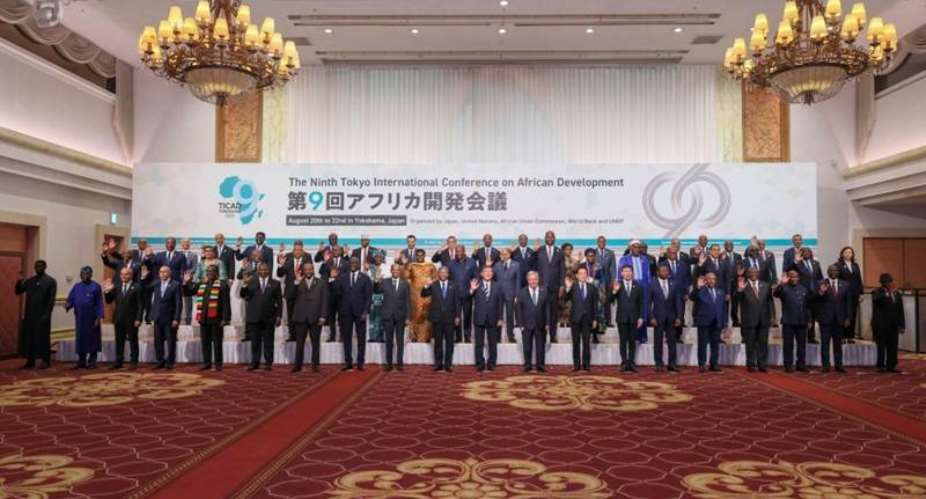
The Ninth TICAD
According to the proponents, TICAD has a different approach, an approach which emphasizes catalyzing ongoing processes for private sector investment, policy interaction and collaborative efforts described as "co_creation" or "kyoso" in Japanese, that is, finding solutions and common interests to development challenges as opposed to traditional "donour- recipient " models.Such an approach is meant to bring about positive and enduring outcomes,
"TICAD focuses on catalyzing ongoing processes for private sector investment, policy interaction, an co_creation " TICAD, 2025.
The Conference August 20_ 22, 2025
Co- organized by Japan, the African Union (AU), United Nations Development Program (UNDP) and the World Bank (WB). 33 African leaders jetted in Tokyo to join Japanese Prime Minister, Shigeru Ishiba. Joined also by leaders from Japanese and African private sector, academia and Civil Society.
Theme of The Conference
"Co_create innovative solutions with Africa"
The platform originated in and with Japan in 1993 with the purpose of providing inclusive growth & sustainable development in Africa ... How? By spearheading innovative solutions for Africa, solutions reflecting& responding to current & future global challenges.Thus, " co_ create innovative solutions with Africa " highlights the need for stronger & more strategic partnerships for African development by encouraging homegrown and collaborative solutions with Africa.
TICAD's Three Pillars
TICAD according to it's objectives and scope, it is there to catalyse three pillars of African development which are firstly, *economy* , secondly, *society* and last but not least, *peace and stability* .
Economy
Whilst Africa' s Gross Domestic Product GDP growth trends are far from enough in terms of ensuring the attainment of the Vision & Aspirations of Agenda 2063. According to TICAD:
"this is partly due to high cost of capital due to Africa's weak credit ratings & high cost debt services which are exacerbating vulnerabilities & *diverting Africa's resources away* from financing African development".TICAD, 2025.
Also,
"increasing *trade protectionism* is limiting Africa's access to global markets and restricting the proportion of global value chains that benefit Africa" TICAD, 2025.
Therefore, as TICAD notes that there is
"need to capacitate Africa to effectively engage with financial market actors including credit rating agencies. And also the establishment of the African Credit Rating Agency (AFCRA) to manage Africa credit ratings & lines".TICAD, 2025.
Also, there is need to
"accelerate African regional integration by boosting efforts to develop value-chains and integrating African countries into global supply chains.Support African exports of value_ __added goods to Japan through_agro industrial zones,export certification hubs,and buyer supplier networks " TICAD, 2025.
TICÀD also notes that there is,
"imperative need to harness Africa's demographic dividend through investment in people & promotion of decent work, especially for Africa's youthful population through youth apprenticeship and tax incentives for firms employing youth in the AI/data sectors", TICAD, 2025
Society
TICAD,2025, noted that although steady progress was being made in Africa's health and education sector,"millions are still being left behind ", TICAD,2025.
Furthermore,
"social and gender disparities undermine inclusive development and social cohesion", TICAD, 2025
Hence, there is need to ,
"champion efforts to expand access to high quality, human_ _centred health, education,and essential social services, with a particular focus on empowering youth, women and persons with disabilities ".TICAD, 2025.
Further noting that such initiatives are;
"critical for addressing widening inequalities, bridging service gaps,and ensuring that Africa's transformation benefits all segments of society ",TICAD,2025
This should be done on,
"strengthening Africa's public health workforce & local production of health commodities through mechanisms like the African Union (AU) Local Manufacturing Initiative and Africa Medicines Agency".TICAD, 2025.
Peace & Stability
TICAD noted the significance of the African Peace & Security Architecture (APSA) and the African Governance Architecture (AGA) in dealing with governance, peace & security challenges facing Africa. TICAD further emphasized need to
"promote the rule of law both at the national and international levels ,and respect and promote compliance with international law, including *international human rights law* and international humanitarian law" TICAD,2025.
It further noted the need to,
"support meausures to address conflict, terrorism,and violent extremism,and strengthen coordination on peace operations in Africa "
And further manage complex threats ,
"including cyber intrusions, maritime insecurity,drug trafficking, transnational organized crime, human trafficking,and illicit financial flows ", TICAD,2025.
Africa Questions TICAD
From a Pan-Africanist perspective, TICAD's focus on partnership and "Africa-led" initiatives aligns with self-determination, though TICAD approach tends to be viewed through the lens of external influence and potential power dynamics against Africa.
Key themes at TICAD 9, such as promoting private sector-led development, empowering youth and women, and fostering regional integration, resonate with Pan-African goals, with African Union (AU) Agenda 2063, but some observers critiques exist regarding the potential for neo-colonial economic dependencies which work against Africa's need for real continental sovereignty (economic & political).
In as much as Africa needs economic sovereignty, but that should also extend to political sovereignty. Doubts persist on whether TICAD leads to political sovereignty and the dismantling of structures that perpetuate external control, in addition to economic growth...or it's the same old system, external control.
TICAD 2025's talk of "African ownership," of "African development" is recommendable,But the significant involvement of Japan, the United Nations (UN), and the World Bank,(WB) as co-organizers raises questions about true agency and potential power imbalances, in this co- creating innovative solutions for African challenges.
The tendency to emphasize on private-sector-led growth and specific development models, while hailed as beneficial for Africa, private sector led growth can further cement economic dependencies on foreign investment and technology, instead of promoting authentic Africa self_ led development and industrialization.
What Africa needs is African solutions to African problems.Then the lingering question is whether TICAD's approach is adequately centred on African homegrown solutions? or it's another dosage of external, foreign, tried and failed initiatives.
Questions To African Leadership
33 out of 54 head of states jetted into Tokyo, Japan to meet one Japanese Prime Minister. Do you honestly think such outpouring of African leaders does make Africa look as if African leaders are in control of their own situation.
Certainly not, rather African leaders appear as recipients of foreign benevolence rather than as architects of own collective vision.The entire AFRICAN leadership leaving home to meet the Prime Minister of Japan.... It seems like Africa leadership are hungry to seek validation abroad.
Why is it that Africa always appear on foreign backyard? Is it really about equal partnership or it's about ritualised dependence? This is the most obvious but painful question which every conscious African needs to objectively ask themselves.
Why is that such conferences, such summits are rarely done in Africa. Why not have such conferences, such summits on African soil? All these foreign summits or conferences is a constant reminder that Africa's destiny is being negotiated & discussed elsewhere except Africa.
What happened to the AU Assembly adopted decision 762(XXXIII)? This adopted decision stated that external partnerships to be attended by a streamlined delegation... for purpose of projecting dignity alas, this was not the case.Worryingly, this was not on display when African leaders turn up in Tokyo, Beijing in Washington... often with greater commitment than they show at AU summit itself.
TICAD emphasized the need to transform Africa.Everyone wants to see a transformed better Africa But how and what will transform Africa. Where are the transformational projects?, the cross border infrastructure corridors, industrial zones, energy grids, solar farms, digital integration initiatives etc... initiatives that can truly transform Africa.
At the end of the day Africa appears to be lost, always seeking for foreign assistance, foreign benevolence, foreign validation. And at the end of the day, it looks as if African leaders are competing for petty, fragmented projects from foreign benevolence and not comprehensive and holistic pan_ African development agenda.
F. Madondo (African Teacher)
[email protected]


 'I couldn’t have refused an order' – Major Adjei-Ampofo explains why he took par...
 'Some NDC members are working with NPP to get your GoldBod job' – Kevin Taylor w...
 'It is too early for you to take this political heat' – Kevin Taylor cautions Ay...
 NPP knows GoldBod is our strength, that is why they want to bring it down – Suhu...
 Stop using radio airtime for greetings, talk about Mahama’s economy – Suhuyini t...
 IEA proposes binding long term national development plan to stop successive gove...
 Health Minister moves to prevent stockouts of HIV, TB and Malaria commodities
 IEA wants MPs, ministers barred from serving on State-Owned Enterprise boards
 Constitutional review: IEA warns against changes that could turn judiciary into ...
 Eastern Regional Minister orders temporary closure of two SHSs after violent stu...

