




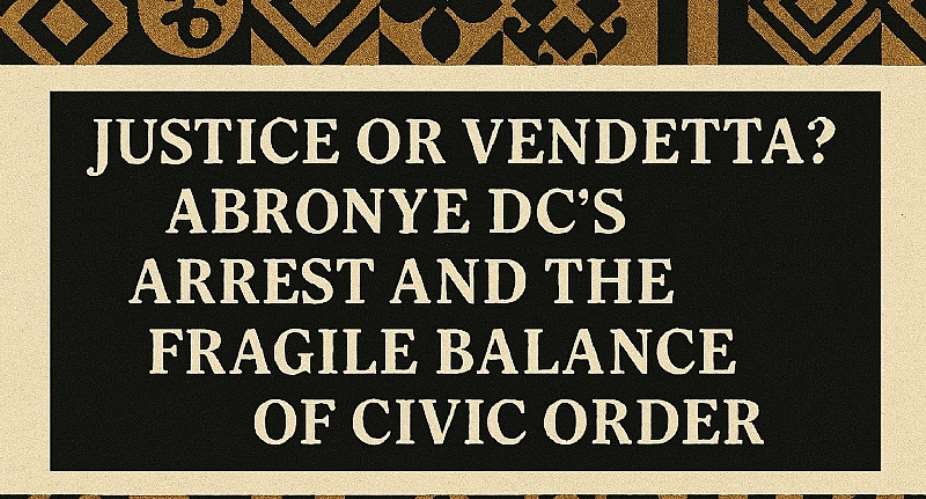
🕊️ A Civic Reflection on Political Speech, Institutional Restraint, and the Youth’s Role in Safeguarding Ghana’s Democracy
Here is a civic education article—ceremonial in tone, bold in message, and rooted in Ghanaian cultural wisdom, constitutional clarity, and youth mobilization:
I. A Chairman in Chains: The Arrest That Stirred the Nation
On 8 September 2025, Kwame Baffoe—known widely as Abronye DC and serving as Bono Regional Chairman of the New Patriotic Party (NPP)—was arrested and remanded into police custody by an Accra Circuit Court. Charged with offensive conduct conducive to breach of the peace, he was denied bail and awaits his next hearing on 12 September.
This arrest, though procedurally legal, has ignited a civic storm. Abronye had recently sought political asylum in eight countries, citing threats to his life and persecution. His controversial public statements—particularly against the Inspector General of Police—have been deemed inciteful by authorities.
The question now reverberates across Ghana: Is this justice, or is it vendetta?
II. The Constitutional Compass: Rights, Restraint, and Responsibility
Ghana’s 1992 Constitution is clear:
- Article 21(1)(a): Guarantees freedom of speech and expression
- Article 14: Protects against arbitrary arrest and detention
- - Article 19: Upholds the presumption of innocence
Yet these rights are not unbounded. They are tempered by civic responsibility and the need to preserve public order. When speech threatens peace, the state must act. But when state action appears politically motivated, citizens must question.
“Power is not fatigue; it must be exercised with wisdom.”
III. The Power and Price of Public Utterance
In Ghanaian tradition, speech is sacred. It is a tool of leadership, a mirror of character, and a seed of consequence.
“When words travel, they return with consequences.”
Political actors must speak with clarity, not cruelty. The youth must learn that verbal dignity is civic duty. Harsh insults, reckless accusations, and inflammatory rhetoric do not build democracy—they corrode it.
IV. Legal Boundaries: When Speech Crosses the Line
In Ghana, the right to speak freely is enshrined in the 1992 Constitution. Article 21(1)(a) guarantees every citizen the freedom of expression—a pillar of democracy and a shield for dissent. But this freedom, like all civic liberties, carries a weight of responsibility. When speech becomes reckless, misleading, or inciteful, it ceases to be a right and becomes a threat.
The arrest of Abronye DC has reignited public debate about the limits of political speech. His statements—deemed inflammatory and potentially disruptive to public peace—have drawn the attention of both the judiciary and the Ghana Police Service. But beyond the headlines lies a deeper civic lesson: words have consequences, and the law is clear about what those consequences may be.
Under Section 208 of Ghana’s Criminal Code (Act 29), any person who publishes false news likely to cause fear or alarm to the public commits an offence. The punishment? Up to two years imprisonment, a fine, or both. This provision is designed not to silence dissent, but to protect the public from panic and misinformation.
Further, the Electronic Communications Act, 2008 (Act 775) addresses the digital dimension of speech. Section 76 makes it a criminal offence to knowingly transmit false or misleading information via electronic means. The penalties are even stiffer—up to five years imprisonment, a fine of GHS 36,000, or both. In an age where a single post can ignite unrest, this law serves as a firewall against digital recklessness.
And while criminal libel has been repealed, civil defamation remains actionable under Ghanaian common law. Individuals who feel their reputation has been unjustly tarnished by another’s speech may seek redress through the courts, often resulting in substantial monetary damages.
🛡️ These laws are not mere formalities—they are the moral guardrails of our democracy. They exist to ensure that freedom of speech uplifts, not unravels. For Ghana’s youth, the call is clear: speak with courage, but also with conscience. Know your rights, yes—but know your responsibilities even more.
The Constitution grants you a voice. The law reminds you that every word carries weight.
These statutes do not seek to silence—they seek to shield. They protect the public square from becoming a battlefield of reckless rhetoric. Freedom of speech is not freedom from consequence.
Let our words be guided by wisdom, not just emotion. Let our voices reflect not only passion, but principle.
“Humility is power.”
Let that power shape our civic discourse—with dignity, restraint, and truth.
V. Cultural Wisdom as Civic Shield
Let Ghana’s proverbs guide our civic conduct:
“No one shows a child God”
→ Truth reveals itself. Let youth seek it early.
- “Humility is power”
→ Let leaders speak with restraint, not rage.
VI. Youth at the Crossroads: From Spectators to Stewards
This moment is not just political—it is generational. Ghana’s youth must rise as stewards of democracy:
🔔 Call to Action:
- Educate: Learn the Constitution. Know your civic rights and responsibilities.
- Engage: Join forums, challenge injustice, and demand transparency.
- Mobilize: Use art, speech, and digital platforms to amplify truth—not tribalism.
- Protect: Defend the dignity of all—whether in power or in prison.
Let no youth be misled by slogans. Let no future be mortgaged by blind loyalty.
VII. Closing Reflection: A Nation at the Edge of Its Values
As Abronye DC awaits his next hearing, Ghana awaits clarity. Justice must not be vengeance. Restraint must not be weakness. And the youth must not be silent.
*“The tables will turn,” said Salam Mustapha.
Let them turn toward justice, not revenge.*
Let us rise—not in rage, but in reason.
Let us speak—not to provoke, but to protect.
Let us act—not for party, but for principle.
Here's a solemn and instructive civic reflection—anchored in historical truth and designed to guide Ghana’s youth with clarity and caution:
⚠️ A Note of Caution: When Speech Becomes a Spark
Freedom of speech is a sacred civic right—but without wisdom, it can become a weapon. The Rwandan Genocide stands as a chilling reminder of what happens when rhetoric is poisoned by hate, and public discourse is hijacked by propaganda.
In 1994, over 800,000 lives were lost in just 100 days. The seeds of that horror were sown long before the first machete was raised. Ethnic divisions, stoked by colonial policies and deepened by political manipulation, created a powder keg. But it was the unchecked spread of hate speech—on radio, in newspapers, and from public figures—that lit the match.
Ordinary citizens were incited to commit unspeakable acts. The airwaves became battlegrounds. Words became weapons. And silence from the international community allowed the fire to rage.
Let Ghana’s youth take heed:
- 🗣️ Speak boldly, but never recklessly.
- 📜 Know your rights, but honor your responsibilities.
- 🛡️ Let your voice be a shield for truth—not a sword of division.
“Humility is power.” Let our speech reflect not just passion, but principle. Let our civic education teach that freedom of expression must be paired with moral restraint and historical awareness.
We do not invoke Rwanda to dwell in fear—we invoke it to rise in wisdom.
Retired Senior Citizen
Teshie-Nungua
[email protected]

 Trump and Iran's supreme leader trade threats as mediators try to save deal
 More than 1 million evacuated as Typhoon Bavi makes landfall in China
 Franklin Cudjoe urges Minister to intervene as Azumah Resources, E&P dispute hea...
 'They took the mud from the gutters and put them on the streets' – Kofi Bentil f...
 Susu Collector arraigned for allegedly defrauding 35 traders of GH¢156,455
 Migration dream turns sour as Ghanaian teacher battles debt and visa crisis in T...
 South Africa World Cup midfielder Jayden Adams dies aged 25
 Former Akan NPP PC pays GHS105,000 as T&T for 1,012 delegates ahead of constitue...
 One injured, three arrested as violence mars NPP Bantama Constituency elections
 GAC raises alarm over rising HIV infections among homosexuals in Bono Region

