




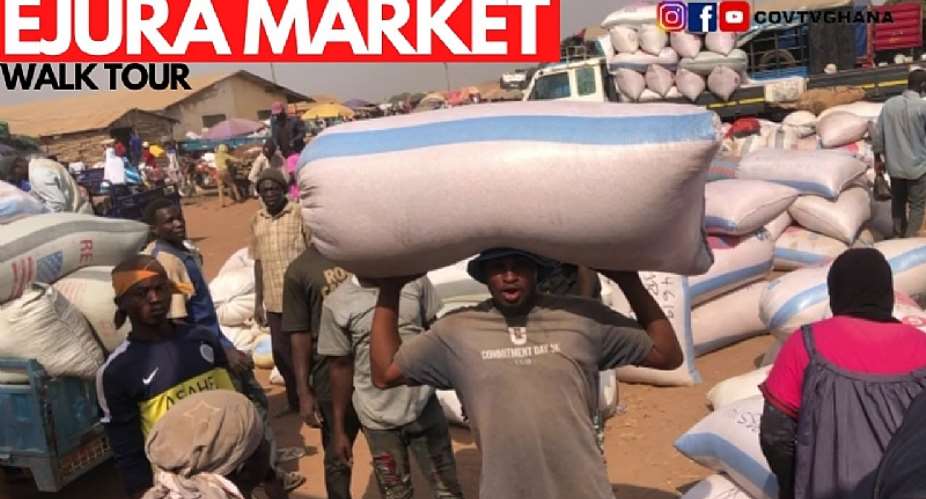
Ejura has long been recognized as the food basket of Ghana, particularly as a leading hub for maize production. For decades, its fertile lands and hardworking farmers have supplied maize not only to the Ashanti Region but to various parts of Ghana and beyond. However, a disturbing trend has emerged. One that threatens both the livelihoods of farmers and the stability of Ghana’s food economy.
Recent months have seen a drastic fall in the price of maize in Ejura and surrounding markets. What may appear to consumers as “good news” is, in reality, a silent crisis for farmers who invest heavily in production. Upon closer analysis, it becomes clear that the fall in prices is not due to a bumper harvest or improved productivity, but rather from oversupply fueled by unchecked cross-border trade.
Reports indicate that business moguls, working in partnership with traders from neighboring countries such as Nigeria, Togo, and Burkina Faso, are importing large volumes of maize into Ejura every market day. This has created a surplus that depresses local market prices, leaving farmers unable to recover even their basic production costs. For example, ploughing a single acre costs around GHC 400, fertilizer prices average GHC 450 per bag, and labor costs stand at not less than GHC 100 per day. Despite these high inputs, a 90kg bag of maize currently sells for as little as GHC 400 a clear economic loss for farmers.
The situation is worsened by the diversion of bulk buyers. Traditionally, traders and distributors from across Ghana flocked to Ejura, Amantin, and Techiman to purchase maize in large quantities. Today, many of these buyers have shifted to neighboring countries, where they acquire maize cheaply and transport it back into Ghana, further destabilizing the local market. Meanwhile, cross-border traders continue to profit because the Ghana cedi, when converted into other currencies, gives them a favorable trading edge.
The ripple effect of this crisis is visible across Ejura. Nearly every household stores at least one bag of maize, even among non-farming families, signaling oversaturation. What was once a sign of abundance has become a symptom of market failure. Without immediate intervention, farmers will lose interest in maize production, threatening food security for the entire nation.
It is against this backdrop that we call on the Government of Ghana, under the leadership of His Excellency President John Dramani Mahama, through the Minister of Food and Agriculture Hon. Eric Opoku, to act decisively. Measures such as partial border closures, trade regulations on abundantly produced crops like maize, and strategic market stabilization policies are urgently required. Such interventions will not only protect Ejura’s farmers but also safeguard Ghana’s broader agricultural economy.
Ejura’s place as Ghana’s maize capital is not in question. But unless the crisis is addressed with urgency, the very foundation of this identity is at risk. Protecting farmers means protecting Ghana’s future. To secure food sustainability, ensure fair trade, and stabilize prices, safeguarding Ejura’s agricultural future must become a national priority.
Acknowledgments and Recommendations
In addressing this crisis, it is also important to recognize and commend the efforts of key stakeholders who have consistently supported Ejura’s farmers and agricultural development.
First, special recognition goes to our hardworking Member of Parliament, Hon. Muhammad Bawah Braimah, and the Municipal Chief Executive, Hon. Rafiu Adam Seidu, for their collaborative agenda aimed at boosting agriculture in Ejura and its surrounding rural areas. From road maintenance to road extensions, they have made it easier for farmers to transport their produce to the market. Furthermore, electrification projects are underway across rural communities that previously lacked power, with contractors actively working to provide this essential infrastructure. This effort is highly appreciated because many of our farm products come from these rural communities, and such development directly supports production and distribution.
We also extend appreciation to the Ghana Police Service in Ejura Sekyedumasi for their proactive and swift measures to ensure the safety of farmers, traders, stakeholders, and civilians. Their presence and initiatives have restored confidence in the market, addressing the insecurity that previously discouraged traders from coming to Ejura.
Lastly, heartfelt commendation goes to Nana Barimah Osei Hwedie II (Ejura Hene) and the entire traditional council for their unwavering support. Unlike in some areas where fertile lands are given out for destructive activities such as galamsey, the chiefs and elders of Ejura have dedicated land to farming, reinforcing the town’s identity as Ghana’s maize capital.
Conclusion
Ejura stands at a turning point. The current maize crisis is both an economic and social challenge, but with government intervention, community support, and continued leadership, Ejura can rise above this difficulty. The collaborative efforts of political leaders, traditional authorities, and security services already show that the foundation is strong. What remains is a clear, urgent policy direction to protect farmers and secure Ejura’s agricultural future for generations to come.


 'Chief Justice was talking as a citizen; you have to look at the context in whic...
 Mandatory towing to remove broken-down, stationary vehicles from roads to begin ...
 Domelevo backs OSP probe into alleged GH¢70,000 payment to Appiagyei despite den...
 WAEC releases 2026 WASSCE results, cancels entire results of 861 candidates for ...
 Baffour Agyeman-Duah explains why profitability may not be only reason behind SO...
 Kofi Bentil defends Mahama’s dissolution of nine State Boards
 5-year-old girl dies after falling into water-filled manhole at Winneba
 Sierra Leone ex-president to return after treason case dropped
 'Explain how you spent your Common Fund' — Boako, Annoh Dompreh challenge Tano N...
 Ghana ends South Africa evacuation; brings home nearly 1,900


Comments
I said this so many time on my page. The government can solve this alone unless we the citizens also help. We need price floor and price ceiling and the policy must be compulsory on every single person. Now come to think of it, Has the Kenkey seller and the Kooko seller reduced the price of their Kenkey and Kooko ?! Where are our buffer stock ?? Where are our industries?? Maize has so many industrial benefits.. We can get corn oil, starch, ethane , etc. The government can buy all ...
Author's Reply
Well said brother