




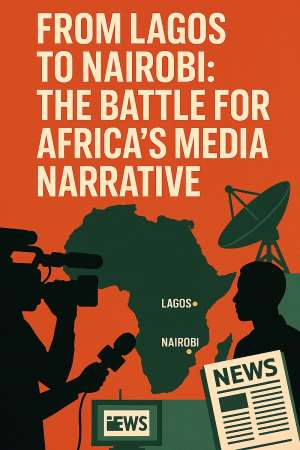
From Lagos to Nairobi: The Battle for Africa’s Media Narrative
In today’s hyperconnected world, controlling the narrative is as powerful as controlling territory. While Africa has long battled external misrepresentations in global media, a new front has opened within the continent itself from Lagos to Nairobi, Accra to Johannesburg where African voices are struggling to reclaim and reshape the continent’s image in the digital and broadcast arenas. The battle for Africa’s media narrative is no longer just about how the world sees us, it is about how we see ourselves.
The Legacy of Outsider Lenses
For decades, Africa was depicted in international media through a narrow, reductive lens: a continent defined by poverty, war, disease, and dysfunction. This portrayal largely shaped by Western journalists and foreign media conglomerates stripped Africans of nuance, agency, and complexity. It rendered 54 diverse nations as a single "dark continent" in perpetual crisis.
This framing wasn’t accidental; it served geopolitical and economic interests, reinforcing Africa’s position on the global periphery. When you control the story, you control perception and perception shapes policy, aid, investment, and international relations. As the Nigerian writer Chimamanda Ngozi Adichie warned, “The danger of a single story” is not just distortion, it is erasure.
A New Generation, A New Voice
Fortunately, a shift is underway. African filmmakers, journalists, podcasters, and digital creators are challenging the status quo. From Nigeria’s booming Nollywood industry to Kenya’s investigative journalism and Ghanaian YouTubers redefining vlogs, African storytellers are taking back the mic.
Lagos and Nairobi, as cultural and media hubs, exemplify this shift. In Lagos, the rise of Afrobeats, social satire, and web series has shown the world a vibrant, humorous, resilient Nigeria. Nairobi’s media space, rich with tech-savvy youth and bold newsrooms, has exposed corruption, championed civic engagement, and given voice to marginalized communities. These cities symbolize an Africa that is young, restless, and unwilling to be spoken about without speaking for itself.
Social media platforms especially Twitter (now X), TikTok, Instagram, and YouTube have democratized content creation, allowing everyday Africans to challenge stereotypes, celebrate their cultures, and document realities often ignored by mainstream outlets. These platforms have birthed new celebrities, opinion leaders, and movements from within Africa, for Africans, and by Africans.
The Internal Struggle
Yet even within this renaissance lies tension. Much of Africa’s media infrastructure remains heavily influenced or owned by foreign interests. From satellite providers to advertising agencies and content distribution channels, the gatekeepers often sit abroad. Algorithms still favor Western content, English-language narratives, and global trends pushing African stories to the margins even in African markets.
Furthermore, many African media houses face censorship, underfunding, political interference, and corporate pressure. Journalists in various countries risk arrest, intimidation, or worse for telling the truth. This internal repression hinders the free flow of ideas and limits the media’s potential to catalyze change.
There is also a growing concern over the replication of harmful narratives within Africa itself. Classist, colorist, and Westernized ideals dominate screens. Rural voices are sidelined. Local languages are disappearing from airwaves. In the quest to look “modern,” many media outlets inadvertently mimic the same Eurocentric frameworks they once sought to resist.
Building a Pan-African Media Identity
To win the battle for Africa’s media narrative, we must go beyond representation, we must seek transformation. African media must not only tell African stories but also shape African consciousness. This means investing in local content, nurturing independent journalism, and supporting creative industries with meaningful policies and funding.
Pan-African collaboration is key. Why should a Nollywood film struggle to find distribution in Tanzania? Why are Kenyan documentaries not on screens in Senegal? A unified African media market could allow creators, journalists, and audiences to share stories across linguistic, cultural, and regional divides fostering solidarity and mutual understanding.
Moreover, African governments, private sectors, and civil societies must protect press freedom, promote digital literacy, and fight disinformation. Without trust in our media, the battle for narrative is lost before it begins.
Conclusion
The question is no longer whether Africa will speak for itself. The question is: who will listen, and how will those voices be amplified? From Lagos to Nairobi, the fight to define Africa’s story is a fight for dignity, ownership, and truth. It is a struggle not just for image, but for identity.
In this defining moment, we must remember: whoever tells the story holds the power. And it is time that Africa not as an idea, but as a collective of lived experiences takes full control of the pen.

 US fears wider Middle East escalation after Houthi attack Riyadh
 Pop star Ed Sheeran calls Gaza situation “unjustifiable” amid controversy
 'We have spent 60years arguing about Nkrumah and rather less time doing what he ...
 Judge recounts attempted MoMo scam on him moments after jailing scammer
 'Systemic failure due to NACOC removal from port inspections' – Inusah Fuseini o...
 Police uncover alleged network behind Ghana Jollof videos
 NACOC says cocaine suspects were under surveillance for up to two years
 Suhuyini assures Accra-Kumasi Expressway won’t miss December 2028 deadline
 Foreign Affairs Ministry releases 200-page RTI response on GH¢49.7m South Africa...
 Chartered flights account for GH¢27.18m of South Africa evacuation cost


