




The Ministry of Tourism, Culture and Creative Arts (MoTCCA) has unveiled a renewed strategy to reposition Ghana’s tourism sector by fully integrating culture and creative arts into its national tourism agenda.
This initiative was outlined during a fact-finding tour of the Volta Region, led by sector Minister Hon. Abla Dzifa Gomashie. Describing the move as a "call to action," she urged both public and private stakeholders to recognise and invest in Ghana’s untapped tourism potential.
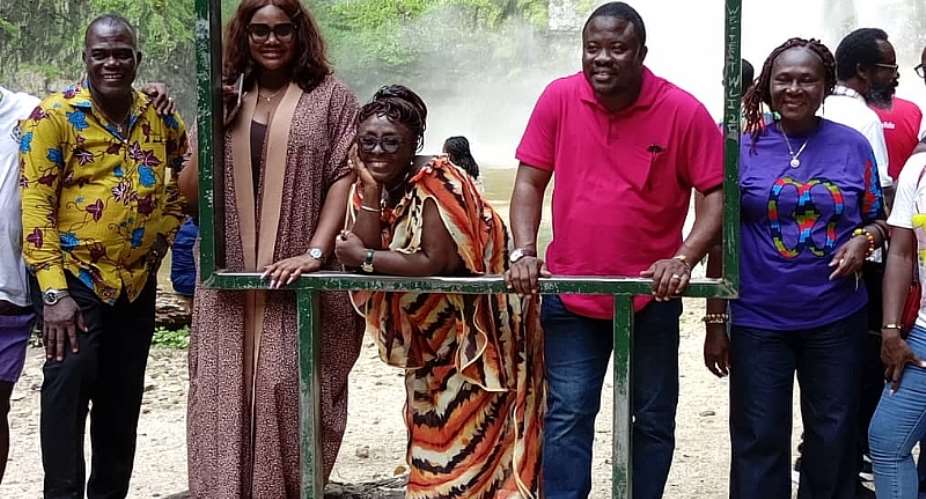
Speaking at the Wli Waterfalls on Saturday, 24th May 2025, Hon. Gomashie said the visit marked the first field trip by the Ministry’s new leadership. She stressed that Ghana’s cultural and creative arts sectors had long been overlooked, despite their immense value. “Now what we are doing is putting all of them together,” she said, referring to traditional performances observed at the Monkey Sanctuary and the House of Chiefs.
“We’re unearthing and repackaging what we already know,” she noted. “If you’re born in the Volta Region, and you don’t know Agbadza, you know Borborbor. If not Borborbor, then Atsiagbekor. These art forms, dances, and crafts are our goldmines. With just a little more packaging and branding, I’m confident that we can rake in more revenue and benefit the communities.”
During the tour, the Minister underscored the need for infrastructure upgrades to improve visitor experience. At the Monkey Sanctuary, for example, she pointed out the lack of basic facilities such as washrooms along the 45-minute path to the Wli Waterfalls. “This is something we need to address immediately,” she said. “While we don’t manage the land directly, the ministry promotes the sites. So if we received even a small share of the income generated, we could reinvest it to improve facilities.”
Hon. Gomashie emphasized that the success of the new tourism strategy depends on collaboration with local authorities, traditional landowners, and district assemblies. “We need to strengthen these relationships,” she said. “Some of these lands are family-owned, but the benefits could be far-reaching if we work hand-in-hand.”
She called on private investors and patriotic Ghanaians to partner with the ministry in boosting the sector. “I want to use your platform to ask those with the means—those who know investors with a passion for tourism—to approach the Ministry,” she urged. “Together, we can create eco-friendly centres that not only preserve nature but also provide economic opportunities for communities.”
Part of the tour's purpose, she said, was to gather first-hand insights to inform collaboration with other government ministries and agencies. The findings, she assured, would be compiled into a report for inter-ministerial coordination to enhance delivery across sectors.
In a meeting with Metropolitan, Municipal and District Chief Executives (MMDCEs), the Minister charged them to identify and elevate local cultural resources. “There are cultural assets we haven’t celebrated yet, It’s time we brought them to light and helped communities to package them.”
The issue of environmental destruction at tourist sites also came up, with the Minister condemning illegal activities like tree felling. “There are laws that protect our natural resources, and we’re going to enforce them,” she stated. “We’ll engage with legal experts, community leaders, and parliamentarians to find lasting solutions.”
Drawing from her experience in cultural advocacy and as a former deputy minister, Hon. Gomashie noted that even after visiting all 16 regions, she continues to discover unique cultural expressions worth national attention. “I’ve been to all 16 regions before, but I’m still discovering unique sites, dances, and traditions that deserve national attention.”
She cited a recent photography competition organized in collaboration with UNESCO as an example of the Ministry’s innovative approach to discovering untapped attractions. “We received amazing submissions. We’ll keep doing this—not just once but repeatedly—to discover as many new products as we can.”
Highlighting the diverse interests of tourists, she concluded, “Some people love hiking; others prefer watching monkeys. Some are drawn to waterfalls, others to traditional dances. The more diverse our offerings, the more people we can attract to explore and appreciate our country.”

 Ghana Armed Forces to hold land combat firepower demonstration at Bundase on Oct...
 Gambia to pay victims of Yahya Jammeh’s rule from proceeds of his seized US mans...
 Kolgo Paramount Chief questions 24-hour economy market without security
 'ABFA utilisation data excluded from PIAC's report not withholding of informatio...
 Obuasi SHTS sex scandal: Manasseh never said headmaster is a rapist - Brako-Powe...
 Government targets GH¢15.38bn domestic financing in Q4 to support 2027 bond buyb...
 Obuasi SHTS sex scandal: GES to ban teachers from inviting students to bungalows...
 Adwoa Safo to contest Dome-Kwabenya parliamentary seat again
 UG directs students with CGPA below 1.00 to go home
 Uganda Revenue Authority delegation visits TOR to understudy Ghana’s oil refinin...


