




West Africa has been home to several powerful kingdoms from the earlier Sahelian kingdoms (Ghana Empire, Mali Empire and Songhai Empire) to the later powerful kingdoms of the forest regions. These were wealthy African states that were respected, and were major producers of gold and other important trade commodities of that time. Historical archives inform us some of this trade also unfortunately involved slaves. However for the sake of context, it has to be mentioned that the rest of the world was also involved in this unfortunate practice - enslaving others from their larger community (including war captives).
This predates transatlantic chattel slavery with victims being entirely enslaved Africans. The Sahelian kingdoms got their enslaved from other African communities too, which was part of their trade with the Arabs aside the trade of gold and other commodities. We also learn from historical archives some of these African monarchs bought Arab slaves too. These enslaved Arabs served as servants in their royal court.
When we talk of past Sahelian African monarchs, one name that easily comes to mind is Mansa Musa, the past ruler of the Mali empire who singlehandedly devalued the price of gold drastically in the Middle East through his generous gold gifts when he made his pilgrimage to Mecca. News of this spread across the outside world and in European circles he was renowned as a wealthy ruler in control of the largest gold deposit in the world. This led to them immortalizing him in the ancient Spanish map (Catalan Atlas), where he is depicted holding a golden orb on a golden throne.
Dahomey was a later West African kingdom that existed from the early 1600's to the 1800's made up of the Fon and Aja people who are part of the Gbe language group/speakers which includes the Ewe people too. This group of people are believed to have migrated centuries ago from present day Nigeria - neighbouring the Oyo Empire of the Yoruba people. They are said to have paid homage to the Oyo Empire for some period during their stay. Later exodus would take them to present-day Benin, Togo and Ghana, different groups settling in these locations. The group that settled in Benin, started the Dahomey kingdom.
This kingdom would become a powerful West African state conquering other near existing settlements on the Atlantic coast. They had a well-organized military force which also had a special wing known as Mino, made up entirely of females. The word ‘‘Mino’’ means our mothers in Fon, likewise the Ewe language. The Mino of Dahomey were also referred to as Agojie. They would come to be known by Europeans as Dahomey Amazons. They were a group of strong, skilful women trained for war.
They were said to be equally as good as their male counterparts in the art of battle. Women were accorded great respect in this society and it was considered prestigious to serve in the king’s army. Dahomey had a good economy which was supported by extensive trade, agriculture and all sorts of craftsmanship. Businesses were taxed to fund social projects such as the construction of roads. The kingdom could boast of enormous art which is still evident in their old palace buildings, sculpture and textiles. The old royal palace complex can be located at Abomey (the former capital) with a few existing buildings which are no longer in use.
The palace infrastructure was usually imposing with several quarters for the kings household and other large halls for council meetings among others. The building's interior and pillars were decorated with bass-reliefs. Every newly installed King constructed his own palace next to his predecessor’s within the palace complex. This new palace symbolized a new reign and promise of further expansion of the kingdom.
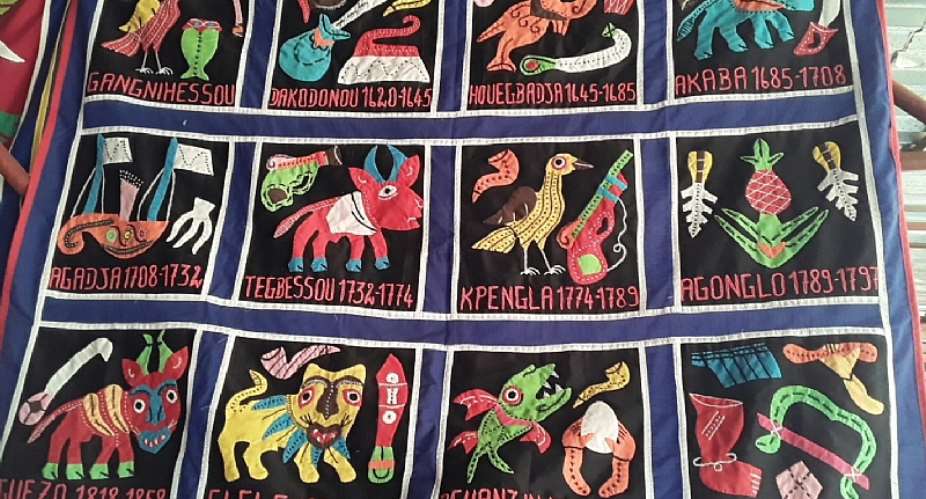
A king’s palace was designed with his symbol/totem in bass-relief sculptures. All kings had their individual totems and are represented by these totems even till this day. When you visit Benin you'll easily come across their popular Applique textiles decorated with totems of their past twelve kings. Which serves as a documentation of the history of the kings of Dahomey. Similar to the Asafo flags of the Fante people in Ghana which also documented their history. Dahomey had a vibrant textiles industry, which comprised of cotton spinners, weavers and dyers.
It can be said that Dahomey’s rich textiles history continues till this day, evident with the presence of skilful weavers and beautiful traditional textiles. The totems of the Dahomey kings come with meanings. The first king called Gangni Xesu ruled from 1620. His totem is represented by a bird known locally as Saswe known for its greed. This is because the king is known for leaving nothing to his opponents. Dahomey’s most popular king was King Guezo (1818-1858). He is represented by a buffalo because the animal is known to be powerful and reckless. It was his nature and opponents avoided encountering him. This was his way of keeping opponents away from his kingdom. Another popular ruler was King Behanzin (1889-1894) who is represented by a shark and egg. It was during his reign that the kingdom suffered their defeat to France and later became a colony. This is why he is mostly referred to as the last king of Dahomey even though he was succeeded by King Agoli Agbo (1894-1900). This king is represented by a leg hitting a rock because he was enthroned by the French who he had assisted in defeating his predecessor. Starting from his reign, Abomey struggled with its autonomy but did not totally surrender to the French.
King Behanzin was known for his intolerance and hostility towards the French people. The French considered him a prideful, clever and vindictive king . The shark in his totem means the angry shark will terrorize its enemy. Which was a warning to his French opponents. Though he commanded a formidable army of men, he was mostly guarded by the army of women referred to as Mino. His reign is marked for the series of wars fought against the French army and their allied forces. Some wars lasting as long as two years.
His opponents blamed him for starting hostilities by attacking neighbouring French colonies and arresting French officials. His response was: ‘‘I am the king of Africans here and French people have nothing to do with what I do. Settlements which you speak of are mine, they belong to me and I want them to be independent. I would like to know how a settlement originally French was attacked by me, King of Dahomey’’. King Behanzin finally lost the war and was exiled with his nuclear family to France and later Algeria where he would die.He is remembered for his fight against French colonialism.
Many of the Dahomey female warriors (Mino) fought fiercely and lost their lives in the battles against the French soldiers - a fight for freedom. This will inspire later insurrections in the colonial era that would finally lead to an independent present-day Benin (formerly Dahomey). Though it is said that some of the female warriors found it difficult adjusting with their new life in the Dahomey-French colony, some coped and engaged in different types of trade as livelihood. Others are said to have disguised themselves as wives of the brother of the exiled king Behanzin, who was heir to the Dahomey royal throne, and serving as his protection when in a real sense they were actually serving as vanguards of Dahomey tradition.
For Further Reading.
- A Fistful of Shells: West Africa from the Rise of the Slave Trade to the Age of Revolution by Toby Green
- The Migration Saga of the Anlo-Ewes of Ghana. 2009 Edition ISBN 9988-0-3513-6 by Agbotadua Kumassah.
- Journey of West African Textile Traditions by Seyram Agbleze.
- Behanzin, The last King of Dahomey, Benin by Unseen Benin.


 Kwame Dzokoto reportedly dies
 Ghana intensifies airport screening and Ebola surveillance amid reported cases i...
 'Our wives are not our slaves' – Nigerian man urges husbands to share housework
 'My son is mentally unstable' — Father of man arrested over alleged Gbewaa Palac...
 15,000 aspirants to contest NDC constituency executive elections this weekend
 Seven 'missing' Sekondi fishermen to be repatriated from Benin to Ghana — Police
 Websites go dark as AI exposes critical security flaws worldwide
 Ghana remains friends to all and enemies to none — Mahama
 October 22: Cedi sells at GHS12.25 on forex market, GHS11.66 on BoG interbank
 Foreign Affairs Ministry denies Minority’s claim of harassing staff over South A...


