




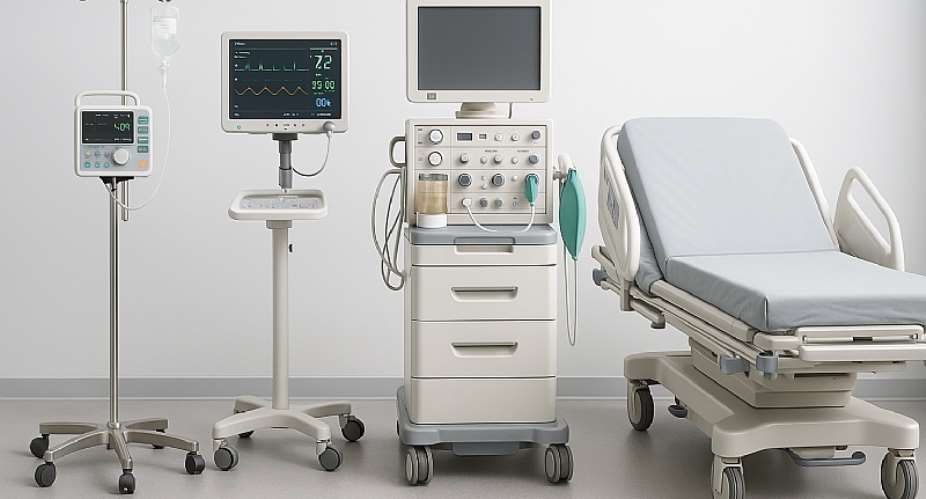
Health Beyond Hospitals
Health is more than the absence of disease—it is the backbone of productivity, dignity, and national resilience. In Ghana, every ailment untreated, every rural clinic abandoned, and every health worker unmotivated is a dent in the nation's future. And at the center of this health ecosystem is the Ministry of Health (MoH)—a body that should orchestrate prevention, cure, innovation, and equity.
Yet the Ministry faces a crisis of capacity, financing, and trust. Ghana’s health sector today is a paradox: we’ve made gains in immunization and maternal care, yet basic healthcare delivery is patchy, urban-centered, and vulnerable to shocks—as painfully demonstrated during the COVID-19 pandemic.
As we reset Ghana for the future, we must reimagine MoH not as a reactive institution, but as a proactive driver of universal, equitable, and smart healthcare delivery.
Current Challenges in Ghana’s Health System
1. Unequal Access to Healthcare Services
Over 55% of health infrastructure is concentrated in Greater Accra and Ashanti regions, while many communities in the Northern, Savannah, and Oti regions lack functional health posts (GHS, 2023).
2. Brain Drain and Health Workforce Shortage
According to the Ghana Medical Association, over 3,000 nurses and doctors left Ghana between 2021 and 2023, largely due to poor working conditions, low wages, and limited professional development.
3. Underfunding and Inefficiencies in NHIS
The National Health Insurance Scheme (NHIS), designed to make healthcare accessible, is riddled with delays in claims reimbursement, systemic fraud, and outdated digital systems (NHIA, 2022).
4. Weak Public Health Preparedness
COVID-19 exposed Ghana’s fragile emergency response mechanisms, from PPE shortages to testing bottlenecks and vaccine distribution gaps.
Policy Reset:
Building a Future-Ready Ministry of Health
1. Establish the Ghana Universal Health Access Fund (GUHAF)
A dedicated health investment fund modeled after Rwanda’s Community-Based Health Insurance (CBHI), funded through a mix of green taxes, sin taxes (alcohol, tobacco), and health levies on extractive industries.
2. Build a National Telehealth and e-Pharmacy Network
Scale up the pilot telemedicine projects in Ashanti and Volta into a national grid of digitally connected health centers, integrating video consultations, AI triage, and home-based diagnostics. Kenya’s m-TIBA platform shows this is viable in low-resource settings.
3. Decentralize Health Budgets to District Assemblies
Empower MMDAs to oversee local health financing, workforce deployment, and facility maintenance. This bottom-up approach ensures context-sensitive health delivery and civic accountability.
4. Build a Diaspora Health Workforce Exchange Program
Create a bilateral agreement framework for short-term deployment of Ghanaian doctors and specialists abroad to return annually for teaching, mentoring, and complex procedures.
5. Integrate AI and Predictive Analytics in Public Health Surveillance
Establish a Health Data Science Directorate within MoH to deploy real-time disease tracking, predictive outbreak modeling, and digital vaccine registry systems.
Case Study:
Thailand’s Health Transformation
Thailand achieved universal health coverage (UHC) through a combination of district-level budget autonomy, digital health ID systems, and strategic purchasing of health services. In two decades, they reduced out-of-pocket expenditure from 33% to 10% and improved life expectancy by 6 years (WHO, 2022).
Ghana can adapt this model—if the Ministry of Health is reset into an agile, transparent, and citizen-centric institution.
Conclusion:
A Nation’s Health, A Nation’s Wealth
The Ministry of Health must evolve—from a procurement-heavy bureaucracy into a forward-thinking health leadership center. The challenge is no longer just building more hospitals. It is building a health culture that reaches rural mothers, protects the poor, harnesses technology, and inspires health professionals to stay and serve.
Healthcare must no longer be seen as an expense—it must be treated as a sovereign investment in national resilience, productivity, and equity.
"When a nation’s health fails, everything else becomes a waiting room for disaster. Resetting our health system is the first vaccine for Ghana’s future."
— Bismarck Kwesi Davis
References:
Ghana Health Service. (2023). Annual Health Sector Performance Report. Accra: Ministry of Health.
Ghana Medical Association. (2023). Brain Drain Impact Assessment. Accra: GMA Research Unit.
National Health Insurance Authority. (2022). NHIS Annual Report. Accra: NHIA.
World Health Organization. (2022). Thailand UHC Case Study. Geneva: WHO Publications.
#bismarckinspires

 Appointment of Emelia Agbenyo as EC deputy chair was well calculated, reasoned –...
 Relief for students as GAUA and TUSAAG call off strike; declare return to work o...
 Who gave Cabinet authority to decide for Ghanaians to join BRICS without parliam...
 Mahama urges Ghanaian businesses to tap CSIR innovations
 Partisan EC appointments could set dangerous precedent — NPP's Kamaldeen
 Winneba: Afenyo-Markin commissions police apartments at Fetteh-Osakam
 Council of State failed Mahama over Emelia Agbenyo’s EC appointment – Prof. Asa...
 CDD‑Ghana: EC Deputy Chair Should Step Down Now
 Family Announces October 23 Memorial Mass for Nana Konadu Agyeman-Rawlings
 Eduwatch Urges Nationwide Audit of Sexual Misconduct in Secondary Schools



Comments
Excellent mindset analysis of the state of Heatth of Ghanaians. I agree with you over 100%.. UNIVERSAL HEALTH CARE POLICY IS AN OBLIGATION ! POVERTY alone ,including all the INFRASTRURES enumerated , CLAIMS the lives of hundreds of thousands of Ghanaians that COULD BE SAVED !. As a surgeon( rtd ) based in Italy , I solecitated the prof .ATTA MILL's government to build a Diaspora Health Workforce Program !. Over 2000 Ghanaian specialist medical practitioners live and practise outside ...
Author's Reply
The Electricity Company of Ghana (ECG) stands at a pivotal moment in Ghana’s development journey. Revitalizing ECG is not just about fixing power outages—it’s about empowering a nation. To modernize ECG, Ghana must adopt smart technologies, integrate renewables, ensure transparent billing, and reform governance structures.
This transformation will power hospitals, schools, businesses, and homes—replacing frustration with pride. The time for bold reforms is now. Powering Ghana must mean empowering Ghanaians.
The reset begins with a spark of courage—and ends with sustainable light.