




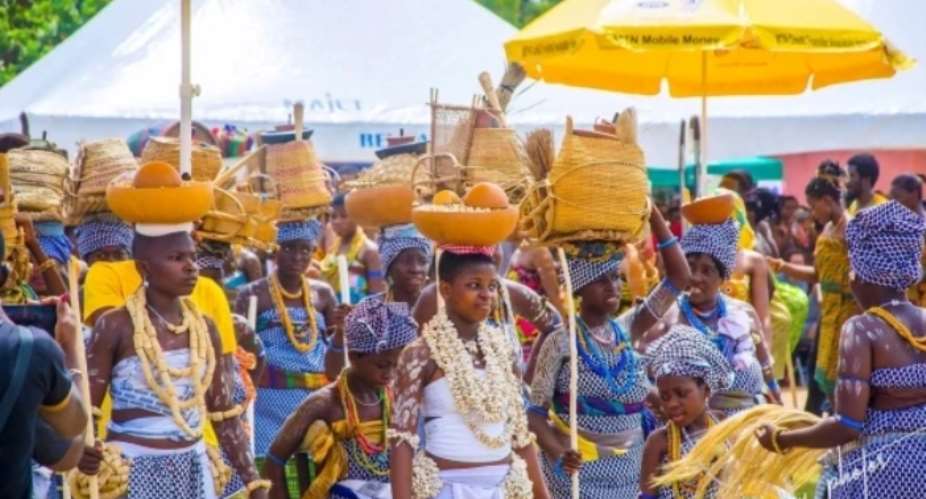
The Anlo people, a prominent subgroup of the Ewe ethnic group in Ghana, are renowned for their resilience, rich traditions, and vibrant culture. From their migration story to their distinctive festivals and regalia, the Anlo heritage is steeped in history and spiritual significance.
HISTORICAL BACKGROUND
The Anlo people's origin story is traced back to Notsie, a walled city in present-day Togo. Oral tradition recounts how they fled the oppressive reign of Togbui Agorkorli, a tyrant king. Their escape, under the cunning leadership of elders, involved the weakening of Notsie’s walls through ritual efforts, enabling their departure. This event is central to the Anlo identity and is celebrated annually during the Hogbetsotso Festival, which means "the day of crossing over."
Prior to Notsie, that the Ewe people, including the Anlos, migrated from as far as Sudan or regions along the Nile. Their journey is seen as a testament to their adaptability and determination, qualities that continue to define the Anlo people.
CULTURAL HERITAGE
LANGUAGE AND RELIGION
- The Anlo people speak EWE, a dialect of the Gbe language cluster.
- Their traditional beliefs center on MAWU, the Supreme God, and other deities. Many Anlos also practice Christianity, which coexists with traditional spiritual practices like VODU.
SOCIAL ORGANIZATION
- The AWOAMEFIA, the paramount chief, presides over the Anlo State, with ANLOGA serving as its spiritual and administrative capital.
- Anlo society is patrilineal and values kinship, justice, and communal harmony.
ART AND MUSIC
- Traditional music, instruments, and dances like the AGBADZA are essential expressions of the Anlo culture, performed during festivals, ceremonies, and social gatherings.
JUSTICE AND HARMONY
- Unique institutions like the TROXOVI SHRINES play roles in ensuring social harmony and administering traditional justice.
FESTIVALS OF THE ANLO PEOPLE
1. HOGBETSOTSO FESTIVAL
- The pinnacle cultural event for the Anlo people, celebrated annually in ANLOGA.
- MEANING: Commemorates their historic exodus from Notsie to freedom.
- HIGHLIGHTS: Traditional drumming, storytelling, the famous AGBADZA DANCE, and the grand durbar of chiefs.
2. DZAWUWU FESTIVAL
- Celebrated by the Klikor Traditional Area, a subgroup of Anlos.
- SIGNIFICANCE: Offers thanksgiving to deities and ancestors for guidance and blessings.
- ACTIVITIES: Rituals, feasts, and cultural performances emphasize gratitude and unity.
3. AMU FESTIVAL
- A unique celebration centered on AMU (brown rice), a traditional food of great cultural importance.
- *PURPOSE*: Promotes sustainable farming practices, communal unity, and appreciation of local cuisine.
THE REGALIA OF CHIEFS DURING FESTIVALS
The regalia of Anlo chiefs is an embodiment of their authority, cultural pride, and spiritual symbolism, especially during festivals like the Hogbetsotso:
1. KENTE CLOTH
- Chiefs wear elaborately woven Kente cloth, representing royalty, heritage, and dignity. Each pattern and color carries specific meanings, such as prosperity, unity, and courage.
2. CROWN AND HEADGEAR
- Adorned with GOLD AND BEADS, the crowns symbolize authority and spiritual connection.
3. CEREMONIAL STAFFS AND SWORDS
- Chiefs carry SWORDS OR STAFFS, inscribed with symbols of wisdom, justice, and leadership. These items are prominently displayed during rituals and festivals.
4. BEADED ACCESSORIES
- Chiefs and queen mothers wear intricate BEADS as necklaces, bracelets, and anklets, signifying ancestry, status, and spiritual protection.
5. UMBRELLAS, STOOLS, AND PALANQUINS
- Chiefs are often shaded by ORNAMENTAL UMBRELLAS and carried in PALANQUINS, while symbolic STOOLS represent their connection to ancestors and the community's soul.
CONCLUSION
The Anlo people’s rich history, cultural practices, festivals, and regalia form an intricate tapestry of identity and pride. Their resilience, as seen in their migration from Notsie, continues to inspire their dedication to unity and tradition. By celebrating their heritage through vibrant festivals and ceremonial practices, the Anlo people preserve their legacy while fostering community bonds for future generations.
Retired Senior Citizen
Teshie-Nungua
[email protected]


 Obuasi SHTS alleged sexual abuse: Kwasi Kwarteng criticises Education Minister o...
 ECOWAS’ $250,000 flood relief donation arrives in Ghana – Ablakwa
 Kennedy Agyapong has not resigned from NPP – Kwasi Kwarteng
 State failure, not GoldBod, driving galamsey – Daryl Bosu
 A Rocha Ghana raises alarm over human rights abuses in mining communities
 ECOWAS, AfDB discuss ways to advance West Africa’s development priorities
 October 16: Cedi gains against dollar, sells at GHS12.25 on forex market, GHS11....
 Galamsey: Ghana’s rivers now run chocolate and milk colour — Sam Jonah
 A nation of job-seekers will always be poor — Sir Sam Jonah
 “If you attack us with pepper spray, we’ll fight back” — NDC Yakubu Tony Aidoo w...


