




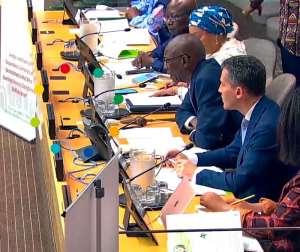
Desirous of promoting the cherished ideas of multilateralism and the accepted principles of mutual coexistence across regions and races, the Economic Community of West African States (ECOWAS) has taken its evolving building blocks for the strengthening of multilateralism to the United Nations (UN).
The ECOWAS Commission’s Commissioner for Political Affairs, Peace and Security Amb Abdel-Fatau Musah made this in-road on the occasion of the ECOWAS @ 49 high-level event which held at the ECOSOCC chamber on the 7th of June, 2024 at the UN headquarters in in New York, USA.
Amb Musah Musah who was standing in for the ECOWAS Commission’s President Omar Alieu Touray, used the occasion to draw meaningful correlation between regionalism, democracy and development in the West Africa. Commissioner Musah drew attention to the historical evolution of the strides of ECOWAS within the context of world events which had allowed it to unlock hitherto closed doors beginning with its intervention in Chad in 1981, as well as other interventions through ECOMOG in Liberia, Sierra Leone, Guinea Bissau, down to the more recent remarkable mediation missions in its Member States.
He stated that West African region had been the quintessence, epitome and source of great African empires and civilisation; a feat that puts it in good stead to examine critically, the fate of regionalism and its relationship with multilateralism. He said ECOWAS must be supported to build on its visionary accomplishments having been the first regional organisation to establish the protocol relating to the free movement of persons, goods and right of residence and establishment.
Today, he noted further, the West African regional block holds aloft its big dream of interconnectivity whether on land, at sea and in the air, and has established a good number of entities and integration schemes in this regard, such as common external tariff as well as a few others billed to boost economic interdependence including some others that are still in the works.
Hand in hand with co-prosperity, Commissioner Musah told the august body that the idea of self-sufficiency was high on the agenda of the ECOWAS Commission as it draws 75 to 80 percent of its funding needs from the 0.5 percent accruing from the community levy. He thanked Nigeria, the regional hegemon and about the largest economy on the continent for its continuous sacrifices in this regard. The qualified successes in UN peacekeeping exercises were also underscored. Cited in this regard were the ECOWAS normative frameworks including the supplementary protocol on good governance and democracy which prescribes zero tolerance of unconstitutional seizure of power.
Restating the firm stand of ECOWAS on democratic ethos, Commissioner Musah referenced the three Member States who have served notice of withdrawal from the organisation and disclosed that it is also a pointer to the fading fortunes of multilateralism and the need to rebuild it. He noted that the planned special summit on the future of integration would be used to openly engage the disoriented States, and discuss issues relating to their grievances.
“Disagreement must not lead to divorce. We are determined that they come back as there is a lot to lose by all sides should they go. We have to rebuild multilateralism if not through same values but through similar global values” Commissioner Musah added.
The session was moderated by Dean of the ECOWAS Group of Ambassadors at the UN and the permanent representative of Senegal to the UN, H.E. Amb. Cheikh Niang, also featured presentations by the Deputy Secretary-General of the UN African Ambassadors’ permanent reps Deputy Secretary General of the United Nations, Ms. Amina J. Mohammed, who reeled out a long chain of achievements by ECOWAS.
There were also goodwill messages from the ECOWAS Permanent Representative to the UN, H.E Ambassador KinzaJawara-Njai, Prof. Rita Kiki Edozie of the Deval Patrick Endowed Chair and Africa Scholars Forum, University of Massachusetts, Boston, the Reps of the African and European Union to the UN, who pledged their willingness to support the idea of strengthening multilateralism for development in partnership with ECOWAS.
The special session is expected to facilitate a collective understanding of ECOWAS' approach to addressing ongoing challenges and the continued pertinence of regionalism for democracy, sustainable development and enhanced multilateralism.
High level dialogue event had its theme as ËCOWAS at 49: Regionalism, Democracy, and Development in West Africa: Building Blocks to Strengthening Multilateralism. It was stream live by the UNWeb TV.
Editor's Note:The Economic Community of West African States (ECOWAS) was established when the ECOWAS Treaty was signed by 15 West African Heads of State and Government on the 28th of May 1975 in Lagos, Nigeria. The ECOWAS region spans an area of 5.2 million square kilometres. The Member States are Benin, Burkina Faso, Cabo Verde, Côte d'Ivoire, The Gambia, Ghana, Guinea, Guinea Bissau, Liberia, Mali, Niger, Nigeria, Sierra Leone, Senegal and Togo.
Considered one of the pillars of the African Economic Community, ECOWAS was set up to promote co-operation and integration, leading to the establishment of an economic union in West Africa to raise the living standards of its peoples, and to maintain and enhance economic stability, foster relations-among Member States and contribute to the progress and development of the African continent.
In 2007, ECOWAS Secretariat was transformed into a Commission. The Commission is headed by the President, assisted by a Vice President, and Five Commissioners, comprising experienced bureaucrats who are providing the leadership in this new orientation. As part of this renewal process, ECOWAS is implementing critical and strategic programmes that will deepen cohesion and progressively eliminate identified barriers to full integration. In this way, the estimated 300 million citizens of the community can ultimately take ownership for the realization of the new vision of moving from an ECOWAS of States to an “ECOWAS of the People: Peace and Prosperity to All” by 2050.
 Atta Akyea takes over from Andy Appiah Kubi as lawyer for Wontumi’s Samreboi cas...
 Woman loses temper, fights mentally challenged lady over alleged disrespect
 WHO welcomes UK's move to ban social media access for children under 16
 June 15: Cedi appreciates, sells at GHS12.30 on forex market, GHS11.06 on BoG in...
 Samreboi case: How rejection of Appiah Kubi's withdrawal could offer Wontumi a p...
 UK to ban under-16s from social media over safety and mental health concerns
 Samreboi case: Appiah Kubi cites disappointment with court in withdrawal applica...
 ECOWAS mourns demise of former Commission President James Victor Gbeho
 Andy Appiah Kubi's application to withdraw as Lawyer for Wontumi in Samreboi ill...
 I’ll file a notice of withdrawal and leave the case—Appiah Kubi on next line of ...


