




African Court on Human and People’s Rights, in collaboration with the African Union Commission (AUC) and other relevant sub-committees of the AU Permanent Representatives Committee (PRC), to develop key performance indicators and targets regarding the protection of human rights on the continent for the next ten years of the implementation of Agenda 2063.
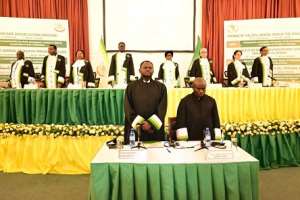
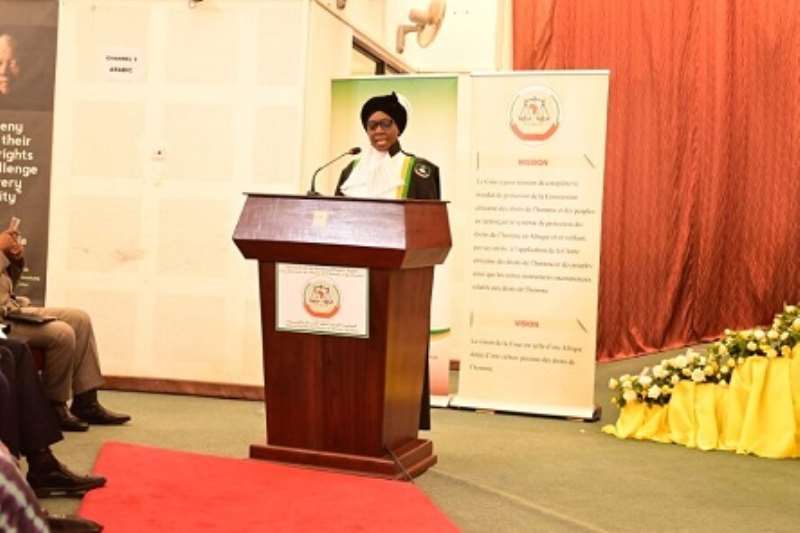
The President of the African Court, Lady Justice Imani Daud Aboud, noted this during the opening of the 2024 Judicial Year of the African Court in Arusha, Tanzania, which was on the general theme “Enhancing the Justiciability of Economic, Social, and Cultural Rights, with an Emphasis on the Right to Education.”
She said the African Court, together with other AU human rights organs—the African Commission on Human and Peoples’ Rights and the African Committee of Experts on the Rights and Welfare of the Child—has been entrusted with the responsibility to develop Moonshot three, that is, "public institutions are more responsive to citizens’ needs."
Lady Justice Aboud's speech was made available to the Communication for Development and Advocacy Consult (CDA Consult), which is a development communication advocacy non-governmental organization based in Tema, Ghana.
She said the task requires the African Court and other human rights bodies of the African Union to formulate human rights-specific strategic goals that could be mainstreamed throughout Agenda 2063.
Lady Justice Aboud stated: “I wish to indicate that the African Court has been actively involved in the development of the AU-wide 2024-2028 Strategic Plan, which builds into the Second Ten-Year Implementation Plan.
“The African Court attended and participated in the technical experts on the AU-Wide Strategic Plan 2024-2028 in Kigali, Rwanda, from October 2 to 6, 2023, to review and fine-tune the AU Strategy Balance Scorecard.”
She also noted, “At the dawn of what one might term the year of new beginnings, we believe that it is a sobering moment and the perfect time. to reflect on how the Court might contribute towards “the Africa we want.” by linking the Court’s vision with the AU focus for 2024.
“That is to say, by asking ourselves what an Africa with a viable human rights culture actually means.
“During the Executive Council Kigali Retreat of October 2023 on the implementation of Agenda 2063, I insisted, and I am insisting here again. The Africa we want must be an Africa founded on a viable human rights culture.”
Lady Justice Aboud stressed that it should be “an Africa with universal ratification of human rights instruments, an Africa where Member States comply with decisions of human rights institutions, an Africa where the full potential of its citizens is manifested in an environment of respect for human rights.
“Without human rights, we cannot have peace; without peace, we cannot have development; and without any of these, the Africa we want may remain a pipe dream.”
Focusing on the theme, the African Court President said the justiciability of economic, social, and cultural rights in general and the right to education in particular. “Justiciability refers to the ability to claim a remedy before an independent and impartial body when a violation of a right has occurred. or is likely to occur. “Economic, social, and cultural rights are firmly entrenched within the African human rights system.
“In fact, the African Charter on Human and Peoples’ Rights is the first international human rights instrument that codifies the three generations of human rights into one legally binding instrument and gives them the same value, thus upholding the principle of indivisibility, interdependency, and interrelatedness of human rights.”
She said that based on this understanding, several African countries have included economic, social, and cultural rights in their national constitutions and made them justiciable.
Lady Justice Aboud noted that the African Union human rights treaty bodies have also developed a rich jurisprudence on the protection of socio-economic rights in general and the right to education in particular.
Among the high-profile personalities who participated in the ceremony was President William Samoei Ruto of Kenya, who was represented by Justin Muturi, Attorney General of Kenya; Pindi Chana, Minister of Constitutional and Legal Affairs of the United Republic of Tanzania; and Justice Modibo Sacko, Vice-President of the African Court.
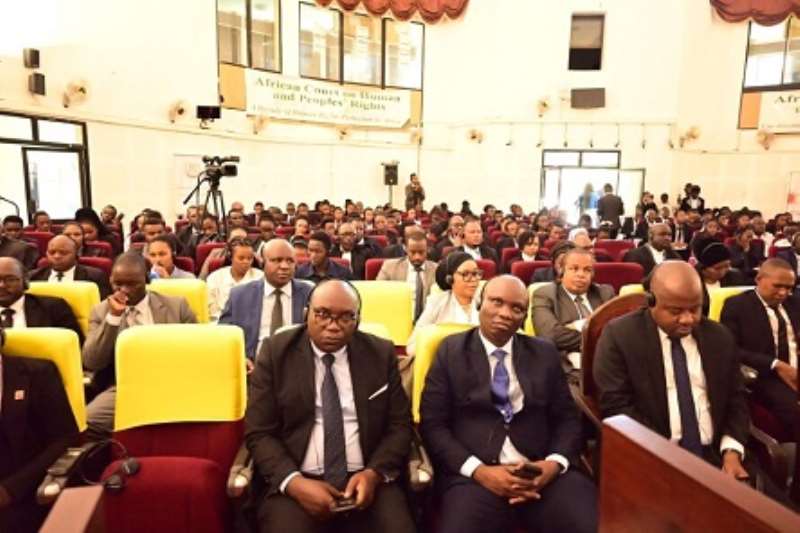
Others are Judges of the African Court, as well as Moussa Faki Mahamat, Chairperson of the African Union Commission; Chairperson of the African Committee of Experts on the Rights and Welfare of the Child; Presidents of International and Regional Courts; Government officials; Judges of International, Regional, and National Courts; and the Registrar of the African Court.
The rest are members of the judicial corps of Tanzania, representatives of Bar Associations, civil society organizations, members of academia, members of the media, and other stakeholders involved in the work of the Court and the protection of human rights on the continent.
The ceremony commenced with a solemn procession of honourable judges of the African Court.
 YEA deploys over 11,700 youth under Community Police Assistant Model – Basintale
 Parliament’s Human Rights Committee demands swift investigations in Obuasi SHTS ...
 'Let the law take its course' – Veep on Obuasi SHTS sexual abuse allegations
 Obuasi SHTS sex scandal: 'The powerful ride the law to trample the weak' – Kofi ...
 19-year-old remanded over alleged fatal stabbing of boyfriend at Ofankor
 Woes of SHTS Headmaster deepen as he resigns as old students’ chairman
 'NPP has 35 NDC scandals to drop from now till 2028 elections' — Sammi Awuku
 'NDC will pay for Obuasi SHTS sex scandal' – Sammi Awuku warns
 Use of hormonal contraceptives linked to increased breast cancer risks – Doctor ...
 ECOWAS deepens EU cooperation to improve disaster response in West Africa


