




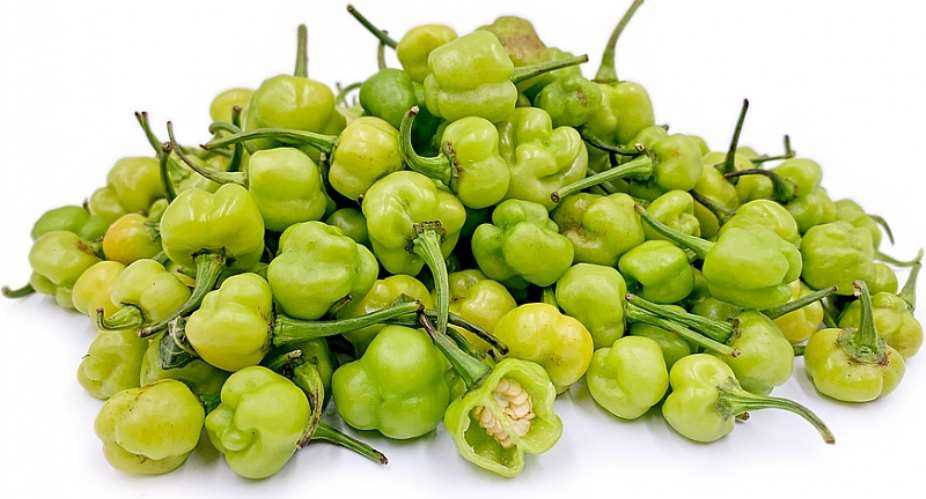
Green Kpakpo Shito peppers are best suited for both raw and cooked applications such as boiling and sautéing. Due to the pepper’s miniature size, it is most commonly chopped and added to sauces, stews, and salsas. When used in sauces, Green Kpakpo Shito peppers are mixed with ingredients such as onion, garlic, ginger, tomatoes, scotch bonnet peppers, bell peppers, and salt, and the ingredients are traditionally blended with a mortar and pestle for a smooth consistency. These sauces can also be mixed using a blender and are served in stews and soups or over-fried fish, grilled plantains, fried yams, and grain bowls. Green Kpakpo Shito salsa can be utilized raw, or it can be cooked over low heat to combine flavors. It can also be used as a spread on cheeseboards or mixed into ground meat to make spicy meatballs. Green Kpakpo Shito peppers will be kept for 1-2 weeks when stored whole and unwashed in the refrigerator.
Ethnic/Cultural Info
Green Kpakpo Shito sauce is one of the most popular condiments in Ghana, especially among the Ga people in Accra, Ghana. Used on fried fish, grilled lamb, or pan-fried liver and served with banku or kenkey which are paste-like doughs, Green Kpakpo Shito sauce is made with a variety of ingredients depending on the favored spices and culinary traditions of the region. In Ghana, the sauce is often made fresh and sold on public beaches, served in restaurants, or mixed at family picnics for a fresh, fruity, and spicy condiment. The sauce is also so popular in Ghana that it is infused with other cuisines such as Chinese and is topped over steamed rice, fried rice, and on spring rolls.
Geography/History
Green Kpakpo Shito peppers are native to Africa, but their exact origins are mostly unknown. Believed to be a habanero variety, habanero peppers came to Africa from South America via Spanish trade routes and were spread throughout the continent, especially to Western Africa. With their introduction to Western Africa, new varieties of peppers were developed over time through cultivation, eventually creating the Kpakpo Shito. Today Green Kpakpo Shito peppers are found in backyard gardens and are cultivated on a small scale in regions across Western Africa, specifically in Ghana.
Contents
The US Department of Agriculture revealed that 1 tablespoon (15 grams) of raw, fresh, red chili peppers contain-
- Calories: 6
- Water: 88%
- Protein: 0.3 grams
- Carbs: 1.3 grams
- Sugar: 0.8 grams
- Fiber: 0.2 grams
- Fat: 0.1 grams
One study by Whelton and He J(2014) found that these spicy fruits contain:
- Vitamin C- good for wound healing and immune function.
- Vitamin B6- B6 plays a role in energy metabolism.
- Vitamin K1- Also known as phylloquinone, vitamin K1 is good for blood clotting and healthy bones and kidneys.
- Potassium- reduces the risk of heart disease when consumed in adequate amounts.
- Copper- an essential trace element, important for strong bones and healthy neurons.
- Vitamin A. Red chili peppers are high in beta-carotene, which your body converts into vitamin A.
Other compounds
Studies(Gómez-García et al. 2013; Kim et al. 2009; Rodríguez-Burruezo et al. 2020; Deli et al. 2001; Abdel-Aal el-SM et al. 2013; Neda Nićiforović and Helena Abramovič, 2013; Materska et al. 2003; Srinivasan et al. 2007) found that chili peppers further has the following:
- Capsanthin. The key carotenoid in red chili peppers — up to 50% of the total carotenoid content — capsanthin gives the pepper the red color and the powerful antioxidant properties that fight cancer.
- Violaxanthin. The key carotenoid antioxidant in yellow chili peppers, violaxanthin accounts for 37–68% of the total carotenoid content.
- Lutein. Plenty in green (immature) chili peppers, lutein’s levels reduce with maturation. High intake of lutein is associated with eye health.
- Capsaicin. Has been extensively studied in chili peppers, capsaicin gives the pungent (hot) flavor and most of their health effects.
- Sinapic acid. Also known as sinapinic acid, this antioxidant contains diverse health benefits.
- Ferulic acid. Similar to sinapic acid, ferulic acid is an antioxidant that could protect against diverse chronic diseases.
Gómez-García Mdel and Ochoa-Alejo(2013) study reasoned that the antioxidant in mature (red) chili peppers is more as compared to the immature (green) peppers.
Peppers, science
Good news for pepper soup consumers. A recent study by Semaniuk et al.(2022) showed that the regular use of chili peppers whether in soup or any other form improves life spans. Indeed, chili pepper fruits contain phenolic substances which are structurally similar to those that show anti-aging properties. Chili powder added to food in concentrations of 0.04%-0.12% significantly extended the median lifespan in fruit fly cohorts of both genders by 9% to 13%. However, food supplemented with 3% chili powder shortened the lifespan of male cohorts by 9%.
A previous report by the American Heart Association(2020) also revealed that consumption of chili peppers may reduce the relative risk of cardiovascular disease mortality by 26%, according to an analysis of diet and mortality data from four large, international studies. Chili pepper consumption was associated with a 25% reduction in death from any cause and 23% fewer cancer deaths, compared to people who never or only rarely consumed chili pepper.
Pain killer
Several studies have found capsaicin, the key bioactive plant compound in chili peppers, to bind with pain receptors, nerve endings that sense pain. Thus, it has been reasoned that the more chili peppers one eats, the more it deals with pains and others such as heartburn triggered by acid reflux.
For instance, Bortolotti et al. (2002) study found that when 2.5 grams of red chili peppers were prescribed daily to people with heartburn, the pain increased at the beginning of the 5-week treatment but improved over time.
Another study by Jutaghokiat et al.(2009) also found that when a 3-gram chili pepper was administered for a 6-week daily, the heartburn in people with acid reflux improved.
The major issue is that the effect of reducing the pain is not permanent and it starts again once one stops taking the supplement(Karrer and Bartoshuk, 1995).
Weight loss
Whiting et al. 2014; Ludy et al. 2012) found that capsaicin could help with weight loss by decreasing appetite and enhancing fat burning.
Yoshioka et al. 1995; Yoshioka et al. 1998; Lejeune et al. 2003; Josse et al. 2010; Lee et al. 2010; Yoneshiro et al. 2012) studies found that 10 grams of red chili pepper can enhance fat burning in both men and women.
Westerterp-Plantenga et al.(2005) study of 24 people who took chili frequently found that eating capsaicin before a meal decreased calorie intake.
Another study by Ludy et al.(2011) found that those who did not take chili pepper regularly had a decrease in appetite and calorie consumption.
On the other hand, some studies found chili peppers ineffective. For instance, Ahuja et al. 2007; Smeets et al. 2009; Galgani et al. 2010) found no drastic effects on calorie consumption or fat burning.
Warnings
Das et al.(2005) study found that oleoresin capsicum extracted from chili peppers is the main ingredient in pepper sprays. This spray in large quantities can trigger heavy pain, inflammation, swelling, and redness(Lee et al. 1996).
Some also experience stomach pain, cramps, and diarrhea. For instance, Schmulson et al. 2003; Gonlachanvit et al. 2009; Aniwan and Gonlachanvit. 2014) studies found chili to alter people with irritable bowel syndrome (IBS).
Also test tube and animal studies on chili and cancer have been mixed (Bode and Dong, 2011). Besides, observational studies in humans(Serra et al. 2002; López-Carrillo et al. 1994) found chili pepper consumption to an increased risk of cancer, particularly gallbladder and stomach.
An older study by Notani and Jayant(1987) found red chili powder to increase the risk of mouth and throat cancer in India. This notwithstanding, they are observational studies.
NB:
Prof. Nyarkotey has strict sourcing guidelines and relies on peer-reviewed studies, academic research institutions, and medical associations to justify his write-ups. My articles are for educational purposes and do not serve as Medical advice for Treatment. I aim to educate the public about evidence-based scientific Naturopathic Therapies.
The writer is a Professor of Naturopathic Healthcare, a Medical Journalist, and a science writer. E. mail: [email protected].


 Mahama unveils H-Enabler platform to boost health investment and manufacturing i...
 Calm restored at Larteh Ahenase after Odwira Festival disturbances — Police
 Young woman found hanging from mango tree at Kasoa Akweley Peace Town
 Service Machinery Ghana Limited MD caged over alleged $1m fraud against employer
 Bawumia pledges support for John Boadu-led NPP leadership ahead of 2028
 Boakye Agyarko pledges support for John Boadu, calls for NPP unity after electio...
 Meet the newly elected national executives to lead NPP return to power in 2028
 'I extend my hand of friendship, partnership to contenders for ideas, experience...
 Rwandan genocide suspect 'hunter' Dafroza Gauthier dies at 72
 Brazilians begin voting in tight election between Lula and Flavio Bolsonaro


