




It is essential that you stop allowing your former enslaver to define the history of humanity. As the original human beings, only the Afrakan can define the history of humanity.
Archaeology proves Eniyan (complete homosapiens physiologically identical to modern humans) began AT LEAST 400,000 years ago (4-7 million if we include various early hominids) in the Great Lakes region of Central-East Africa. The Twa people of today (misnamed Pygmies) are the closest descendants of these original homosapiens.
It is crucial that you understand that homosapiens only lived in Afraka for the first 75% or more of human existence. In truth, there was no need to leave Afraka. It was protected on all sides by water, save for a tiny link in Sinai. There was no Sahara, just green pastures and great lakes full of fish and wildlife. Afraka was a paradise on Earth.
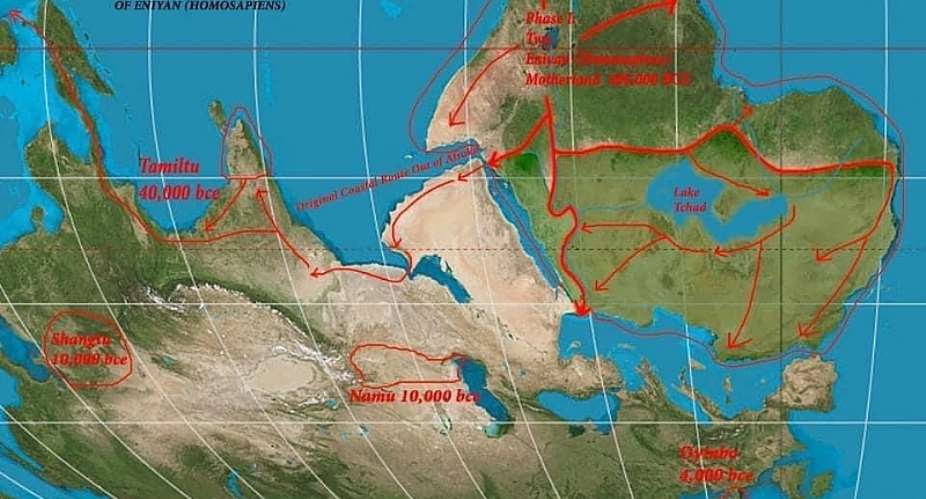
Nearby in Eurasia was the territory of the Neanderthal, a hominoid manbeast of great savagery and cannibalism. Thus, the original human route out of Africa (approximately 80,000 years ago when man first developed good boats to cross channels) was NOT to Mesopotamia or Asia Minor where the Neanderthal roamed, but via Ethiopia/Eritrea's sea channel with Sabaea (Yemen). From there, Twa human beings on small boats journeyed east along the coast to South India. Many of the Twa humans identical to their African ancestors in skin and hair texture, continued their coastal journey all the way to Thailand and down to Indonesia, eventually reaching Papua New Guinea, Australia, and the close islands of Melanesia.
However, those that stayed in South India eventually became isolated over time when the great migration out of Africa declined. By 40,000 years ago, these people in South India developed a popular trait of straight hair, though maintained the same African facial features and skin color. These people, ancestral to the Tamil (often referred to as Dravidian). They eventually settled nearby islands like Sri Lanka, and some of these sailors traversed the eastern Indian Ocean coast and arrived at Australia, where they grew in massive number. The Australian Aborigines are their descendants, and a more pure form of "Dravidian" appearance before Namu (misnamed "Aryan") invasion of India.
However, the emergence of Namu people, as well as the Shangtu (misnamed Mongoloid), did not begin until after 10,000 bce and the Last Glacial Period of the Ice Age. These massive ice sheets blocked the mountain range passes and the Namu and Shangtu's ancestors became completely isolated from South Asia where they originated from the Dravidians.
In central China, they developed into the Shangtu race, misnamed Mongoloids. They kept many typical African facial features like their Proto-Dravidian ancestors (flat broad noses) as well as the straight hair of Dravidians, but lost significant levels of melanin, going from dark brown to pale yellow.
In the region of northern Iran and the stans between the Caspian and Afghan mountains, the Dravidian hiking explorers became completely isolated as well when the last Ice Age's sheets blocked them from returning south. To spare themselves from cannibal Neanderthals, they intermixed with them (who were now low in number and had lost many people to Africans exterminating them). Via mixing with the Neanderthals, the Dravidians in the Caspian region inherited the Neanderthal's pale-beige (so-called olive) skin, long prominent noses, and excessively hairy bodies.
These mixed species people were called Namu by the Kemetic people because of their endlessly nomadic raiding lifestyle. They referred to themselves as "Aryan" which they wish to claim means "noble." However the accurate etymology of the word Aryan is actually a slur from Kemet, referring to them as Ab-Ra-'n, meaning "Without Ra's Divine Soul." The words Aryan, Ab-ra-ham, Brahmin (ab-ra-hm), and Arab all etymologically originate from this Kemetic slur against Neanderthal descendants.
The youngest of the races, the Oyinbo, are descendants of Namu who had managed to traverse north into Europe. By 4,000 bce, they were able to maintain large numbers in the peninsula that is now northern Germany and Denmark. Here, they were safe from the greatest wild beasts such as giant polar bears which ruled the ice sheets of Europe. Their isolation from other Namu and their greater proximity to the cold gave them some distinct features, such as loss of nearly all melanin in the hair and even eyes. What we called "blue" or "green" eyes is NOT an actual color of the eye, but the reflection of light from an eye lacking in melanin. These features became very common in the early Oyinbo people.
There is no such thing as a Caucasian, or Caucasian origin of Europeans. That is a myth the Oyinbo created to locate themselves in West Asia nearer the land of their Hebrew religion.
However, while the Sumerians (West Asia's first civilization) were Cushitic speakers with half Dravidian ancestry from the Indus, as were the Kanaanites and Sabaeans, the Hebrews were not of any Afrakan or even Dravidian lineage. The mythical biblical chronology of the Hebrew's origin states clearly that they were NOT indigenous to Kanaan (which they would colonize and turn into Israel). But that they came from the land around Mt. Arawat (northeastern Turkey). That region never had a primarily Afrakan presence ever, but was instead the homeland of the Neanderthal. Which is why the Hebrews later presence in Kanaan as colonizers does NOT make them the same Afro-Dravidian race as the Kanaanites or Babylonians. The Hebrew's cultural central myth is rooted in a Neanderthal-based heritage with Neanderthal values such as anti-nature, divine justification for genocide and slavery, scarcity, nomadic colonization over agricultural people, patriarchal structure, etc.
The story of the Hebrews-- which to be clear is based on myth, not history--nonetheless does not belong to any Afrakan race in West Asia. Instead, it is the allegorical Neanderthalian tale of the hairy beige Namu's invasion and colonization of West Asia from the Afro-Dravidian Kanaanites and Mesopotamians.
Give thanks to MaTseba.
MaTseba
MoKga-a-Bjwala
Edward Mitole, PhD
Professor of Development Studies and Dean of Faculty of African Renaissance Studies,
University of the State of the African Diaspora (USOAD)


 Obuasi SHTS sex scandal: Parliament Gender committee demands full accountability
 Some NDC MPs didn't vote for me; NPP votes made me Speaker in 2021 – Bagbin
 Ghana Armed Forces to hold land combat firepower demonstration at Bundase on Oct...
 Gambia to pay victims of Yahya Jammeh’s rule from proceeds of his seized US mans...
 Kolgo Paramount Chief questions 24-hour economy market without security
 'ABFA utilisation data excluded from PIAC's report not withholding of informatio...
 Obuasi SHTS sex scandal: Manasseh never said headmaster is a rapist - Brako-Powe...
 Obuasi SHTS sex scandal: GES to ban teachers from inviting students to bungalows...
 UG directs students with CGPA below 1.00 to go home
 Uganda Revenue Authority delegation visits TOR to understudy Ghana’s oil refinin...



Comments
This is amazing information. I've learned a lot. Thank you for sharing. Words mean so much. I remember when, as a child, I noticed the word "Slav" was really "slave". I realized that we weren't the only enslaved people. That Slavs were the slaves of the world for probably thousands of years. I also read that robot comes from the Slavic word "robotnik" and refers to these people existing just to be the most submissive of slaves. Considering they are around th...