




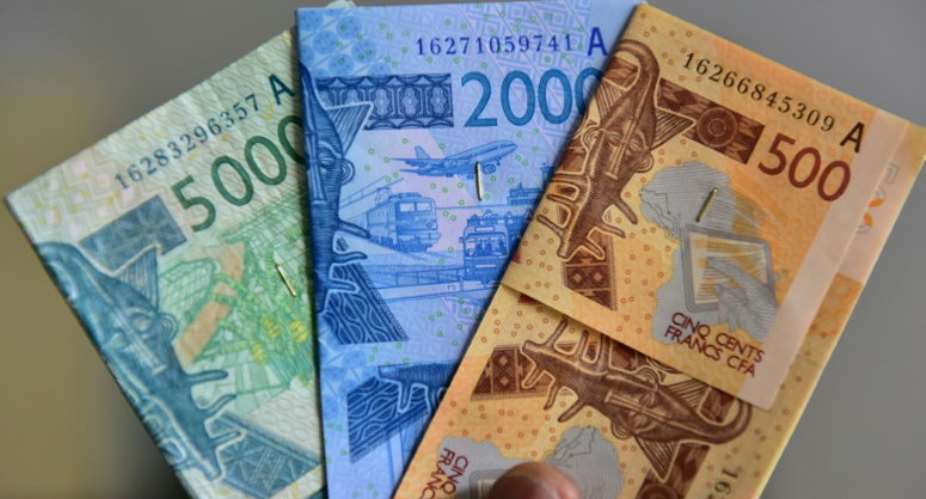
I was a young Junior High School boy travelling with my father on the Kumasi-Accra high road, right at the Bunso Junction in the Eastern part of Ghana. A long the road there was huge sign board with inscription on introduction of “ECO Currency” in West Africa precisely in 2003. In 20 years on, the “Eco Currency” could not become real paper notes for medium of exchange for goods and services in West Africa but an illusion-concept. The cost associated with such publicity and education had gone waste, and I believe same publicity were carried out in other member states.
Background, in December 2000, six leaders met in Accra, Ghana to declared their intention to form a Monetary Union for then fifteen-member Economic Community of West African States (ECOWAS) and proposed a single or common currency ( ECO) introduction framework in 2003 and to be adopted by both West African Monetary Zone (WAMZ )and West African Economic and Monetary Union (UEMOA) across the ECOWAS states, and was supposed to spread towards other states by 2004. However, since inception, the launch of the single currency (ECO) has been excuses upon excuses by the ECOWAS leaders and postponed at least four times: In 2005, 2010, 2014, and 2020 and currently slated for 2027. A common currency will facilitate trade, lower transaction costs, and facilitate payments, and controls exchange rate risk (conversion and hedging cost) among ECOWAS countries.
The goal of the single currency framework centre’s on controlling inflation, budget deficits, central banks financing and reserves, exchange rate stability and Debt-to- Gross Domestic Product (GDP) ratio. However, the set parameters of the criterion of the goals are over ambitious, knowing very well the political instability situation in the region especially in the Sahel Area. The criteria is very strict convergence one which is the main standing block to materialize the aims of the envisioned “Currency Zone” . Meeting benchmark of a budget deficit of not higher than 4% and an inflation rate less than 5% and debts less than 70% of GDP is big challenge for almost all the member states performance data I have analysed so far.
Considering Mr. Schuman’s Plan, on 9 May 1950, French Foreign Minister Robert Schuman declared and proposed the creation of a European Coal and Steel Community (ECSC), whose members would pool coal and steel production. Aims at finding a lasting peace for the bloody World War II. Mr. Schuman’s Plan was the beginning of today’s European Union. Within a year ECSC was founded (1951) and followed by the Treaty of Rome establishes the European Economic Community in 1957. It took Europe just 12 months to implement Schuman’s Plan and 6 years to transform the plan into a community (EEC) not 20 years as in the case of ECOWAS.
The criteria limit sets by ECOWAS is directly the “EU EURO” model benchmark which needs to be reviewed and re-modelled to ease the challenges member states are facing in meeting up the criteria e.g. Economic powerhouses like Nigeria, Ghana, Ivory Coast do fail consistently to meet the inflation criteria below 3%. So how do we make the ECO currency a reality?
The challenges posed by ECOWAS strict convergence criteria must be reviewed and the regional politically instability should not deter us from pursuing the common currency ambition because there is no guarantee for political stability in all the member states especially the Sahel region , and therefore we cannot continue to wait till the region attains 100% stability before considering the “ECO Currency” even the EU model had not achieved full “Euro Zone” integration but the exchange rate mechanism and other economic alignment policies among the EU member states and non-member states is working credibly.
“The ‘Eco currency’ and regional policies should be the beginning of African unity, closer- cooperation, economic integration and securing a lasting peace among the politically instable states.” God Bless Ghana & Long Live Africa!
Produced by: Mr. Evans DARKO, Ph.D. Finance Researcher, CREM LAB, France.


 NDC not worried about NPP’s Kojo Bamba, he is small boy – Azorka
 Obuasi SHTS: 'Children are not buffet' – NPP’s Fatimatu confronts Zuba
 'I didn’t know I was supposed to chop and not work' – Blakofe on her time at GTD...
 Resource exploitation fuelling Africa’s conflicts – Mahama
 Our ports' growth always depended on collaboration across maritime, logistics va...
 Stranded Ghanaian fishermen narrate how they ate fresh fish, drunk sea water to ...
 How notorious armed robber died on the way whiles leading police to arrest accom...
 'We must continuously improve cargo handling, coordination among port operators'...
 Nii Lante Vanderpuye confident of winning NDC national chairmanship despite Gold...
 Agalga dismisses critics, assures Builsa North of progress on Sandema–Wiaga Road



Comments
I returned to Sierra Leone in 2001. One of the first noticeable was the absence of educational radio documentaries. I began to develop and produce such documentaries to inform and educate the public--The one I love most is called "Money Palaver" a program that informed and updated listeners on money, banks, trade. Central in the documentary was information about the ECO... It was such a disappointment when in 2005 they deferred its launching to a latter year because ECOWAS went into a...