




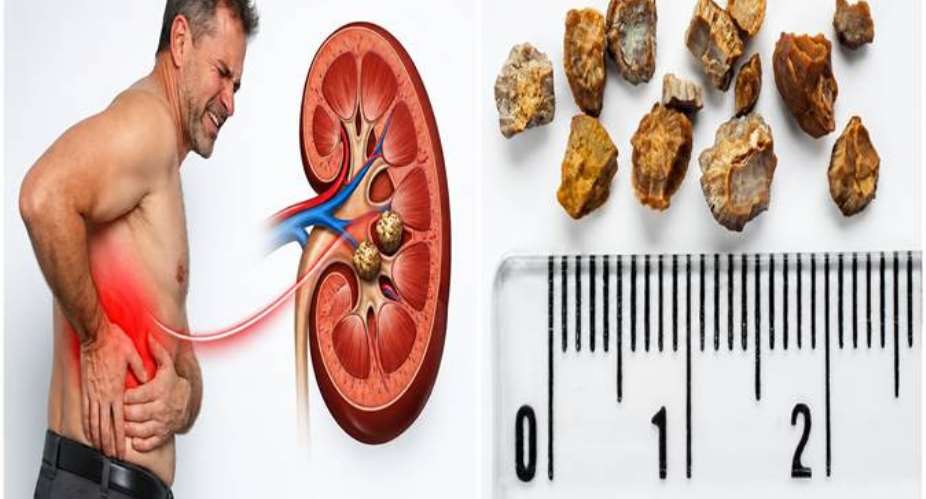
Imagine being suddenly struck by a sharp pain in your side so severe that you cannot sit still, only to discover that a tiny stone inside your kidney is responsible.
What begins as a tiny crystal in the kidney can grow into a painful stone that sends a person rushing to the hospital, making a condition that is often overlooked one worth understanding.
Kidney stones are hard deposits that form when certain minerals and salts in urine become highly concentrated and begin to crystallise inside the kidneys.
Although some stones may be as small as a grain of sand, they can cause severe pain when they move through the urinary tract.
The kidneys quietly filter waste from the blood, remove excess substances through urine and help maintain the body’s balance of water and minerals.
Normally, substances such as calcium, oxalate and uric acid remain dissolved in urine, but when their concentration becomes too high, crystals can develop and gradually grow into stones.
One of the major risk factors is inadequate water intake, because insufficient water makes urine more concentrated and creates favourable conditions for crystals to form.
This is particularly important in hot conditions, as the body loses water through sweating and people who fail to replace those fluids may produce more concentrated urine.
However, drinking too little water is not the only risk factor. Excessive salt intake, certain dietary habits, obesity, family history and some medical conditions can also increase the likelihood of developing kidney stones.
Consuming large amounts of added sugar, particularly through sugary drinks, may also be associated with an increased risk of kidney stones, although sugar itself should not be described as the sole cause.
For many people, the first warning is sudden and severe pain in the side or back that may move towards the lower abdomen or groin.
Other possible symptoms include blood in the urine, painful urination, frequent urination, nausea and vomiting, although some small stones may pass without noticeable symptoms.
The situation can become dangerous when a stone blocks the normal flow of urine, especially when an infection occurs at the same time.
People experiencing severe pain accompanied by fever, chills, persistent vomiting or difficulty passing urine should seek medical attention rather than relying solely on self‑medication or unverified remedies.
Preventing kidney stones begins with simple choices such as drinking adequate water, limiting excessive salt and sugary drinks, maintaining a balanced diet and seeking medical advice when symptoms occur or when stones have been experienced before.
The kidneys may work silently, but when a tiny crystal becomes a painful stone, the warning can be impossible to ignore — making awareness and prevention far more valuable than waiting for the pain to begin.

 NCA clears MTN, Telecel and Goal Telecom for next stage of 5G spectrum licensing
 ICT accounts for 41.5% of Ghana’s 6% Q2 2026 economic growth – GSS
 Ghana Highway Authority to correct defects on portions of Eastern Corridor Road
 ECG private sector participation to be determined after transaction advisor's re...
 Over 70% of Ghanaians walking with hypertension unaware – Cardiothoracic Centre ...
 Weija Dam spillage: $350million flood control project to begin by December
 Ghanaians should be grateful for voting Mahama back to power for saving Ghana’s ...
 I remain committed to NPP despite withdrawal from National Organiser race — Sala...
 John Boadu, Sammy Crabbe, Paul Afoko, Boakye Agyarko secure 1st to 4th spots in ...
 Auditor-General report exposes financial rot at 18 assemblies in Volta Region; C...

