




Typography has long held a distinctive place within Ghana’s visual culture. Long before digital design became widely accessible, lettering was woven into everyday life through hand‑painted shop signs, market stalls, commercial vehicles, church posters, product packaging, and roadside advertisements. Many of these letterforms were created not by formally trained typographers but by sign painters, printers, illustrators, and local businesses responding creatively to their environments. Letters were stretched, condensed, outlined, shadowed, and painted in colors chosen less by conventional typographic rules and more by the need to communicate, attract attention, and establish identity. As the document notes, these everyday forms of lettering represent “an important visual language well worth observing and exploring.”
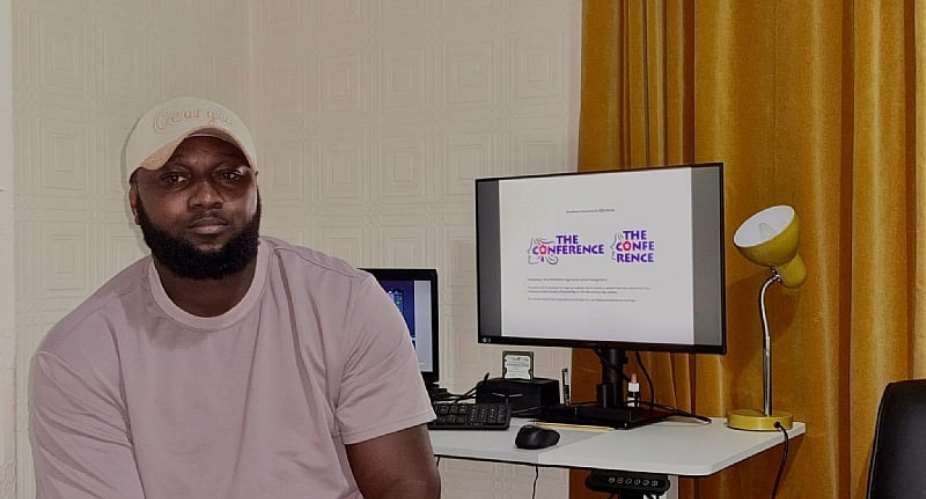
For Ghanaian graphic designer Patrick Osei, this vernacular visual language offers fertile ground for rethinking how typography can draw from African environments without relying on familiar stereotypes. He approaches type not merely as a tool for presenting written information but as a vessel for personality, memory, language, and culture. “The weight, shape, spacing, and arrangement of letters can already create a feeling,” he explains, emphasizing that typography communicates visually even before a word is fully read.
Patrick’s interest in type emerged naturally from his broader practice as a graphic and brand designer. Constantly searching for letterforms capable of expressing different personalities led him to question why contemporary African designers often begin with typefaces developed in entirely different cultural contexts. While he does not oppose the use of Western typefaces, he believes African designers should feel confident drawing inspiration from their own surroundings. “What interests me is the possibility of also looking at Ghana and Africa as places from which new typographic ideas can emerge,” he notes.
The Street as an Informal Archive
This curiosity has pushed Patrick to observe Ghana’s streets more closely, treating them as an informal visual archive. Hand‑painted lettering appears outside barbershops, food businesses, and neighborhood stores, while religious phrases and personal expressions adorn commercial vehicles. Market traders rely on bold lettering to communicate products and prices, and churches combine oversized headlines, expressive type, and dense information to promote programs and conventions.
Although many of these examples do not follow formal typographic principles, they communicate with striking confidence. Patrick is especially drawn to their imperfections: “When something has been painted by hand, every letter isn’t necessarily identical… those differences can give the lettering personality. You can feel that a person made it.”
Rather than reproducing these examples directly, he studies what makes them visually effective—exaggerated scale, unexpected character construction, color contrast, or the boldness with which words occupy space. His goal is not to romanticize imperfect design but to recognize that valuable visual ideas can emerge outside formal studios and digital type libraries.
Redefining African Visual Identity
Patrick’s perspective challenges the narrow ways African graphic design is often represented internationally—through traditional patterns, symbolic motifs, earthy palettes, and decorative elements. While he acknowledges their cultural importance, he argues that African visual expression should not be confined to these devices. “I don’t think adding an African pattern or symbol to letters automatically makes the typography African,” he says. “Our culture can influence type in much deeper ways.”
For him, contemporary African typography should be free to be minimal, geometric, experimental, expressive, or restrained. It can participate confidently in global design conversations while remaining rooted in African experiences. His interest lies not in creating typography that loudly announces its Africanness, but in exploring how African environments, languages, and rhythms can inform a broader typographic vocabulary.
Language plays a central role in this exploration. Ghana’s rich linguistic landscape—English, Twi, Fante, Ga, Ewe, Dagbani, and many others—contains words with unique sounds, rhythms, and cultural associations. Patrick sees vast potential in giving these expressions new visual life. “There are Ghanaian words and expressions that immediately connect you to a particular place, person, or experience,” he notes. “I am interested in how typography can give those words another level of visual expression.”
Process, Precision, and Human Character
Patrick’s creative process begins with observation and research. He collects photographs of signage, posters, packaging, and other everyday communication, then sketches and experiments with character construction. An unusually wide letter, an unexpected curve, or an imperfect baseline can spark an entirely new typographic direction. What begins as spontaneous observation gradually evolves into a refined visual system.
This interplay between imperfection and precision has become central to his work. Digital tools allow for near‑perfect consistency, yet many vernacular references were created without such advantages. Their irregularities reveal something intimate about the people behind them. Patrick believes contemporary typography can learn from this human quality without intentionally producing poor construction. “Sometimes a small irregularity can make something feel much more alive,” he reflects.
Underlying his exploration is a belief that typography is a form of storytelling. Letters operate simultaneously as language and image, shaping not only what a word means but how it feels. Just as spoken communication shifts depending on tone—whispered, shouted, or confidently delivered—typography alters emotional response through weight, scale, spacing, and composition.
Preserving and Evolving Visual Culture
Patrick’s work contributes to a broader conversation about African visual identity in an era of unprecedented access to global design references. While he values this accessibility, he is mindful of the risk of homogenization when designers everywhere rely on the same tools and typefaces. He argues that African designers possess visual references others may never encounter—references that can enrich global design.
Ghana, for him, is not merely a backdrop but a living visual resource. The lettering on storefronts, commercial vehicles, church posters, and market signs all contain ideas worth documenting. As hand‑painted communication increasingly gives way to digital printing, Patrick sees documentation as essential to preserving Ghana’s evolving visual culture and generating new contemporary ideas.
Ultimately, Patrick Osei’s exploration of typography remains an evolving pillar of his practice. He intends to continue studying vernacular lettering, experimenting with custom letterforms, and investigating how African languages and experiences can inform new typographic systems. “The exciting question isn’t only what African typography looked like before,” he concludes. “It is also what it can look like next.”
For Patrick, bringing African expression into typography is not about making every letter appear overtly African or rejecting international influence. It is about recognizing that Ghana already possesses a rich visual language—its streets, signs, languages, and everyday communication—and understanding how these references can meaningfully shape contemporary design. By combining observation with experimentation and digital precision, he explores how letters can become more than vehicles for words: they can become records of place, expressions of identity, and new ways of telling African stories through design.

 Adu-Boahene’s lawyers ask court to strike out fabricated, invented evidence in D...
 'He is part of National Film Authority' – Kwasi Kwarteng exposes Obuasi SHTS hea...
 'Mahama should have appointed Edudzi Tameklo to EC to teach hypocrite NPP some s...
 'You have no moral right to complain about cost of living' – Prof Anankware to B...
 'You did the same thing' – Solomon Owusu defends EC appointment
 GFL vows to pursue justice for worker who lost five fingers at Afienya Industria...
 State to call first witness on January 12 in Canadian murder case
 Haruna Iddrisu refers Obuasi SHS headmaster's sexual misconduct allegations to C...
 Bawumia is a ‘prophet of pocket economy’ in opposition, ‘priest of paper economy...
 Bolgatanga Technical University Council Chairman allegedly locks up Vice-Chancel...


