




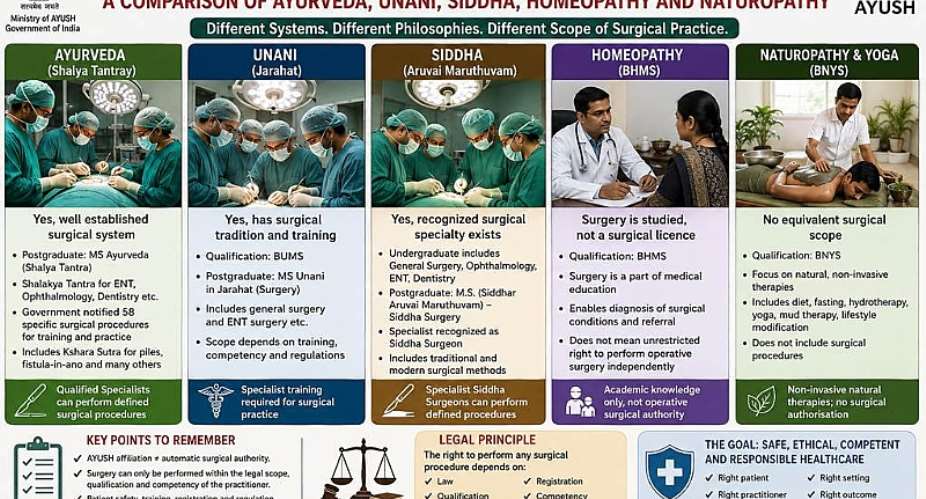
My exposure to India's traditional medical systems has challenged several assumptions I previously held about traditional, complementary and integrative medicine. One of the most striking discoveries is the place of surgery within some Indian traditional medical systems.
For many people in Ghana and other African countries, traditional medicine is associated mainly with herbal preparations, dietary interventions, massage, spiritual practices and other non-invasive therapies. Surgery, on the other hand, is generally regarded as belonging exclusively to conventional biomedicine.
India presents a more complicated picture. Some of India's traditional medical systems have historically developed surgical knowledge, and contemporary regulatory and educational structures continue to recognize surgical education within particular disciplines. However, this does not mean that every practitioner under the broad AYUSH umbrella is legally entitled to perform surgery.
The crucial questions are: Which medical system? What qualification does the practitioner possess? What specialist training has been completed? What procedure is proposed? What do the applicable laws and regulations permit? These distinctions are particularly important for Ghana as we consider the future professionalization and regulation of traditional, complementary and integrative medicine.
Understanding AYUSH
AYUSH is commonly used in India to refer to systems including Ayurveda, Yoga and Naturopathy, Unani, Siddha and Homoeopathy. But AYUSH should not be mistaken for one profession.
Ayurveda is not naturopathy. Unani is not homeopathy. Siddha is not Ayurveda. They have different histories, philosophies, educational programmes, regulatory arrangements and clinical traditions. Consequently, being an AYUSH practitioner does not automatically confer an identical scope of practice across all systems. This is particularly important when discussing surgery.
1. Ayurveda: The Clearest Contemporary Surgical Framework
Among these systems, Ayurveda has one of the clearest contemporary frameworks for postgraduate surgical education. Its classical surgical discipline is known as Shalya Tantra, while Shalakya Tantra addresses areas involving the eyes, ears, nose, throat, oral cavity, head and related structures.
Current postgraduate education combines classical Ayurvedic principles with structured hands-on clinical and surgical training. India's widely discussed framework concerning 58 specified surgical procedures for postgraduate Shalya and Shalakya training further illustrates this development.
Even here, there are limitations. It does not mean every BAMS graduate can perform every operation. Nor does an Ayurvedic surgical qualification amount to unrestricted authorization to undertake every procedure performed within conventional surgical specialties. Scope follows education, specialty, competency, registration and regulation.
2. Unani Medicine: Surgery Also Exists
Unani medicine also has a surgical tradition and formal surgical education in India. The basic professional qualification is the Bachelor of Unani Medicine and Surgery (BUMS).
Postgraduate Unani education includes recognized pathways associated with Jarahat, a term connected with surgery. It would therefore be incorrect to present surgery as completely foreign to contemporary Unani education.
However, the existence of surgery in the curriculum does not mean every BUMS practitioner possesses unlimited surgical privileges. A distinction must be maintained between undergraduate exposure to surgical sciences, specialist postgraduate training, procedural competency and legally permissible scope.
3. Siddha: A Developed Surgical Component
Siddha medicine provides another fascinating example. Contemporary educational frameworks include Aruvai Maruthuvam, or surgery, and describe classical Siddha surgical techniques such as excision, incision, bloodletting, probing, bandaging, cauterisation and caustic applications.
India's postgraduate Siddha regulations identify M.S. (Siddhar Aruvai Maruthuvam) — Siddha Surgery — and recognize the specialist designation of Siddha Surgeon. This demonstrates that contemporary recognition of surgery within indigenous medicine is not confined to Ayurveda.
4. Homeopathy: Surgery in the Degree Name Does Not Mean Surgical Licence
India's undergraduate homeopathic qualification is the Bachelor of Homoeopathic Medicine and Surgery (BHMS). But the word 'Surgery' in BHMS should not be interpreted to mean that every homeopathic physician is thereby an operative surgeon.
Healthcare practitioners may study surgical diseases so that they can recognize them, understand diagnosis and know when a patient requires surgical referral. Studying surgery as an academic and clinical subject is not necessarily equivalent to possessing independent operative privileges.
Unlike Ayurveda's Shalya Tantra or an expressly identified Siddha surgical postgraduate pathway, ordinary homeopathic practitioners should not be described as surgeons merely because their undergraduate degree contains the words 'Medicine and Surgery.'
5. Naturopathy and Yoga: A Different Clinical Philosophy
Naturopathy presents another important distinction. India has institutional education in Yoga and Naturopathy, including the Bachelor of Naturopathy and Yogic Sciences (BNYS) pathway.
Naturopathy's therapeutic philosophy is principally centred on non-invasive and natural approaches such as nutrition, fasting, hydrotherapy, mud therapy, therapeutic exercise, yoga and lifestyle modification. It should therefore not be assumed that naturopathic doctors possess the same operative surgical privileges as postgraduate Ayurveda Shalya specialists or recognized Siddha surgical specialists.
Learning about surgical conditions in a hospital does not transform a naturopath into a surgeon. Observing surgery does not confer surgical privileges, and receiving a certificate from a clinical attachment does not override the laws regulating professional practice in the country where the practitioner subsequently works.
So, Can All AYUSH Doctors Perform Surgery?
The simple answer is no. AYUSH affiliation does not create automatic surgical authority. The lawful scope depends on the medical system, recognized qualification, specialist training, competency, registration, the particular procedure and applicable law.
Why Degree Titles Can Be Misleading
An African encountering qualifications such as Bachelor of Ayurvedic Medicine and Surgery, Bachelor of Unani Medicine and Surgery, or Bachelor of Homoeopathic Medicine and Surgery may understandably conclude that all graduates are surgeons. That conclusion would be unsafe.
The word 'surgery' in the name of a medical qualification must be distinguished from the legal scope to independently perform particular operations. The proper questions concern the proposed procedure, the practitioner's qualification and supervised training, specialist requirements, registration, legal authorization and the suitability of the facility.
Why Naturopathy Is Different
Naturopathy does not need to imitate Ayurveda to become a respected healthcare profession. If Ayurveda has surgery, naturopathy does not automatically need surgery. If Siddha has surgical specialties, naturopathy does not need to manufacture a surgical specialty simply to appear equally advanced.
Professional maturity means developing competencies that naturally belong to a profession while creating safe pathways for collaboration and referral where another profession is better equipped. For naturopathy, enormous opportunities already exist in preventive healthcare, lifestyle medicine, clinical nutrition, physical medicine, hydrotherapy, therapeutic fasting, behavioural modification and chronic disease prevention.
An Important Lesson for Ghana
India provides Ghana with a powerful lesson in scope-of-practice regulation. One weakness affecting traditional and complementary medicine in many African jurisdictions is the tendency to group very different practitioners together.
Herbalists, naturopaths, homeopaths, traditional healers, chiropractors, acupuncturists and other practitioners may be discussed as though they constitute one profession. India demonstrates another approach: different medical systems can maintain distinct educational pathways and professional identities while existing within a broader national traditional and integrative medicine policy.
The better regulatory question is not simply, 'Is this traditional medicine?' but rather, 'Which profession is this practitioner trained in, and what is the lawful scope of that profession?'
Training in India Does Not Automatically Confer Ghanaian Surgical Rights
A Ghanaian naturopath, herbal practitioner or complementary medicine practitioner who travels to India and observes Ayurvedic, Unani or Siddha surgery does not automatically acquire the legal right to perform those procedures upon returning to Ghana.
Likewise, a short course or certificate in a procedure should not be confused with a recognized surgical qualification. Foreign clinical exposure can expand knowledge, stimulate research, improve referral decisions and inspire educational reform, but it cannot independently rewrite Ghanaian scope-of-practice law.
What Ghana Should Study from India
The real lesson is how India differentiates professional systems and progressively develops specialist education. Ghana should study how to create clearer distinctions between profession, qualification, registration, specialty, competency, scope of practice and facility privileges.
These distinctions become particularly important when procedures carry significant clinical risk. A healthcare practitioner should not be permitted to perform an invasive procedure merely because the practitioner belongs to a recognized profession. The practitioner should possess the specific competency required for that procedure.
Conclusion
The question, 'Can AYUSH doctors perform surgery?' cannot properly be answered with a simple yes or no. India's traditional medical landscape is much more sophisticated.
Ayurveda has established postgraduate surgical disciplines. Unani possesses surgical education and recognized postgraduate pathways associated with Jarahat. Siddha has expressly recognized postgraduate surgical qualifications. Homeopathy includes surgery within broader medical education, but the presence of the word 'surgery' in BHMS must not be mistaken for unrestricted operative authority. Naturopathy and Yoga remain fundamentally different, with no equivalent surgical scope to be presumed.
The most important lesson for Ghana and Africa is therefore not that traditional medicine practitioners should become surgeons. It is that scope of practice should follow education, competency, specialization and law. India demonstrates that indigenous medical systems can be modernized and institutionalized without forcing every profession into an identical clinical model.
Author's Profile
Prof. Raphael Nyarkotey Obu is a Ghanaian naturopath, lawyer, researcher and advocate for the professionalization of traditional, complementary and integrative medicine in Africa. He is President of the Nyarkotey College of Holistic Medicine and Founding President of the African Naturopathic Federation (ANF). His scholarly interests include naturopathic medicine, health law, professional regulation, competency-based education and the development of an African model of naturopathic healthcare.
Comparative Summary
| Medical system | Surgical education/tradition | Key pathway | Important limitation |
| Ayurveda | Yes | MS Ayurveda/Shalya and related Shalakya training | Defined scope; not unrestricted surgery |
| Unani | Yes, within recognized pathways | BUMS and relevant MS-Unani/Jarahat specialties | Depends on qualification, training and regulation |
| Siddha | Yes | M.S. Siddhar Aruvai Maruthuvam | Specialist training and regulatory scope required |
| Homeopathy | Surgery studied within medical education | BHMS; MD (Homoeopathy) | Degree title does not itself confer unrestricted operative privileges |
| Naturopathy/Yoga | Primarily non-surgical | BNYS and related education | No equivalent surgical scope should be presumed |
Selected Regulatory Sources
• National Commission for Indian System of Medicine (NCISM): postgraduate Ayurveda curricula for Shalya Tantra and Shalakya Tantra.
• Government of India, Press Information Bureau: clarification on specified surgical procedures in postgraduate Ayurveda education (2020).
• NCISM: Unani curriculum and postgraduate educational pathways, including Jarahat.
• NCISM: Siddha undergraduate and postgraduate regulations, including M.S. (Siddhar Aruvai Maruthuvam).
• National Commission for Homoeopathy: BHMS and postgraduate Homoeopathy regulations.

 Obuasi SHTS alleged sexual abuse: Kwasi Kwarteng criticises Education Minister o...
 ECOWAS’ $250,000 flood relief donation arrives in Ghana – Ablakwa
 Kennedy Agyapong has not resigned from NPP – Kwasi Kwarteng
 State failure, not GoldBod, driving galamsey – Daryl Bosu
 A Rocha Ghana raises alarm over human rights abuses in mining communities
 ECOWAS, AfDB discuss ways to advance West Africa’s development priorities
 October 16: Cedi gains against dollar, sells at GHS12.25 on forex market, GHS11....
 Galamsey: Ghana’s rivers now run chocolate and milk colour — Sam Jonah
 A nation of job-seekers will always be poor — Sir Sam Jonah
 “If you attack us with pepper spray, we’ll fight back” — NDC Yakubu Tony Aidoo w...


