




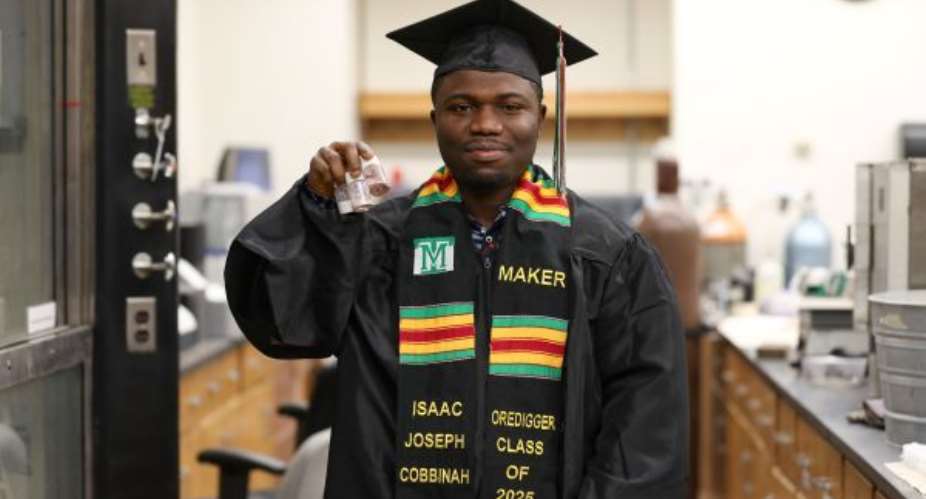
When Isaac Joseph Cobbinah becomes curious about something, he doesn’t just skim the surface—he dives in completely. It’s a trait that has shaped his academic journey from the gold‑rich town of Tarkwa, Ghana, to the snowy hills of Butte, Montana, where he is preparing to graduate from Montana Technological University with a master’s degree in Metallurgical/Minerals Processing Engineering.
Cobbinah will cross the commencement stage on December 13, but he isn’t rushing away from the lab bench just yet. Instead, he plans to spend the next few years putting his research on rare earth permanent magnet recycling into practice.
“I want to apply what I’ve learned before continuing my studies,” he said, a quiet confidence in his voice.
A Journey That Began Far From Montana
Growing up in Tarkwa—a region defined by its gold mines—Cobbinah never imagined he would one day be studying how to recycle rare earth elements (REEs) essential to smartphones, aircraft engines, and electric vehicles. But his path shifted when he discovered hydrometallurgy and the chemistry behind mineral processing.
“I have a strong passion for chemistry and hydrometallurgy,” he said. “Mineral processing is all about chemistry. I wanted to find a novel and cheap method of recovering critical rare earth elements, especially those that support high‑tech industries.”
Before coming to Montana Tech, Cobbinah earned his bachelor’s degree in Minerals Engineering from the University of Mines and Technology in Ghana. He worked as a research and teaching assistant and senior lab technician, and his fascination with complex gold‑ore processing pushed him to seek expertise beyond Ghana’s borders.
His search led him to Dr. Courtney Young, the Lewis S. Prater Distinguished Professor at Montana Tech.
“I found Professor Young listed as one of the top mineral processing professors,” he said. “I reached out, applied, and was accepted. That’s how my journey to Montana Tech began.”
Finding Purpose in the Lab
Since arriving in Butte two years ago, Cobbinah has immersed himself in research on recovering rare earth elements from end‑of‑life neodymium‑iron‑boron magnets. These magnets are everywhere—inside electric vehicles, wind turbines, computers, and even household electronics. Yet the materials they contain are scarce, and the United States relies heavily on China for supply.
“China is known to be the main source of rare earths, but the U.S. doesn’t have many reserves or primary resources,” he explained. “That’s why we’re studying how to recycle permanent magnets and recover these critical REEs. It’s a way to bridge the gap.”
His thesis, Recycling NdFeB Magnets I: Production of REE Fluorides by a Novel LPC Process, explores hydrometallurgical techniques for extracting valuable elements from magnets that have reached the end of their lifespan.
“Without magnets, engines, computers, and phones wouldn’t function,” he said. “So finding a way to recycle them in the U.S. is very important.”
Life in Butte: Cold Weather, Warm Community
The research came naturally. The Montana weather did not.
“The hardest part was adapting to the weather,” Cobbinah said with a laugh. “I learned about the three‑layer dressing strategy, and I had to save enough money to buy a car so I could get around. That helped a lot.”
Despite the cold, he found comfort in the community he built—friends he plays soccer with three times a week, supportive faculty, and a campus culture that encourages hands‑on learning.
“At Montana Tech, you own your work,” he said. “You learn how to use advanced equipment like SEM, EDS, and XRF, and you do almost all of the analysis yourself. That experience will really help me in my career.”
A Mentor’s Confidence
Dr. Young has watched Cobbinah grow from a newcomer adjusting to a new country to a confident researcher ready for industry.
“Isaac Joseph is very determined,” Young said. “He struggled at first with a different school and community but settled in quickly. Soon enough, he was getting data from his research and figuring out how to optimize the results. I love it when students have that ‘ah‑ha’ moment and become independent. He will do well. The company that lands him will get a dedicated and hardworking engineer.”
Looking Ahead
As he prepares to graduate, Cobbinah reflects on how far he has come—and how much more he hopes to achieve.
“I’m proud to be a Montana Tech alumnus,” he said. “This research area is new, and very few people are studying it. It feels good to be part of something that matters.”
For students hoping to follow a similar path, he offers simple but powerful advice:
“Graduate school is all about your advisor and your determination,” he said. “If you love what you do and you have the right support, you can succeed anywhere.”
 Adu-Boahene’s lawyers ask court to strike out fabricated, invented evidence in D...
 'He is part of National Film Authority' – Kwasi Kwarteng exposes Obuasi SHTS hea...
 'Mahama should have appointed Edudzi Tameklo to EC to teach hypocrite NPP some s...
 'You have no moral right to complain about cost of living' – Prof Anankware to B...
 'You did the same thing' – Solomon Owusu defends EC appointment
 GFL vows to pursue justice for worker who lost five fingers at Afienya Industria...
 State to call first witness on January 12 in Canadian murder case
 Haruna Iddrisu refers Obuasi SHS headmaster's sexual misconduct allegations to C...
 Bawumia is a ‘prophet of pocket economy’ in opposition, ‘priest of paper economy...
 Bolgatanga Technical University Council Chairman allegedly locks up Vice-Chancel...


