




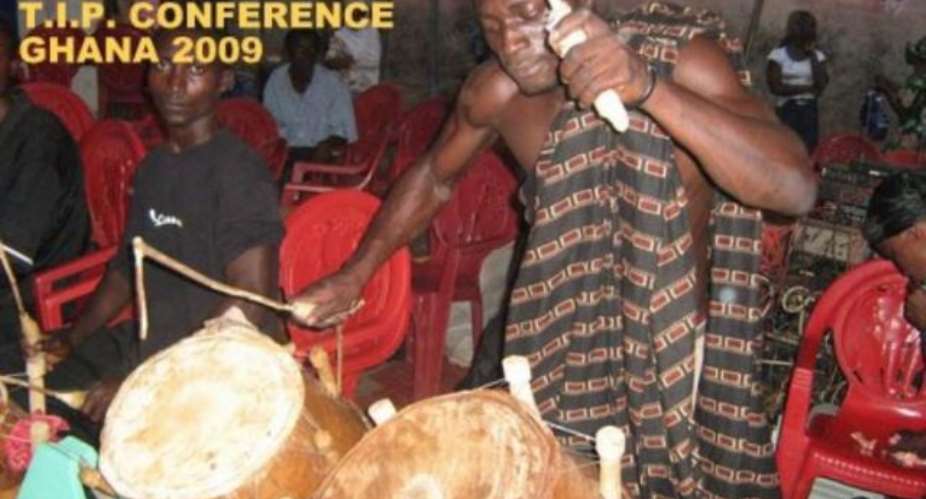
A director of the Adansi-South district office of the National Commission for Civic Education, Mr. Willie Klutse has called on the government, many non-governmental organisations and community leaders to promote the use of cultural arts to facilitate peace in the country and to effect social change in our communities. This call was made at Mankessim at the week end when Mr. Klutse chaired the KPANLOGO FOR PEACE Percussion Festival and T.E.A.C.H.E.R S Conference which was incorporated into the Borborfantse Afahye (festival) of the community.
KPANLOGO FOR PEACE Percussion & T.I.P. Conference was a celebration of culture, arts, community awareness, and percussion music of Ghana. A week of explosion of percussive music, powerful choreographed and cultural dances, educational theatre, seminars, street performances and more took place at Mankessim in the Central region from 7th to 14th September, 2009.
Kpanlogo for Peace Percussion and T.I.P Conference was a combination of two separate world class community programmes. It is a joint project of the Ghana Percussive Arts Society and the T.E.A.C.H.E.R.S International Project (USA). (T.E.A.C.H.E.R.S) is an acronym for Teachers Educating All Communities about Health, Environment, Rights and Security.
T.I.P is an International membership organisation for Teachers and Educators with headquarters in USA. Its mission is to collaborate with local communities to organise conferences and seminars aimed at creating awareness about global issues of concern such as Health, Security,Human Rights and Environment.
Days of Percussion (D.O.P) are a major percussive arts project of the world's famous music service organisation, the Percussive Arts Society of USA. Through sponsorships, local chapters all over the world host D.O.P to celebrate percussive music with a theme relevant to local needs. Ghana Percussive Arts Society, which is primarily the local host of this spectacular percussion festival christened the D.O.P, Kpanlogo for Peace Percussion Festival.
The Ghana Percussive Arts Society (GPAS) is the premier chapter in Africa of the music service organisation which has its headquarters in the USA. GPAS is dedicated to undertaking research into percusssion, documenting and the promoting of percussive arts culture in Ghana.
The GPAS which has an open membership, organises percussive related events in many Ghanaian institutions and communities as well as hosts annual Days of Percussion in collaboration with a number of local non-profits. These events bring performers, teachers, cultural instructors and drum enthusiasts from all over Ghana and beyond to share the arts, network, inspire creativity, create awareness about the work of PAS and help to preserve and promote percussion as a valuable tool for national development and social change.
Kpanlogo for Peace, as a title theme was used for the second year in a roll, having used it last year to reflect the need for peace during the 2008 general elections in Ghana. Culturally, Kpanlogo is a communal music making and dance activity that brings people of all backgrounds together. Kpanlogo ensemble like other ethnic music suites has the ability of creating unity in communities.
As the country is ushering itself into a smooth transition in a post- electioneering year, tolerance to opposing views and peaceful dispensation of our democratic practices and development is heavily dependent on peace. Kpanlogo, therefore, is a symbolic representative of all Ghana's cultural groupings and the need for unity.
Speaking about how culture relates to our democratic pursuits, Mr. Willie Klutse said traditional drumming and dance ensemble teaches Ghanaians certain developmental and human relations concepts. Some of the concepts are community building, responsibility, acceptance, leadership qualities, critical thinking skills, tolerance, peaceful co-existence and citizenry skills. He went to say that in a typical performance of an ensemble, the lead drummer who can be likened to the role of a community leader is the one who directs the choreography. To dance well, dancers have to pay attention and follow directions from the master drummer. Members of an ensemble, like citizens of any country, come from different backgrounds but come together during performance to present quality and sterling show to the public. He said in ensemble, every instrument no matter how small is very important. He continued that if Ghanaians can learn from what our culture teaches us about true democracy, Ghana will be a real model country for democratic practices.
Many community groups participated in the festival and the conference. Among the groups are Africussion Drum and Dance Company from Accra, Etsii Korowa Drum and Dance Ensemble, Obrumankoma Traditionals, Ebibiman Cultural Troupe, Nananom Dance Company, Borborfantse Fontonfrom Group, Kwaanan and the Percussion All Stars, Owoaman and Essereso Susubiri Adowa group from Kumasi.
Other highlights of the conference included seminars on Domestic Violence, Health Education, and Security concerns such as the menace of armed robbery and how to ameliorate the challenges.
Speaking on domestic violence, Ms. Ernestina Biney, an executive of Ghana PAS called on victims to report cases to the appropriate authorities and intermediary outlets for mediation. She condemned those communities that ridicule victims of domestic violence and advised that the communities should change its attitudes. She also called on private schools in Ghana to introduce Applied Music education in their academic programmes.
Nana Kofi Akoonu, an educationist of Mankessim, also called on Ghanaian parents to take advantage of many free incentives being offered by the government to send their children to school. He also party supporters not to politicise the managements of community places of convenience and the school feeding programme. He called on the government to put structures in place to ensure that peace prevails regarding the managements of these facilities and programmes.
Professor Ama Owusu-Asante, a professor of African Studies in the US, called on Ghanaians to seriously study their history and their rich heritage to help them make progress. She advised Ghanaians against blind copying of western values and mores. She commended the Ghana chapter of the Percussive Arts Society for its efforts in the promotion of percussive music in Ghana.
Other speakers at the conference were Dr. Kofi Acquah, also a professor of African Studies in the USA, Rev. Cynthia Aminsah of Jesus Is Alive Minsitry, Takoradi, Imam Baba Mohammed of Allah Healing Centre,Kumasi and Nana Osei Bonsu, a lawyer from Kumasi.
Major sponsors of the festival and the conference were the Percussive Arts Society, USA; T.I.P (USA) and the International Center for African Culture & Arts (USA Office). Other supporters were OBAATANPA House of Hope Inc.(USA), HighlifeRadio (USA), the Centre for Human Development & Social Change, Ghana and the Adansi-South District Assembly.
 Obuasi SHTS alleged sexual abuse: Kwasi Kwarteng criticises Education Minister o...
 ECOWAS’ $250,000 flood relief donation arrives in Ghana – Ablakwa
 Kennedy Agyapong has not resigned from NPP – Kwasi Kwarteng
 State failure, not GoldBod, driving galamsey – Daryl Bosu
 A Rocha Ghana raises alarm over human rights abuses in mining communities
 ECOWAS, AfDB discuss ways to advance West Africa’s development priorities
 October 16: Cedi gains against dollar, sells at GHS12.25 on forex market, GHS11....
 Galamsey: Ghana’s rivers now run chocolate and milk colour — Sam Jonah
 A nation of job-seekers will always be poor — Sir Sam Jonah
 “If you attack us with pepper spray, we’ll fight back” — NDC Yakubu Tony Aidoo w...


