




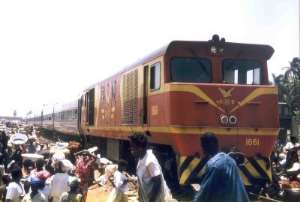
The recent demolition of structures within the railway corridor in Ibadan has sparked off controversy between the resident 'landowners' and the Railway Property Company Limited, which considers them illegal squatters. Abiodun Awolaja conducted a three- week investigation on the crisis, and here profiles the saga. I held tight to a police woman. My entire being convulsced. I was begging her and her colleagues to assist, watching helplessly as thugs and miscreants made away with my soft drinks and satchet water bags. In one instant, my shop, my source of livelihood, was gone. But for the grace of God, the event could have been more disastrous. It was the kind that claims people's lives”, said the 76-year-old woman. She was narrating her experience during the demolition exercise carried out by the Railway Property Company Limited in Ibadan, Oyo State, pursuant to the 2009 railway rehabilitation exercise of the Federal Government.
The demolition notice served on the residents in Bodija (and other environs extending as far as Akobo Oju-Irin), signed by the Zonal Manager, West, of the Railway Property Company Limited, A.O. Abdulsalam and dated 01/07/09 read in part “In compliance with the Federal Government matching order (sic) to commence demolition exercise all-line to remove quarters on the Rail corridor with immediate effect as a result of the 2009 Rehabilitation exercise.You are hereby advised to dismantle your structure within the setback of 50ft (15m) from the centre of the main line track.'' The notice enjoined its recipients to “kindly comply to avoid forceful removal of your structure in order not to compel you to pay for the cost of demolition.''
As soon as the notices were pasted, frantic discussions ensued among the residents, and preparations began to be made, by those who knew their houses or shops were within 15 metres from the centre of the main line track, for alternative shelter. However, for the majority of the Bodija residents, there was no need to panic, as their 'structures' were well beyond the 15-metre point. But as things turned out, they were in grave error
Mrs. Helen Clement, a member of the Seventh Day Adventist Church, said: “We were surprised when they (railway personnel) pulled down our church. They had promised that the demolition would not affect us.” Indeed, the demolition affected far more than church buildings: sightless PA Abiade Adediran, 102, a Railway retiree, had his six-room house pulled down by the uncanny bulldozer, losing, in the process, property said to be worth, in all, about N1.2 million, and so did Mr. Emmanuel Olatunde, whose trailoring and provision shops were also pulled down. “I lost nothing less than N850,000, “he sobbed.
As Nigerian Tribune surveyed the environs affected by the demolition, a young woman with a baby strapped to her back walked by, saluting neighbours. “That woman has been out in the cold since the demolition. Her husband has gone to stay with friends faraway from here, and is making frantic efforts to relocate his family, “a young male resident of the area informed this writer.
“I was born in 1922. I'm not a rich man. They pulled down my only possession, my shop which I rented out to a tailor. Please help us tell the government to look into our case,” another affected resident, Pa Jimoh Adedotun said. As he spoke, his muscles quivered and, dabbing into his pocket for a brown cloth, he wiped his face with it, every inch a manly old man. He put his loss at a modest N100,000. Residents said that the demolition could have been worse, but for the gallant efforts put up by Evangelist Emmanuel Olatunde,63, a retired civil servant. “I just don't like cheating,''the evangelist told the Nigerian Tribune.
A young guide, and makeshift historian, painted graphic details of the demolitions faraway. “When the brothel down there was pulled down”, he said without prompting. “I heard that some of the ashewo (sex workers) had no time to pack their underwear. It was a terrible day for business.” As he went on and on, giving lurid and salacious details of the brothel's demotion in a rather cinematographic style, the Nigerian Tribune moved further down the street, interviewing the victims. The case of one Mr. Saka, who was just about moving into his newly-built four-bedroom flat, was heatrending.” We got this place in 1990, 50 feet by 50 feet. My four shops, which were rented out to people, were destroyed. My working tools were destroyed. I lost not less than N4 million,” said Sir Mathew Olaniyi, also affected by the demolition.
As Nigerian Tribune learnt, all the tenants believed the land belonged to the Akingbola family. Head of the Akingbola family, Pa Mathew Akinbode, 83, said:“In 1992, the railway people started leasing out our land. One retired railway station master, Owoaje, was trying to seize part of our land and arrestedAlhaji Bayo Akinbiyi, who was taken to the Special Anti-Robbery Squad (SARS) office in Ibadan. We hired a lawyer, one Barrister Omisore, and verdict was given by the court in 2007.
“When the court had given judgement, the tenants who were paying rent to the Railway stopped doing so, so they (Railway personnel) were annoyed. Salam, the zonal manager of the Railway Property Company, led the demolition team here, together with the DPO of the Railway Police Station and others. Salam asked where Alhaji Lamidi Akinniyi and Alhaji Bayo Akinbiyi's houses were, eager to pull them down because we were giving the Railway a headache by going to court, but changed his mind when he saw that their houses were too far from the demolition point.
“The Glory Tabernacle people took powerful steps, and that's why you see that although it is very close to the main track, they could not pull it down. In fact, they have started rebuilding the part that was affected. The Railway didn't go beyond 50 feet in Osungbade and Elerumoke lands, only on our own land,” he said. Railway reacts
When the Nigerian Tribune visited the Railway Property Company premises at Dugbe, Ibadan, the story took a different turn. Mr A.O Abdulsalam, the Zonal Manager, the District Public Relations officer and the District Manager, Engineer Gbadamosi Folorunso Rasheed, patiently took the Nigerian Tribune through the nitty gritty of the case, explaining that the demolition exercise was not targeted at the Akingbola family or any other family affected by it. “Indeed, only an insane person would take delight in pulling down buildings. The fact is that the land belongs to the Railway. No line was singled out. Western District comprises Ogun, Oyo, Osun, Kwara, and a part of Niger State. The first demolition took place in Ilorin, then we moved to Osun and Ogun. But because of the nature of Ibadan, we had to exercise caution. So, we started campaigning, appealing to the people to get structures along the railway corridor removed by the owners themselves, so that we would not be seen to be collapsing structures and destroying items which could be removed. Our objective is to get squatters off our corridor; no more, no less'' said Engineer Gbadamosi.
He added that in the cases of stations like Bodija, which had sidings(ports where goods could be temporarily kept, like a harbour) the measurement was taken from the sidings, hence the complaint that the body had gone beyond the specified limit of 50 feet from the main line track. “The Akingbola family should not put sentiments into a national assignment; I've never seen any of them in my life. We don't have a single line. We may take the measurement from the last line,'' he said.
The district PRO, for his part, stated that the property company had, prior to the demolition, marked the structures likely to be affected by the exercise, “but they(the residents) rubbed it off. The sidings are there.''
According to Gbadamosi, the company had conducted a press conference, mounted enlightenment campaigns and visited the Olubadan-in-Council before the demolition exercise, all in a bid to create awareness. “We gave the squatters a four-month notice,” he said. This was corroborated by the PRO, who said the demolition notice served in July was a mere reminder.
“The Akingbola family was in court with us for 9 years, and the court gave judgement in our favour in 2007. Railway doesn't encroach on anybody's land. We have more than enough. Most of the people in Bodija are on temporary occupation. The Akingbola family just felt this was their land, but there is evidence, dating back to the 1930s, that the land was acquired in overriding interest by government, and all the affected families were paid compensation. Railway land extends by 300 feet, left and right, from the main line track. What we have demolished is just a fraction of our land,'' said Salami.
Salami explained that the Akingbola family had gone ahead to sue the Nigeria Railway Corporation, rather than the Railway Property Company, after the 2007 judgement, but that the company had immediately alerted its legal department to the anomaly.
In a motion medium dated 27th March, 2008, the Akingbola family, being the plaintiffs at the High Court in suit No.I/244/97, had sought (i)”an order staying the execution of the warrant of possession issued by the court and copies of which were pasted on the plaintiffs/applicants' houses situate at near Bodija Railway Station, Bodija, Ibadan''; (ii) “an order setting aside the warrant of possession on the suit by the court and'' (iii) “an order restraining the respondent by itself, its servants, agents and privies from harassing or molesting the plaintiffs' family in the houses lying and being at near Bodija, Ibadan,'' on the grounds that (i) the judgement of the Court of Appeal in Appeal No CA/I/264/02 and delivered on 7th March, 2007 did not confer any title to land on the defendants/respondents; (ii) “that the defendants misled the Honourable Court to issue the warrant of possession dated 6/2/08, leading to a miscarriage of justice, and that (iii) the warrant of possession issued by the Honourable Court is wrongfully issued as there is no legal basis to same.'' While granting all the prayers of the plaintiffs, Justice M.L Abimbola, in a judgement delivered on June 9, 2009, had held inter alia: “If the issuance of a writ or warrant is not justified or it is inappropriately issued, as in this instant case, a court can set it aside.''
However, as explained by Salami, “the Akingbola family only went to court, believing that a court injunction could stop the implementation of a Federal Government directive. We are not aware of this judgement. We only saw this(a copy of the judgement). They sued the Nigeria Railway Corporation rather than the Nigeria Railway Property Company Limited.''
He added that the case of the Glory Tabernacle was different. “The place was given to Mobil long ago, but Mobil transferred its interest to the church, and they have a 99-year lease.They were here yesterday.We are discussing with them, and we don't want to do anything that could tarnish our image. I don't know any member of the Akingbola family, and so could not have planned to demolish their houses.''
Speaking on the rehabilitation exercise, Gbadamosi said the next stage after the demolition, the condition assessment survey, which would determine the scope of work of work to be done, was ongoing, and that consultants were expected to come up with a bill of quantity, which would guide the award of contracts. “This September, we expect contractors to be mobilised to site. Government is acquiring 25 new locomotives, which will arrive in batches by February next year. Of course, demolitions are a continuous exercise, as the expansion goes on. Government is desirous of a modernized railway,'' Engineer Gbadamosi surmised.
Nevertheless, given that the judgement delivered by the High Court regarded the Railway Property Company as a subsidiary of the Nigeria Railway Corporation, the question remains whether the company should have gone ahead with the demolition. Again,it is clear that many Nigerian families are still going to be affected by further demolitions. There is no doubt that dialogue between the two parties and government is needed to avoid chaos.
 No room in our standing orders for reconsideration of anti-LGBTQ+ Bill – Sam Geo...
 Court threatens to struck out Mamprobi Baby theft case over disclosure delays
 How ex-convict allegedly sealed teenager's mouth with super glue, raped and murd...
 About 70% of buildings in Ada East lack permits, to be demolished – DCE
 Accra will no longer be sanctuary for indiscipline — Linda Ocloo declares after ...
 Bono Region: Police investigate murder of retired veterinary officer
 GMA says no emergency patient was denied care at KATH despite congestion concern...
 VIDEO: Fuel tanker driver burnt to death in fiery crash at Adubinso, seven shops...
 IMF boosting financial support for four African nations over war impact
 Anti-LGBTQ+ bill: Public clash between Speaker Bagbin and Majority Leader needle...


