




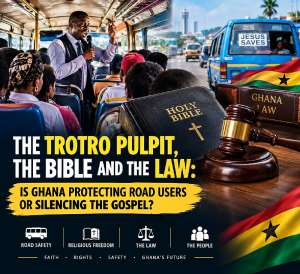
Ghana has found itself at the centre of an important national debate: should a preacher have the right to proclaim the Gospel inside a moving commercial bus, even when the activity may disturb passengers or raise questions about road safety? Or does the state have a responsibility to regulate what happens inside public transport vehicles, regardless of whether the activity is religious, commercial or recreational?
The controversy surrounding preaching and hawking in moving buses is not simply a disagreement between the government and the clergy. It raises fundamental questions about religious freedom, public safety, constitutional rights, the responsibilities of spiritual leaders and the meaning of obedience to the laws of the land.
At the heart of the matter is a distinction that appears to have been lost in some of the public debate: Ghana has not prohibited Christianity, evangelism or preaching in general. The regulation in question concerns preaching and hawking inside public or commercial vehicles while they are moving.
President John Dramani Mahama made this distinction publicly on 9 October 2026, explaining that preaching could take place when a bus was stationary at a terminal, but the activity should stop once the vehicle began moving. His clarification followed public criticism of the road traffic regulations.
Yet the debate deserves more than a presidential clarification. It demands an examination of the law's history, the difference between the old and new regulations, the justification for enforcement, the objections raised by religious leaders and the uncomfortable questions that both government and the clergy must answer.
Is this an attack on Christianity, as some critics suggest? Is it an ordinary public-safety measure that has been unnecessarily turned into a religious controversy? And if the government is wrong, what exactly is wrong with the law?
Equally important: if the law is reasonable, why should a preacher be exempt from obeying it simply because the message being delivered is religious?
1. What year was the law enacted, and what exactly does it prohibit?
The first important fact is that the restriction did not originate in 2026.
Ghana's Road Traffic Regulations, 2012 (L.I. 2180) already addressed nuisance on moving public and commercial vehicles. Regulation 116 expressly included preaching and hawking among the prohibited activities. The provision was therefore part of Ghanaian law long before the present controversy.
The renewed debate followed the introduction of the Road Traffic (Amendment) Act, 2025 (Act 1153), which received presidential assent on 24 December 2025, and the Road Traffic Regulations, 2026 (L.I. 2519), approved by Parliament on 28 May 2026.
The distinction is important because describing the matter simply as a government decision to ban Christianity on buses misrepresents the scope of the rule.
The relevant provision is directed at activities inside moving public or commercial vehicles. It does not amount to a general ban on preaching at churches, markets, campuses, transport terminals or other public places.
The old law versus the new regulations
| Issue | 2012 regulations | 2026 regulations |
| Legal instrument | L.I. 2180 | L.I. 2519 |
| Relevant provision | Regulation 116 | Regulation 141 |
| Conduct covered | Nuisance, including preaching and hawking in a moving public or commercial vehicle | Preaching and hawking remain prohibited in a moving public or commercial vehicle |
| Maximum imprisonment | Up to 30 days under the earlier provision | Up to eight months under the new provision |
| Fine | The earlier provision's general nuisance-related wording and penalty framework applied | Reported fine of 10–50 penalty units, or GH¢120–GH¢600 at GH¢12 per unit |
| Wider context | Earlier road traffic rules | Broader road-safety reforms and stronger enforcement provisions |
Sources: the earlier regulations and reporting on the 2026 framework.
The central difference is not that Ghana suddenly decided in 2026 that the Gospel should not be preached. The underlying prohibition dates back to 2012. The new framework has brought the issue back into public attention with substantially tougher potential penalties.
However, the precise legal application of the new penalties must be distinguished from media summaries. The applicable provision, the relevant penalty clause and the circumstances of an alleged offence matter. Nobody should be told that imprisonment is automatic merely because they have been accused of preaching.
2. Why did a law that existed for years suddenly become controversial?
For many years, preaching inside trotros and long-distance buses became a familiar part of Ghanaian public life.
A preacher could board a vehicle, introduce a sermon, quote Scripture, lead prayers, sing hymns and invite passengers to accept Jesus Christ. Sometimes passengers participated enthusiastically. On other occasions, people simply endured the activity until the preacher left.
Because the practice continued openly, many people may have assumed it was legally permitted.
That assumption illustrates a wider problem with public education and law enforcement: when a law remains largely unenforced for years, citizens can mistake official inaction for legal permission.
The renewed attention followed the government's nationwide public education campaign on road traffic regulations in September 2026. The government then faced criticism from religious figures and members of the public.
The question, therefore, is not merely why the law exists. It is why a provision on the statute book for more than a decade was allowed to become so disconnected from everyday practice.
Where were the transport authorities? Where were the police? What public education was undertaken before enforcement became a national controversy? And why did it take renewed attention in 2026 for many people to discover a rule that had existed since 2012?
These are questions government officials must answer alongside questions directed at the clergy.
3. Is the government attacking Christianity, or is this about road safety?
President Mahama's explanation was that the restriction is intended to protect passengers, drivers and road users rather than suppress religious activity.
According to the President, preaching and selling goods can continue while a vehicle is stationary at a terminal, but the activities must stop once it begins moving.
That distinction provides the starting point for a serious assessment.
A driver operating a commercial vehicle must concentrate on traffic, road conditions, pedestrians, other drivers and unexpected hazards. A person standing near the driver, moving through the aisle or engaging passengers while the vehicle is in motion may create additional distractions or safety risks.
Not every sermon necessarily distracts a driver. Some passengers may listen quietly, and some drivers may say they have no difficulty concentrating. But a road-safety rule does not necessarily require proof that every individual incident has caused an accident before preventative measures can be justified.
The government must nevertheless explain the evidence behind its policy, why the existing rule required stronger penalties and whether less restrictive alternatives could achieve the same objective.
The strongest argument for the regulation is passenger and road safety. The strongest challenge to the government is whether the enforcement measures are proportionate, clear and fairly applied.
There is no need to invent a war between God and government when the real question is how to balance religious expression with the rights and safety of others.
4. What are Ghanaians saying, and do they fully understand the law?
The debate has produced several competing positions.
Position one: Preaching is a Christian duty that should not be restricted.
Some evangelists argue that they have a religious responsibility to reach people wherever they are. For them, a bus is another opportunity to spread the Gospel, especially to people who might not attend church.
Position two: Passengers deserve peace and freedom of choice.
Some passengers welcome the sermons, while others object to unsolicited preaching, loud singing, physical movement through the vehicle or being pressured to participate in religious activities. BBC reporting captured both perspectives.
Position three: Government should not use criminal penalties unnecessarily.
Critics question whether conduct that has long been socially tolerated should expose preachers to a prison sentence of up to eight months. Others argue that the restriction should be removed or amended rather than enforced against evangelists.
Position four: Religious freedom does not automatically create an exemption from traffic law.
Others maintain that religious activity deserves protection, but that protection must coexist with public safety, the rights of non-believers and the lawful regulation of transport.
The difficulty is that public commentary sometimes treats three different questions as though they were one:
* Is preaching a legitimate Christian activity? Yes.
* Does religious freedom mean that every location and circumstance must permit preaching? Not necessarily.
* Should a preacher be imprisoned for breaking a traffic regulation? That requires a separate discussion about proportionality, the legal process and the appropriate punishment.
A person can defend Christianity while supporting restrictions on disruptive behaviour. Equally, a person can support road safety while questioning whether eight months' imprisonment is an appropriate maximum punishment.
The public must learn to separate these issues instead of reducing every disagreement to a contest between believers and unbelievers.
5. What are pastors saying, and what should the clergy be telling their members?
One of the most prominent objections came from Rev. John Ntim Fordjour, the Member of Parliament for Assin South and a pastor. On 8 October 2026, he publicly challenged the regulation and called for the government to abandon it, arguing that he had preached in commercial buses for years and would not be deterred from proclaiming Jesus.
That position reflects a genuine theological concern: Christians are commanded to share their faith. But the public debate becomes more difficult when a religious leader moves from defending the importance of evangelism to suggesting that an existing law can be disregarded.
A different position was expressed by Rev. Enoch Paul Hayes, a senior pastor at International Central Gospel Church, who told the BBC that he did not consider the regulation a denial of religious freedom and urged fellow pastors to obey the law and find alternative means of evangelism, including social media.
These differing views are important. They demonstrate that Ghana's Christian community is not speaking with one voice on the issue.
The Christian Council of Ghana was also approached for comment by the BBC, but the report stated that it had not responded at the time of publication. That should not be misrepresented as an official endorsement or rejection of the regulation.
The broader question is what churches teach their members about citizenship.
Pastors routinely teach congregations about tithes, offerings, marriage, sexual morality, forgiveness, prayer, spiritual warfare and evangelism. How much time do they devote to teaching their members about constitutional rights, road safety, lawful conduct, taxation, civic responsibilities and the limits of religious authority?
If a church teaches that every Christian should evangelise, should it not also teach that evangelism requires wisdom, respect for other people and an understanding of the environment in which it takes place?
If a pastor encourages members to obey God, should that pastor also explain what Christians should do when their preferred method of evangelism conflicts with a lawful public regulation?
These are not anti-Christian questions. They are questions about responsible religious leadership.
6. Does the Bible teach Christians to obey the laws of the land?
The Bible contains passages that explicitly address the relationship between faith and civil authority.
In Romans 13:1–7, the Apostle Paul teaches that governing authorities have a role in maintaining order and that Christians should respect lawful authority.
In 1 Peter 2:13–17, believers are instructed to submit to human authorities and to honour others while maintaining their reverence for God.
These passages do not mean that every government decision is automatically just or that a government can demand absolute obedience in every circumstance. They do, however, make it difficult to argue that Christians are generally free to disregard civil law simply because they are engaged in religious work.
There is also an important qualification in Acts 5:27–29. When the apostles were ordered to stop teaching in Jesus' name, Peter and the other apostles responded that they must obey God rather than human beings.
Christians therefore have a longstanding theological debate about the limits of state authority. Where a government directly commands believers to violate what they understand to be God's command, civil disobedience may be justified in their tradition.
But does the Ghanaian regulation actually order Christians to stop believing in Jesus, reading the Bible, evangelising or preaching in churches?
No. Its stated restriction concerns preaching and hawking inside moving public or commercial vehicles.
That distinction matters. A regulation restricting one method of evangelism is not automatically equivalent to a law prohibiting the Gospel itself.
The constitutional position must also be considered. Article 21 of Ghana's 1992 Constitution protects freedom of thought, conscience and belief, including freedom to practise and manifest religion. Those protections operate within a constitutional framework that also recognises the rights of others and permits certain lawful limitations.
The correct question is therefore whether this particular restriction is lawful, sufficiently clear and proportionate not whether religious freedom means there can never be restrictions on religious conduct.
A question for every pastor
If Romans 13 teaches respect for governing authority, why is the obligation to obey the law sometimes emphasised when congregants are expected to follow church rules, but treated differently when a civil regulation inconveniences a particular ministry?
And if Acts 5 is cited as justification for defiance, what precisely is the government demanding that the preacher do against God's command?
A serious theological argument must establish that conflict. It cannot simply assume that any regulation affecting a religious activity is persecution.
7. Are pastors trained to preach on moving buses and flying aeroplanes?
This question exposes an important distinction between the mission of Christianity and the methods used to carry it out.
Christian ministry has traditionally included preaching, teaching, pastoral care, evangelism, community service, discipleship and the administration of church ordinances. Particular denominations and theological institutions differ in how they train ministers, but preaching on a moving bus is not a universal requirement for ordination or Christian ministry.
Some evangelists choose public transport because it gives them access to people they might not otherwise meet. Others work in churches, schools, hospitals, markets, prisons, communities, media platforms or online.
The Bible commands Christians to spread the Gospel, including in Matthew 28:19–20. It does not prescribe commercial buses as the mandatory venue.
What about preaching on aeroplanes?
There is no sound basis for claiming that Christians in Ghana have a special religious obligation to preach on moving buses while Christians elsewhere are expected to remain silent on aeroplanes.
Preaching to fellow passengers during a commercial flight is not a universal Christian practice or a standard requirement of ministerial training. On aircraft, safety instructions, cabin-crew authority and the rights of other passengers are especially important. An unsolicited sermon that disrupts the cabin or interferes with safety procedures may be stopped under applicable rules.
The same basic principle applies to a bus: religious conviction does not automatically entitle a person to command the attention of everyone sharing a confined public space.
If a pastor boards an aeroplane and does not interrupt passengers with a sermon, does that make the pastor less Christian? If a preacher uses a church, radio broadcast or online platform instead of a trotro, has the Gospel lost its power?
Of course not.
The real question is why one method should be treated as indispensable when so many other methods remain available.
8. Is Ghanaian Christianity different from Christianity elsewhere in Africa and the world?
Christianity in Ghana has distinctive cultural expressions, just as it does in Nigeria, Kenya, Uganda, South Africa, Europe, the Americas and other parts of the world.
Ghana has a vibrant Christian environment in which church attendance, public prayer, religious broadcasting, evangelistic campaigns and the public expression of faith play visible roles in many communities.
But Ghana is not the only African country where Christianity is publicly expressed, and Ghanaian evangelists did not invent the idea of sharing religious messages outside church buildings.
Nigeria, for example, has a strong culture of public evangelism, including preaching at markets and transport terminals. Religious activity aboard public transport can also be encountered in other societies, although its prevalence and regulation differ by city, transport operator and national legal framework.
It would be inaccurate to claim that all other African countries prohibit preaching on moving buses, or that all of them permit it. A reliable comparison must examine each country's actual legislation and enforcement practices.
The same caution applies when comparing Ghana with Europe or North America. Religious freedom, public-order rules and transport regulations vary. The absence of a widely publicised bus-preaching ban does not prove that every form of preaching is permitted on every public vehicle.
There is no credible basis for concluding that Christianity in Ghana is purer, more authentic or more biblical simply because Ghanaian evangelists preach on buses. Nor is there a basis for concluding that Christians elsewhere are less committed because they use different methods.
The purity of Christian practice cannot reasonably be measured by how often a pastor boards a trotro to preach.
The deeper question is whether the message is communicated with truth, love, humility, respect for others and a commitment to the well-being of the community.
9. Comparing Ghana with other African countries
A useful comparison should focus on the legal principle rather than assume that every African country has an identical law.
Ghana
L.I. 2180 of 2012 explicitly addressed preaching and hawking as nuisance activities on moving public or commercial vehicles. L.I. 2519 of 2026 retains the restriction within a tougher road traffic framework.
Nigeria
Public evangelism is visible in many Nigerian communities, including markets and transport areas. However, rules on noise, public order, transport safety and the use of public space vary by jurisdiction. It would be misleading to infer a nationwide right to preach inside every moving commercial bus.
Kenya
Kenya's public transport environment includes privately operated matatus and other commercial services. A proper legal comparison must distinguish ordinary religious expression from activities that interfere with transport operations, public order or passenger safety. Ghana's particular penalty structure should not be attributed to Kenya without checking Kenyan legislation.
Europe and North America
Religious expression is protected in many countries, but the rules governing disruptive conduct, commercial transport and passenger safety differ. There is no universal Christian practice requiring ministers to preach to strangers during a bus or aeroplane journey.
The important lesson is that countries can protect religious freedom while regulating how activities occur in public transport.
Ghana should learn from other countries' experiences, but it should do so through verified comparisons rather than claims that foreigners are more religious, less religious or automatically more respectful of the law.
The most useful questions are practical: How do other transport systems protect passengers from unwanted solicitation? How do they accommodate religious expression? What penalties are proportionate? And what enforcement safeguards prevent selective or discriminatory treatment?
Those are the questions that should guide Ghana's policy.
10. Is the law fair to preachers, hawkers and passengers?
One criticism deserves serious attention: why are preaching and hawking grouped together?
On the surface, one is a religious activity and the other is commercial. Their purposes are different. A preacher may want to save souls, while a hawker wants to sell goods.
However, the government can reasonably argue that the regulation is concerned with the conduct taking place inside a moving vehicle rather than the motive behind it.
Both activities may involve standing in the aisle, moving between passengers, speaking loudly, soliciting attention or engaging people while the vehicle is travelling.
Still, the differences should not be ignored when designing enforcement and penalties. A peaceful, brief religious statement is not necessarily equivalent in its practical effects to aggressive selling, obstruction or behaviour that interferes with a driver.
The government should be prepared to explain why the same broad legal framework is appropriate for these different situations.
It must also consider passengers' rights. A passenger who does not share the preacher's religion should not be treated as hostile to Christianity merely for wanting a quiet journey. A Muslim, traditionalist, atheist or Christian who prefers not to participate in an unsolicited sermon deserves equal respect.
Religious freedom includes the right to manifest one's faith. It does not automatically confer a right to compel others to listen.
11. Should the government enforce the law?
My assessment is that the government has a legitimate public-safety objective and should not abandon it simply because the regulated activity is religious.
However, enforcement should be lawful, proportionate, transparent and preceded by meaningful public education.
The fact that a regulation exists does not mean that every possible application is automatically justified. Nor does the fact that a regulation is unpopular mean it should be ignored.
The government should address at least five matters.
First, it should publish clear guidance explaining what conduct is prohibited and when a vehicle is legally considered to be in motion.
Second, it should explain the evidence supporting the restriction and why the revised penalties are considered appropriate.
Third, it should ensure that police officers and transport authorities apply the rule consistently, without targeting particular denominations or using the provision to harass people because of their beliefs.
Fourth, it should establish accessible ways for people to seek clarification, challenge improper enforcement and understand the legal process.
Fifth, it should distinguish public education from punishment. If a provision has been poorly understood for years, authorities have a responsibility to explain it before relying heavily on criminal sanctions.
The government's position is strongest when it argues that every passenger deserves a safe journey. Its position becomes weaker if officials cannot explain why the penalties are proportionate or if enforcement becomes selective.
12. Has the government suspended the ban?
This is an important development that readers should not overlook.
On 9 October 2026, media reports said the government had suspended implementation of the restriction following public criticism. On the same day, President Mahama clarified the scope of the rule, emphasising that preaching was permitted in stationary vehicles but prohibited once they began moving.
These reports should not be confused with a formal repeal of the underlying regulation. A suspension of enforcement, if formally made, is not the same thing as Parliament removing a provision from the law.
The subsequent public position also needs to be read carefully. On 12 October, a police official publicly defended enforcement of the restriction as a road-safety measure rather than religious discrimination.
These developments create a legitimate question about the government's exact administrative position. Has implementation formally been suspended? If so, what is the scope and duration of the suspension? Has an official directive been issued to enforcement agencies? Does the regulation remain legally in force while enforcement is paused?
Those details should be established from an official written directive or the relevant legal instrument before anyone makes a categorical claim that the law has been repealed or that enforcement is permanently suspended.
Until the legal position is formally clarified, preachers, transport operators and passengers should seek reliable guidance from the relevant authorities rather than rely solely on social media claims.
13. The hard questions Ghana's clergy must answer
The following questions are not accusations against every pastor. They are questions that responsible religious leaders should be willing to discuss publicly.
1. If preaching on a moving bus is indispensable to your ministry, which specific biblical passage makes a moving commercial vehicle a necessary place to evangelise?
2. If you can preach in a church, at a market, on radio, on television, on social media and at a stationary bus terminal, why should compliance with this particular restriction be portrayed as the end of evangelism?
3. When a passenger says, "Please let me travel in peace," is that person rejecting Jesus Christ or simply exercising a right to personal space?
4. If a Muslim preacher boarded a trotro and delivered an unsolicited sermon that you did not want to hear, would you defend that preacher's right to continue regardless of the driver's instructions and the wishes of other passengers?
5. If a passenger belongs to another religion, should that passenger be expected to tolerate a Christian sermon simply because Ghana has a large Christian population?
6. If you tell your congregation to respect the authority of the church, why should the congregation conclude that civil authorities deserve no respect when a regulation inconveniences the church?
7. Are pastors teaching their members the difference between religious persecution and ordinary regulation of conduct in public spaces?
8. If the government enacted a rule restricting loud political speeches inside moving buses, would the clergy argue that political freedom requires an exemption? If not, why should religious speech be treated differently without a clear justification?
9. If a preacher is injured while moving through a bus that suddenly brakes, who bears responsibility? What about the passengers who may be struck or the driver whose attention is diverted?
10. If a church insists that the state must respect its religious freedom, is the church equally committed to respecting the freedom of passengers who do not want to participate in its religious activities?
11. Are all people who preach on buses formally trained and accountable to a church, or are some operating independently? If they are independent, what standards of conduct should apply?
12. If a pastor publicly encourages members to defy a law, has the pastor explained the legal and constitutional basis for doing so or merely invoked God's name to strengthen a personal position?
13. Why should a preacher's religious motivation automatically excuse conduct that would otherwise be restricted in a public transport vehicle?
14. If the Gospel can reach millions through modern communication technology, why should the freedom to preach be measured by access to a captive audience?
15. Is the real concern about the freedom to evangelise or, in some cases, the loss of an established opportunity to solicit donations from passengers?
The last question must be asked carefully. Not every bus preacher collects money, and donations do not automatically make evangelism improper. But where financial incentives exist, churches should be transparent about them rather than allowing every criticism to be dismissed as hostility to Christianity.
14. The hard questions the government must answer
Accountability cannot run in only one direction. Government officials must also confront difficult questions.
* Why did the prohibition remain largely unenforced for so long, allowing the practice to become normalised?
* What evidence demonstrates that preaching inside moving vehicles creates a material road-safety risk, and how was that risk assessed?
* Why was a potentially severe prison sentence considered appropriate for this conduct?
* Were pastors, religious bodies, transport unions and passenger representatives adequately consulted before the new enforcement push?
* How will the police distinguish a genuine violation from an accusation made out of religious hostility or personal disagreement?
* What safeguards will protect preachers against arbitrary arrest and ensure that allegations are dealt with through due process?
* If the government has suspended implementation, what exactly has been suspended, under what authority and for how long?
* Will government publish clear guidance so that citizens do not have to rely on political statements, television interviews or social media posts to understand their legal obligations?
* Why should citizens trust a law that appears to be enforced inconsistently, and what will government do to ensure that similar rules are applied fairly across the country?
These questions matter because public safety is best protected by laws that are understandable, evidence-based and consistently administered.
The government cannot demand respect for the rule of law while leaving citizens confused about its own enforcement decisions.
15. What should Ghana do next?
Ghana does not have to choose between Christianity and public safety. There is a practical way forward.
The government should retain a clear rule against conduct that creates genuine risks or unreasonable interference inside moving public transport, while reviewing whether the current wording and penalties are proportionate.
Transport operators should inform passengers and preachers of the applicable rules. Churches should educate evangelists about lawful alternatives. Police officers should receive clear instructions on the scope of the regulation and safeguards against discriminatory enforcement.
Religious organisations could also develop voluntary guidelines for public evangelism, emphasising consent, respect for passengers, cooperation with drivers and the use of appropriate venues.
Where preaching is permitted at stationary terminals, transport operators can determine reasonable arrangements that do not obstruct boarding, delay departures or compromise safety.
The government should also clarify the reported suspension and publish its position in writing. Public confusion about whether a regulation is being enforced is itself a problem of governance.
Finally, the clergy should use this controversy as an opportunity to teach an important lesson: Christian witness is not measured solely by how loudly a message is delivered or how many strangers are compelled to hear it.
Evangelism can be courageous without being confrontational, public without being coercive, and passionate without being careless about other people's rights.
Conclusion: Is Ghana protecting the public, or are we confusing religious freedom with freedom from regulation?
The controversy surrounding preaching and hawking in moving buses has exposed a broader national problem: Ghanaians often debate the morality of a law before establishing what the law actually says.
The prohibition dates back to the 2012 Road Traffic Regulations. The 2026 framework has renewed attention to the issue and strengthened the potential penalties. President Mahama has clarified that the restriction concerns vehicles in motion, not a general prohibition on preaching. Reports of a suspension have also raised questions that require formal clarification.
The government is entitled to pursue road safety. Pastors are entitled to defend religious freedom. Passengers are entitled to expect a safe journey and to decline unsolicited religious participation. None of these interests should be dismissed.
But the clergy must confront an uncomfortable truth: a good religious intention does not automatically make every method of evangelism lawful, necessary or appropriate.
Government must confront its own uncomfortable truth: a regulation that carries the threat of imprisonment must be clearly justified, fairly applied and accompanied by transparent public education.
The Bible does not teach that every government decision is infallible. Neither does it teach that every religious leader is exempt from civil authority. Romans 13, 1 Peter 2 and Acts 5 must be understood together, with attention to the circumstances in which obedience to God and obedience to government may conflict.
Ghanaian Christianity is not more authentic simply because some believers preach in moving trotros. Nor is the Gospel weakened when evangelists use churches, public gatherings, broadcasting or digital platforms instead.
The question is whether the method serves the mission without unnecessarily infringing the rights and safety of others.
And perhaps the most important question is this:
If Christianity teaches love for one's neighbour, should that love not include the passenger who wants to pray quietly, the Muslim who does not wish to hear a Christian sermon, the Christian who needs rest, the driver who must concentrate on the road and the stranger who simply wants to arrive alive?
A mature society should be able to protect religious expression without surrendering public safety, and enforce public-safety rules without treating religious citizens as enemies.
The Gospel does not need a moving bus to survive. But Ghana's commitment to religious freedom and the rule of law will be tested by how wisely it handles this controversy.
By:
Patrick Belebang Yagsori
0240292413
[email protected]

 Obuasi SHTS alleged sexual abuse: Kwasi Kwarteng criticises Education Minister o...
 ECOWAS’ $250,000 flood relief donation arrives in Ghana – Ablakwa
 Kennedy Agyapong has not resigned from NPP – Kwasi Kwarteng
 State failure, not GoldBod, driving galamsey – Daryl Bosu
 A Rocha Ghana raises alarm over human rights abuses in mining communities
 ECOWAS, AfDB discuss ways to advance West Africa’s development priorities
 October 16: Cedi gains against dollar, sells at GHS12.25 on forex market, GHS11....
 Galamsey: Ghana’s rivers now run chocolate and milk colour — Sam Jonah
 A nation of job-seekers will always be poor — Sir Sam Jonah
 “If you attack us with pepper spray, we’ll fight back” — NDC Yakubu Tony Aidoo w...


