




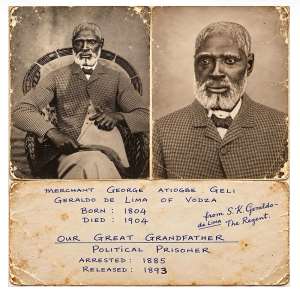
What do we really know about the man whose story crossed slavery, African entrepreneurship, Anlo politics, British colonial expansion and the chambers of the British Parliament?
Few nineteenth-century West Africans left behind a historical record as complicated and as revealing as Geraldo de Lima.
To some colonial officials, he was a dangerous intriguer and a threat to British authority. To historians of African economic history, he was an exceptionally powerful indigenous merchant. To Anlo history, he was a political actor whose influence extended far beyond commerce. And to modern scholars, his life provides an extraordinary window into how Africans navigated the violent transformation of the West African coast from the era of the slave trade to the age of European colonial rule.
Yet perhaps the most fascinating fact about Geraldo de Lima is this:
Geraldo de Lima was apparently not his original name.
According to historian D. E. K. Amenumey, his original name was Adzoviehlo Atiogbe, and he was born at Agoué, then in Dahomey and today in the Republic of Benin, around 1804. A later medical report cited by Amenumey gave his age in 1892 as about 80, meaning that the precise year of his birth remains uncertain.
That immediately raises a question that deserves much more attention:
If the man later remembered as Geraldo de Lima was born Adzoviehlo Atiogbe in what is now Benin, why has his story become so deeply embedded in the history of Ghana's Anlo-Ewe people?
The answer takes us into one of the most complicated chapters of West African history.
WHO WAS GERALDO DE LIMA?
Adzoviehlo Atiogbe appears to have begun life far removed from the enormous commercial and political power he would later acquire.
Amenumey's seminal 1968 study, “Geraldo de Lima: A Reappraisal,” published in the Transactions of the Historical Society of Ghana, describes him as an Ewe trader whose career became extraordinarily important in the history of the Gold Coast after 1850. Amenumey argued that de Lima was one of the few nineteenth-century Ewe personalities about whom sufficient documentary evidence exists to reconstruct a substantial career.
His transformation began in the 1850s.
He entered the service of Cosar/Cesar Cerquira Geraldo de Lima, a Brazilian-associated slave trader operating from Vodza in Anlo. When his employer died in 1862, Adzoviehlo Atiogbe took over the man's business and adopted his name.
In other words, the name “Geraldo de Lima” was inherited rather than his birth identity.
That fact alone challenges the simplistic way African history is sometimes presented.
Names, identities and social status in nineteenth-century West Africa were not always fixed categories. Individuals could move between identities, commercial networks and political communities.
A scholarly study of slavery and memory in southeastern Ghana describes de Lima as an example of a person who became deeply incorporated into Anlo society despite his outsider origins.
BUT WHERE WAS HE REALLY FROM?
This is where the historical record becomes particularly interesting.
Birthplace: Agoué, in present-day Benin.
Original name: Adzoviehlo Atiogbe.
Ethnic/cultural association: Ewe/Anlo.
Major sphere of activity: The Anlo coast and the lower Volta region, particularly areas around Vodza, Anyako, Keta and the Keta Lagoon.
So was Geraldo de Lima Ghanaian?
Strictly speaking, not in the modern national sense.
Ghana did not exist as a nation-state during his lifetime. The modern Republic of Ghana emerged in 1957, more than four decades after his death.
He lived during the period when the territory now divided among Ghana, Togo and Benin was made up of numerous African states, kingdoms, communities and European spheres of influence.
The Encyclopaedia Africana describes him as an Ewe who developed a commercial empire stretching from the lower Volta area in present-day southeastern Ghana to Grand-Popo in present-day Benin.
So the question “Was Geraldo de Lima Ghanaian?” needs historical precision.
He was not Ghanaian by modern citizenship.
But his life became profoundly connected with Anlo and the Gold Coast, and historians have consequently treated him as an important figure in Ghanaian and Ewe history.
That distinction matters.
AND WHO WERE HIS PARENTS?
Here the responsible answer is uncomfortable:
The reliable historical sources I found do not identify the names of Geraldo de Lima's biological father and mother.
Amenumey specifically states that not much is known about his early life and identifies his original name as Adzoviehlo Atiogbe.
This is an important point because historical writing sometimes turns uncertain oral traditions into apparently established facts.
There is currently no sufficiently reliable primary or scholarly source in the material reviewed that allows us to say:
“His father was X and his mother was Y.”
We should therefore resist inventing parents simply to complete the biography.
And that absence itself raises a fascinating historical question:
Why does the historical record tell us so much about the man he became, but so little about the child he was?
Could colonial records have been more interested in his commercial activities and political threat than his family origins?
Did oral traditions preserve his ancestry differently from European records?
Did his later adoption of the de Lima name effectively obscure his earlier identity?
These are questions historians can investigate, but they should not be answered with speculation.
THE MAN WHO INHERITED MORE THAN A NAME
When Cosar Cerquira Geraldo de Lima died in 1862, historical accounts say that Adzoviehlo Atiogbe took control of his business and adopted his name.
Some historical accounts also state that he inherited substantial property and women connected with his former master's household. This aspect of his story is deeply connected to the institution of slavery and should not be romanticised.
The transformation was extraordinary.
A man who had begun as a subordinate in another person's commercial enterprise became one of the most powerful merchants on the Ewe coast.
A study of Ewe slavery and commerce describes Adzoviehlo Atiogbe as moving from a local agent of a Brazilian slave trader to one of the most influential figures in Anlo within about a decade.
His activities eventually extended beyond the slave trade into legitimate commerce, particularly palm-oil trading, while his political influence grew alongside his wealth.
This transition is extremely important.
The nineteenth-century West African economy was not simply a story of Europeans arriving and Africans becoming passive subjects.
African merchants were already sophisticated economic actors.
Research on African merchants of the Gold Coast between 1860 and 1905 identifies Geraldo de Lima among major African commercial figures operating in the region.
HIS COMMERCIAL POWER
De Lima's commercial influence was connected to the palm-oil economy and the network of coastal and inland trade routes.
The lower Volta was economically significant because it connected coastal communities to inland markets.
The expansion of British customs administration therefore created a direct conflict with merchants who had previously operated through older commercial systems.
De Lima reportedly resisted British customs duties and continued moving goods through routes that frustrated colonial enforcement.
A modern scholarly account of imperial incarceration describes him as a powerful intermediary in the palm-oil trade who sought to protect his commercial position and resisted British attempts to expand their authority into the Ewe coastal trade.
The conflict therefore wasn't simply personal.
It involved:
money + trade + taxation + sovereignty + political authority.
And that is where his story becomes much larger than the story of one merchant.
GERALDO DE LIMA AND BRITISH EXPANSION
The British were expanding their political and economic influence along the Gold Coast.
Anlo communities, however, possessed their own political structures, commercial interests and military traditions.
De Lima became one of the individuals who repeatedly stood in the path of British expansion.
Amenumey's assessment is revealing: between approximately 1864 and 1884, de Lima was deeply involved in Anlo politics and became an important factor in the region's political entanglements with neighbouring states and the British government.
British authorities consequently came to regard him as a serious problem.
The Encyclopaedia Africana records that in 1871 British forces bombarded his residence at Bodza and placed a £200 reward on his capture.
But he continued operating.
This is perhaps one of the most remarkable features of his story.
Military pressure did not immediately destroy his commercial network.
WAS HE A RESISTANCE LEADER?
This is where we must be careful.
Calling him simply a “freedom fighter” would oversimplify the evidence.
Calling him merely a “criminal” would also reproduce the colonial government's perspective without examining the wider circumstances.
The historical evidence indicates that he pursued his own commercial and political interests, while those interests frequently collided with British imperial expansion.
Cambridge's study of imperial incarceration says British officials viewed him as someone who threatened British interests and sought to frustrate British expansion.
But Amenumey's later historical reassessment places greater emphasis on understanding him as an African merchant and political actor operating within the realities of nineteenth-century Anlo.
That distinction is crucial.
He did not necessarily fight Britain because he possessed a modern nationalist ideology.
Ghanaian nationalism as we know it had not yet emerged.
He was defending economic interests, political influence, autonomy and the networks upon which his power depended.
Yet the consequences of his resistance were political.
THE TAL ETO CRISIS AND HIS ARREST
By 1884, tensions had become acute.
Geraldo was based around Anyako, and he became associated with Chief Tenge of Anyako.
A dispute involving political authority, trade routes and British influence eventually brought the confrontation to a crisis.
The British believed de Lima was connected to opposition to their authority.
In January 1885, British authorities arrested him.
But the arrest itself produced another extraordinary episode.
Chief Tenge and his supporters attempted to rescue him.
Historical accounts describe an armed confrontation in which de Lima's escort was intercepted and he was temporarily freed before British forces regained control.
The resulting conflict became associated with the Taleto War of 1885.
The episode demonstrates how one merchant could become the centre of a much broader confrontation involving chiefs, soldiers, commercial interests and an expanding colonial government.
THE STRANGE LEGAL CASE: THEY COULD NOT PROVE THE CRIME
This is perhaps the most important part of the story.
De Lima was taken to Accra to face prosecution.
But British authorities struggled to produce sufficient evidence for a criminal conviction.
Cambridge's historical account states that witnesses could not be secured and that Governor Young eventually concluded that a criminal prosecution was unlikely to succeed.
That created a profound legal dilemma.
If the authorities could not successfully prosecute him, what could they do with him?
The answer was extraordinary.
He was detained as a political prisoner.
He was imprisoned at Elmina Castle from 29 May 1885 until November 1893, according to the Encyclopaedia Africana.
And the British government's own statements eventually acknowledged the central problem.
In Parliament in 1892, the Under Secretary for the Colonies stated that Geraldo de Lima could not then be brought to trial and that the Governor had not recommended his release.
THE BRITISH PARLIAMENT EVENTUALLY ENTERED THE STORY
This brings us directly to the Hansard material you supplied.
On 27 May 1892, the British House of Commons discussed the case.
Mr. Patrick O'Brien, speaking on behalf of Mr. John O'Connor, raised the matter of Geraldo de Lima.
He referred to a letter de Lima had published in the African Times.
De Lima claimed that he had recommended loyalty to Britain to the Awoonahs and their king despite the treatment he had received.
He also rejected the accusation that he was a slave dealer in the same sense as his former master, claiming that after his master's death his own business had been based on free trade.
Most importantly, he said:
“I do not know on what charge I was deported to Accra. I was never tried at all.”
The parliamentary question then raised claims that de Lima had a £5,000 claim against the British Government, that his property and business had deteriorated during his imprisonment, and that he had not been permitted to see his family after being deported to Accra.
Baron H. de Worms responded that de Lima's statements were “entirely ex parte” and said the Colonial Office had no information confirming the alleged £5,000 claim.
Nevertheless, the Governor was to be asked for a report and whether he could recommend de Lima's release.
This is an extraordinary historical moment.
A man detained in a British colony had become the subject of debate inside the British Parliament itself.
THE EVEN MORE SHOCKING 17 MAY 1892 PARLIAMENTARY RECORD
Ten days earlier, the House of Commons had already discussed political prisoners on the Gold Coast.
John O'Connor specifically asked whether Geraldo de Lima was still imprisoned after a murder charge against him had not been substantiated.
The government's response was startling.
It said de Lima was still detained, that he could not then be brought to trial, and that the Governor could not recommend his release.
The British government further acknowledged that there were political prisoners against whom no charge had been brought before the courts, explaining that colonial authorities considered detention necessary for the safety and order of the colony.
It also stated that there were no legal means at the Gold Coast for testing the legality of such detention under the circumstances being discussed.
That statement deserves to be remembered.
Because the question was no longer merely:
Was Geraldo de Lima guilty?
It became:
Can a government imprison a person indefinitely when it cannot successfully bring him to trial?
WHAT DID BRITISH OFFICIALS THINK OF HIM?
British colonial officials clearly regarded de Lima as dangerous.
In Parliament in May 1892, Baron de Worms referred MPs to an 1885 Blue Book and described de Lima as a “dangerous character.”
But historians have since complicated that picture.
Amenumey argued that colonial histories often treated de Lima unfavourably because he had resisted British expansion and had earlier associations with the slave trade. His own 1968 article was explicitly framed as a “reappraisal.”
This creates two historical portraits:
The colonial portrait:
A dangerous intriguer obstructing British authority.
The African historical portrait:
A powerful Ewe merchant whose wealth and political influence enabled him to resist colonial expansion.
Neither should simply be accepted without examining the evidence.
THE GREAT CONTRADICTION OF GERALDO DE LIMA
Here lies one of the most uncomfortable parts of his biography.
De Lima himself tried to distance his activities from the slave trading of his former master.
Yet historical scholarship also connects his early career to a slave-trading environment, and sources differ in how they characterise his own involvement.
Some later accounts describe him as participating in the slave trade; others emphasise his later involvement in legitimate commerce and political resistance.
Therefore, it would be historically irresponsible to turn him into either a hero or villain without qualification.
His story belongs to a much more complicated history in which:
Africans were simultaneously victims, traders, intermediaries, political actors, resisters and beneficiaries of systems that were themselves exploitative.
That is precisely why his life deserves serious study.
DID HE HAVE AN INFLUENCE IN BRITAIN?
Not in the conventional sense.
There is no evidence that Geraldo de Lima became a major political figure in Britain or exercised influence over British policy as an individual.
But his case reached the British political system.
His imprisonment was debated in the House of Commons in 1892 and remained part of parliamentary questioning into 1893. In March 1893, MPs were still asking whether de Lima and other political prisoners had been released or brought to trial. The government reported that five Gold Coast political prisoners remained detained.
So his influence in Britain was indirect but historically significant.
His imprisonment became evidence in a larger debate about colonial government, arbitrary detention and the limits of imperial power.
AND WHAT WAS HIS INFLUENCE IN GHANA?
His influence was considerable within the historical development of the Anlo area.
He was:
a major merchant;
an intermediary in regional commerce;
a political actor;
an ally of influential chiefs;
an opponent of aspects of British expansion;
a participant in conflicts surrounding trade and political authority;
and eventually a colonial political prisoner.
Scholars of African entrepreneurship continue to identify him among significant African merchants of the Gold Coast.
His story also demonstrates that indigenous African commercial power existed before formal colonial rule consolidated itself.
That is important for understanding Ghanaian history.
Colonialism did not enter an economic vacuum.
It entered societies that already possessed merchants, markets, political authorities, taxation systems, military organisations and international trading connections.
BUT HERE IS THE QUESTION GHANA SHOULD ASK
Why is a man who appears in British parliamentary records, Ghanaian historical scholarship, studies of African entrepreneurship, histories of slavery and studies of colonial detention not more widely known among Ghanaians?
Why is Geraldo de Lima not a household name?
Why do many Ghanaians know the names of European colonial officials but know comparatively little about African merchants who negotiated, resisted and sometimes collaborated with those officials?
And perhaps the most uncomfortable question:
How much of Ghana's history was written from the perspective of the colonial administrator rather than the African participant?
THE IDENTITY QUESTION IS EVEN DEEPER
Geraldo de Lima's life challenges modern ideas of nationality.
He was born in territory that is now Benin.
He was culturally connected to the Ewe world.
He became deeply embedded in Anlo.
His commercial operations crossed what are today Ghana, Togo and Benin.
He acquired the name of a Brazilian-associated slave trader.
He became an important Gold Coast merchant.
He was imprisoned by the British.
And his case was debated by British MPs in London.
So where does he belong?
Benin? Ghana? Anlo? Ewe history? West African history? Atlantic history?
Perhaps the correct answer is:
all of them but none exclusively.
The borders that define modern Ghana, Togo and Benin did not define his world.
THE NAME “DE LIMA” DESERVES ITS OWN INVESTIGATION
There is another historical mystery.
How many African identities were transformed by the Atlantic slave trade?
De Lima's case demonstrates that names could travel from Brazil to West Africa and become attached to Africans who subsequently built their own wealth and influence.
The name that originally belonged to the Brazilian-associated trader became the name by which his former servant entered history.
This is more than a curiosity.
It raises a profound question about identity after slavery:
When an African appropriated the name of a slave trader and subsequently became a powerful African merchant, was he erasing his past, inheriting power, strategically reinventing himself or doing all three?
There is no simple answer.
THE LEGACY OF A MAN WHO WAS BOTH PRODUCT AND CHALLENGER OF HIS ERA
Geraldo de Lima cannot comfortably be placed into a single category.
He emerged from a society deeply affected by the Atlantic slave economy.
He worked within a slave-trading commercial network.
He inherited the business of his former master.
He became a wealthy African merchant.
He participated in legitimate commerce.
He built relationships with Anlo political authorities.
He resisted British expansion.
He became the target of British military and administrative action.
He was arrested.
He was not successfully prosecuted.
He was detained as a political prisoner.
And eventually, his case reached the British Parliament.
According to the Encyclopaedia Africana, he was released from imprisonment in 1893, later became blind, and died in 1912 from injuries following a fall.
THE QUESTIONS HISTORY HAS NOT FINISHED ANSWERING
The story of Geraldo de Lima should not end with the question of whether he was a hero or villain.
Much more important questions remain.
1. Who were his biological parents?
The available scholarship does not provide their names. Why has this part of his biography remained so obscure?
2. What exactly happened to his original family?
If Adzoviehlo Atiogbe became Geraldo de Lima, what happened to the Atiogbe identity and family line?
3. How much wealth did he actually control?
Was his commercial empire comparable to the major African merchant houses of the Gold Coast?
4. How much of his wealth came from slavery and how much from legitimate commerce?
This question deserves rigorous archival research rather than assumptions.
5. Was British opposition to him primarily political, economic or security-related?
The evidence suggests that all three dimensions were involved.
6. If the British could not secure enough evidence to prosecute him, why was he detained for years?
That is perhaps the central legal question raised by his story.
7. How many other Africans experienced similar detention?
Hansard itself shows that Geraldo was not an isolated case.
8. Why did his case reach Parliament?
Who inside Britain was advocating for colonial prisoners?
9. Did his imprisonment destroy an African commercial empire?
Historical sources say his commercial and political position was severely damaged.
10. What would Anlo's economic history have looked like if men such as Geraldo de Lima had been allowed to develop without colonial restrictions?
That question cannot be answered with certainty but it is worth asking.
THE BIGGER LESSON FOR GHANA AND THE WORLD
The story of Geraldo de Lima is ultimately not simply about one man.
It is about who gets to write history.
For generations, colonial records often described African actors according to how they appeared from the viewpoint of colonial administration.
A person resisting British authority could become a “dangerous character.”
A trader avoiding colonial customs could become a “smuggler.”
A political opponent could become an “intriguer.”
But historians must ask another question:
What did that same person look like from the African side of the story?
That does not mean reversing the judgment and declaring every opponent of colonialism a hero.
It means investigating the evidence from multiple perspectives.
And that is precisely why Geraldo de Lima deserves renewed attention.
CONCLUSION: GERALDO DE LIMA WAS MORE THAN A NAME IN HANSARD
The 27 May 1892 Hansard debate is remarkable because it gives us something rare: the voice of a nineteenth-century African detainee entering the British parliamentary record through his own written appeal.
But the deeper story goes far beyond Parliament.
Geraldo de Lima began life as Adzoviehlo Atiogbe, reportedly born around 1804 at Agoué in present-day Benin.
He entered the service of Cosar Cerquira Geraldo de Lima.
After his master's death, he assumed the man's name and commercial interests.
He became an influential merchant in the Anlo world.
He accumulated wealth and political influence.
He resisted aspects of British expansion.
He became entangled in conflict involving Anlo chiefs and British authorities.
He was arrested in 1885.
The authorities struggled to prosecute him.
He was instead detained as a political prisoner.
And his case eventually reached the floor of the British House of Commons.
His life therefore sits at the intersection of Africa, slavery, capitalism, identity, colonialism, resistance, law and political power.
Perhaps the greatest lesson is not whether Geraldo de Lima should be remembered as a hero or villain.
It is that history becomes dangerous when we reduce complicated Africans to simple labels created by the powerful.
And perhaps the question Ghana and the wider world should now ask is this:
How many Geraldo de Limas are still missing from our textbooks because nobody has gone back far enough to ask who they really were?
By:
Patrick Belebang Yagsori
0240292413
[email protected]

 'Suing me won’t gag me, what did you do for NDC to continue to keep you in offic...
 'Ghana is now training lawyers illegally' — Former Bar president
 Akyem Hemang residents demand justice for alleged military shooting of 29-year-o...
 Adenta-Accra morning travel time improves significantly in just 23 minutes under...
 US 'steals' Bawumia’s idea, launches America.gov for public services five years ...
 “Disband Black Stars, sack FA and let FIFA ban us for two years” – Sam George af...
 South Africa summons US ambassador for 'record' third time
 Dangote to launch $16bn refinery in Kenya
 Ghana, Luxembourg to explore visa waiver agreement
 Tullow loses $393m tax arbitration case against Ghana – Finance Minister


