




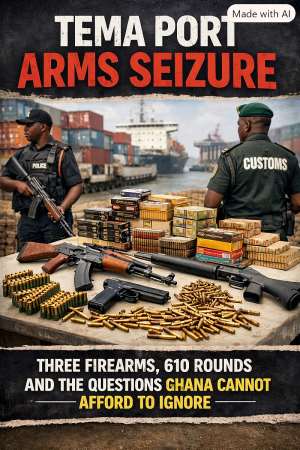
The interception of an assault rifle, two pistols and 610 rounds of ammunition at Ghana’s Tema Port is not merely another Customs seizure. It raises a much bigger question about who is attempting to move weapons into Ghana, who was supposed to receive them, whether the weapons had any legitimate purpose, and most importantly whether anyone attempted to use political or personal influence to facilitate their entry.
At present, however, there is an important distinction between what has been officially established and what is being alleged or circulated.
The Ghana Revenue Authority has confirmed the seizure. But the publicly available official accounts do not yet identify the importer, consignee, sender, the exact models/calibres of the firearms, any telephone caller who allegedly directed a Customs officer, or any proven relationship between the importer and Interior Minister Muntaka Mohammed-Mubarak. Those details should not be presented as established facts until investigators or a court place them on record.
That distinction matters.
Because when firearms are involved, speculation can be dangerous but so can unanswered questions.
THE SEPTEMBER 25 DISCOVERY: WHAT ACTUALLY HAPPENED?
According to the Ghana News Agency and the Ghana Revenue Authority, the seizure occurred on Friday, September 25, 2026, at about 5:15 p.m. at the Golden Jubilee Terminal of the Tema Port.
Two Customs officers conducting a routine inspection subjected a consignment to further examination.
What they discovered was significant:
One assault rifle
Two pistols
610 rounds of ammunition
Other firearm-related accessories
The weapons and ammunition were concealed among items described as personal effects arriving from the United States.
Crucially, the firearms and ammunition had not been declared to Customs.
The items were subsequently handed over to the Ghana Police Service for further investigation.
That is the verified foundation of the story.
Everything else must be tested against evidence.
BUT WHAT KIND OF ASSAULT RIFLE?
This is one of the first questions investigators should answer.
The official GRA account describes the weapon only as an “assault rifle.” It does not publicly specify whether it was an AK-pattern rifle, AR-platform rifle, or another type.
Likewise, the public statement does not identify the make, model or calibre of the two pistols or the calibre of the 610 rounds.
That information is important.
Why?
Because 610 rounds of ammunition accompanying three firearms is not an incidental detail. Investigators should establish exactly what ammunition was found and which firearm each category of ammunition corresponds to.
Were all 610 rounds compatible with the three weapons?
Were there different calibres?
Were the magazines loaded?
Were serial numbers intact?
Were the firearms new or previously used?
Were they legally purchased in the United States?
Were they exported from the United States with the required authorization?
And who purchased them?
These are not sensational questions. They are basic questions in tracing the origin and intended destination of firearms.
THIS IS NOT THE FIRST TIME TEMA PORT HAS SEEN A WEAPONS SHIPMENT
The September 2026 seizure becomes even more significant when placed against Ghana's recent history.
In November 2024, Customs intercepted a 40-foot container arriving from the United States that had been declared to contain vehicles and personal effects.
Inside three suitcases, officers discovered:
53 pistols, 74 magazines and 65 rounds of live ammunition.
The weapons were concealed inside the container.
The agent and consignee's representative were arrested and interrogated, while the shipment was detained for further investigation.
There was also an earlier major interception involving a U.S.-origin shipment in 2021. Subsequent reporting has described that shipment as containing nine pistols, eight assault rifles and 219 rounds of ammunition, concealed among household items.
So the September 2026 seizure cannot simply be viewed in isolation.
It raises a broader national-security question:
How many firearms have successfully entered Ghana through ports without being detected?
Customs can only report what it catches.
The more difficult question is what it does not catch.
WHAT DID CUSTOMS OFFICERS DO BEFORE SEIZING THE WEAPONS?
The official account is revealing.
The officers were conducting a routine inspection.
They subjected the consignment to further examination, which led to the discovery.
The GRA says its intensified scanning and physical examination regime is designed to identify prohibited and restricted goods that might otherwise pass through ordinary inspection.
But that raises another question:
Why did the consignment require further examination?
Was there something unusual on the scanner?
Was the packaging inconsistent with the declaration?
Was the density of the contents suspicious?
Was there intelligence information?
Or was the discovery simply the result of a Customs officer deciding to look more closely?
The public deserves to know because the answer tells us something about whether Ghana's port security system is intelligence-led, technology-led or dependent on individual vigilance.
WHO ARE THE PEOPLE BEHIND THIS SHIPMENT?
This is where the story becomes incomplete.
As of the latest official/public reports I found, the GRA has not publicly named the importer, consignee, sender, Customs agent or any person arrested in connection with the September 2026 firearms seizure.
That means names circulating elsewhere should be treated carefully.
It would be irresponsible to attach an individual's name to the shipment merely because that person allegedly knows a politician or appears in an unverified social-media claim.
But investigators should establish:
1. Who shipped the consignment?
2. Who paid for the firearms?
3. Who purchased them?
4. Who was the consignee in Ghana?
5. Who was the Customs declarant or clearing agent?
6. Who prepared the import documentation?
7. Who knew that firearms were inside the shipment?
8. Who selected “personal effects” as the declaration?
9. Who was supposed to take possession of the weapons after clearance?
10. Was anyone in Ghana expecting the weapons?
Those answers should be traceable through shipping records, Customs declarations, ICUMS records, payment records, CCTV, telephone records and statements from the people involved.
AND THEN COMES THE INTERIOR MINISTER'S NAME
This is perhaps the most politically sensitive part of the allegations.
The current Interior Minister is Mohammed-Mubarak Muntaka.
And there is an important documented fact that cannot be ignored: firearms regulation falls within the Interior Ministry's responsibilities.
The Ghana Police Service's Central Firearms Registry says it is responsible for registering and licensing firearms and liaises with the Ministry of the Interior on the control of imports and exports of arms and ammunition. For applications to import or export arms and ammunition, the application is submitted to the Minister responsible for the Interior for approval or otherwise.
The Ghana Revenue Authority similarly identifies arms and ammunition as restricted goods requiring a permit from the Ministry of the Interior.
So if an individual allegedly tells somebody:
> “The Interior Minister will licence it for me,”
that statement deserves investigation.
But it does not, by itself, establish that the Interior Minister agreed to licence anything.
That distinction is absolutely critical.
WHY WOULD SOMEONE INVOKE THE INTERIOR MINISTER'S NAME?
This may be one of the most important questions in the entire matter.
Suppose investigators establish that a person involved in the shipment genuinely said that the Interior Minister would approve or licence the weapons.
There are several possibilities.
Perhaps the individual genuinely had a legitimate relationship with the Minister.
Perhaps the individual misunderstood the licensing procedure.
Perhaps the name was being used to create the impression of political protection.
Perhaps somebody was attempting to influence a Customs officer.
Or perhaps the Minister actually had prior knowledge of the transaction.
These possibilities are not equivalent, and only evidence can distinguish them.
That is precisely why the telephone records, messages, licensing documents and statements of the people involved matter.
DID THE INTERIOR MINISTER KNOW THE PEOPLE INVOLVED?
This is another question that requires evidence not assumptions.
Being photographed with someone, attending the same event, belonging to the same political network, or knowing someone socially does not establish complicity in an alleged offence.
But if investigators establish that an importer was a close personal associate of the Minister, then the relationship becomes relevant not because friendship proves wrongdoing, but because investigators would need to determine whether the relationship was ever used to influence an official process.
The questions should therefore be very specific:
How long have they known each other?
How did they meet?
How frequently do they communicate?
Have they travelled together?
Have they conducted business together?
Has the individual previously sought assistance from the Minister?
Did the individual ever discuss firearms with the Minister?
Did the Minister ever communicate with Customs officers concerning the consignment?
Did the Minister or anybody claiming to represent him contact the importer?
Was any licensing application submitted to the Interior Ministry?
And perhaps the most important:
Is there an actual documentary trail showing that the Minister was involved or is his name simply being used?
THE TELEPHONE CALL: WHO WAS TALKING TO THE CUSTOMS OFFICER?
This is potentially one of the most consequential allegations but I have not found a credible public source confirming that such a telephone call occurred in connection with this September 25 seizure.
If there was indeed a call in which somebody spoke to a Customs officer and allegedly gave instructions about releasing or handling the consignment, investigators should establish:
The caller's identity.
The recipient's identity.
The time of the call.
The duration.
The telephone numbers involved.
Whether the call was recorded.
Whether WhatsApp or another messaging platform was involved.
Whether the caller claimed to represent the Interior Minister.
Whether the caller mentioned a licence or permit.
Whether the Customs officer acted differently after receiving the call.
And one question towers above the rest:
Who gave the Customs officer authority to follow those instructions?
If the caller was merely a private individual, why would a Customs officer obey?
If the caller claimed to be an official, which official?
If the caller claimed to speak for the Interior Minister, did the Minister actually authorise that communication?
And if the Minister denies knowing anything about the shipment, who was using his name and why?
These are questions that can be answered through telephone records and witness statements not political arguments.
WHO ACTUALLY LICENCES FIREARMS IN GHANA?
This requires some clarification because public discussion often oversimplifies the process.
The Ghana Police Service's Central Firearms Registry says it has responsibility for the registration and licensing of firearms within Ghana. The Police also maintain the records of licensed firearms and firearm owners.
At the same time, importation is a separate regulatory question.
The Arms and Ammunition Act requires prior authorisation for importing or exporting firearms and ammunition, while the Ministry of the Interior is identified as the responsible institution for the relevant import permit.
The distinction is therefore important:
A permit to import a firearm is not simply the same thing as a licence to possess one.
The Police licensing/registration process and the Interior Ministry's role in import/export authorisation operate within the wider firearms-control framework.
That makes the alleged statement “the Minister will licence the weapons” particularly interesting.
What exactly did the speaker mean by “licence”?
Did he mean:
permission to import?
registration?
possession?
transfer?
renewal?
or simply political influence?
Investigators should establish exactly what was meant.
THE INTERIOR MINISTER'S OWN RECORD MAKES THIS QUESTION EVEN MORE IMPORTANT
There is another remarkable part of this story.
In March 2026, Muntaka publicly said he had slowed down the issuance of firearm licences because he had found the previous process too easy.
Then, in June 2026, he announced reforms requiring firearm holders and applicants to undergo measures including mental-health assessment, drug screening and competency training. Existing permits were revoked as part of the revised registration process.
The Minister had therefore publicly positioned himself as someone seeking tighter firearm controls.
That creates an obvious question:
If somebody was allegedly importing firearms without declaring them, why would that person believe the Interior Minister would simply “licence” them?
Was this based on an actual prior conversation?
Was it merely name-dropping?
Was the individual confused about the law?
Or did somebody give him a reason to believe that political access could overcome regulatory requirements?
Again, the evidence must answer this.
THE 610 ROUNDS: THE QUESTION THAT SHOULD NOT BE LOST
Much attention will understandably focus on the assault rifle.
But the 610 rounds of ammunition may be equally important.
Why?
Because ammunition establishes another dimension of intent.
Investigators should determine:
What calibres were the 610 rounds?
How many were rifle rounds?
How many were pistol rounds?
Which weapons were they intended for?
Were the rounds manufactured by the same company?
Where were they purchased?
Were they legally exported from the United States?
Who paid for them?
Was there an import permit?
Why were they concealed?
And perhaps the most basic question:
If the weapons were genuinely being imported for a legitimate purpose, why were they not declared?
The answer could become central to the investigation.
WHAT DID THE IMPORTER EXPECT TO HAPPEN?
There is another question that deserves serious attention.
A person does not normally ship hundreds of rounds of ammunition across international borders accidentally.
So investigators should reconstruct the journey.
Who packed the shipment?
Who knew what was inside?
Who prepared the inventory?
Who declared it as personal effects?
Who received the shipping documents?
Who was waiting in Ghana?
Was there a warehouse or destination address?
Was the consignee aware of the firearms?
Were the weapons intended for personal security, commercial security, political activity, criminal activity, or another purpose?
Only a proper investigation can answer these questions.
THE CUSTOMS OFFICERS DESERVE ANOTHER QUESTION TOO
The two Customs officers who detected the weapons are important witnesses.
Investigators should obtain their complete accounts.
What did they initially see?
What caused them to order further examination?
Did anybody attempt to interfere?
Did anybody ask them to stop?
Did anyone approach them after the discovery?
Were they contacted by telephone?
Were they pressured?
Did anyone identify himself as a government official?
Was there any instruction to release the goods?
Were the officers threatened, persuaded or offered anything?
The integrity of the investigation depends partly on answering these questions.
GHANA'S PORT SECURITY PROBLEM IS BIGGER THAN ONE CONTAINER
The timing is particularly sensitive.
Ghana is currently confronting major questions about the security of its ports following the seizure in France of approximately 3.9 tonnes of suspected cocaine in a container that had originated from Ghana, alongside investigations involving Customs personnel.
The firearms seizure is not the same case.
There is currently no evidence establishing that the firearms shipment and the cocaine investigation are connected.
But both incidents raise a common institutional question:
How secure are Ghana's ports against organised attempts to move restricted or illegal commodities across the country's borders?
That question is bigger than political parties.
It is a national-security question.
THE QUESTIONS THE AUTHORITIES MUST ANSWER
If the government genuinely wants to reassure the public, these are the questions that should be placed before Customs, Police and the Interior Ministry:
1. Who imported the firearms?
2. Who was the consignee?
3. Who sent the shipment from the United States?
4. What was the declared value and description of the consignment?
5. Why were the weapons not declared?
6. What exactly was the assault rifle?
7. What makes and models were the two pistols?
8. What were the calibres of the 610 rounds?
9. Were the weapons legally purchased in the United States?
10. Was there any Ghanaian import permit?
11. Was there any application to the Ministry of the Interior?
12. Who submitted that application, if one existed?
13. Was the Interior Minister personally involved in any part of the process?
14. Did the Minister know the importer?
15. Did the importer claim to have a relationship with the Minister?
16. Did anybody telephone a Customs officer concerning the consignment?
17. Who made that call?
18. What instructions were allegedly given?
19. Did the caller invoke the name of the Interior Minister?
20. Did the Customs officer act on those instructions?
21. Are there CCTV recordings covering the examination?
22. Are there ICUMS records showing every person who handled the consignment?
23. Were the weapons intended for one individual or multiple people?
24. Why would anybody believe an undeclared firearm shipment could simply be licensed after arrival?
25. If the Minister had nothing to do with the shipment, who was using his name and why?
THE MOST UNCOMFORTABLE QUESTION
Perhaps the question Ghanaian authorities should be asking is not merely:
“Who imported the guns?”
It is:
“Who did the importer believe could protect him if the guns were discovered?”
That question goes to the heart of the alleged political connection.
If the answer is “nobody,” investigators must establish why the weapons were concealed.
If the answer is “someone at the Interior Ministry,” investigators must identify that person.
If the answer is “the Interior Minister,” evidence must establish whether that belief came from an actual communication with the Minister or was simply an attempt to invoke his name.
And if the answer is “a friend of the Minister,” then the nature of that friendship becomes relevant not as proof of wrongdoing, but as a line of inquiry.
A MINISTER'S NAME IS NOT A LICENCE
This may ultimately be the most important principle arising from the controversy.
No individual's friendship with a minister should substitute for the law.
No telephone call should replace a permit.
No political connection should replace Customs declaration.
And no importer should believe that knowing a powerful person automatically transforms an undeclared shipment of firearms into a lawful consignment.
At the same time, the mere mention of Muntaka's name does not establish that he authorised, facilitated or even knew about the shipment.
That is precisely why the investigation must move beyond political accusations and establish the documentary and electronic evidence.
CONCLUSION: GHANA NEEDS ANSWERS, NOT RUMOURS
The facts currently established are already serious: one assault rifle, two pistols, 610 rounds of ammunition and related accessories were allegedly concealed among personal effects arriving from the United States and were not declared to Customs. Customs detected them during further examination and handed them to the Police.
But the unanswered questions are potentially more consequential than the seizure itself.
Who bought the weapons?
Who shipped them?
Who was waiting for them?
Why were they concealed?
Who was supposed to licence or authorise them?
Was anybody claiming access to the Interior Minister?
Did anybody telephone a Customs officer?
Did anyone give instructions?
And, above all:
Was the name of the Interior Minister merely being used or was there an actual connection between the Minister and the people behind the shipment?
Those questions should not be answered by social media.
They should be answered by Customs records, Police investigations, licensing records, shipping documents, CCTV footage, telephone evidence and, if necessary, testimony under oath.
Until that evidence is produced, the responsible position is to distinguish firmly between the firearms seizure that is confirmed and the allegations about political connections that remain to be proven.
Because when 610 rounds of ammunition enter Ghana hidden among “personal effects,” the country deserves more than a seizure announcement.
It deserves to know who wanted those weapons, why they wanted them, who was expected to authorise them and whether anyone believed that political access could make the law disappear.
By:
Patrick Belebang Yagsori
0240292413
[email protected]

 'Suing me won’t gag me, what did you do for NDC to continue to keep you in offic...
 'Ghana is now training lawyers illegally' — Former Bar president
 Akyem Hemang residents demand justice for alleged military shooting of 29-year-o...
 Adenta-Accra morning travel time improves significantly in just 23 minutes under...
 US 'steals' Bawumia’s idea, launches America.gov for public services five years ...
 “Disband Black Stars, sack FA and let FIFA ban us for two years” – Sam George af...
 South Africa summons US ambassador for 'record' third time
 Dangote to launch $16bn refinery in Kenya
 Ghana, Luxembourg to explore visa waiver agreement
 Tullow loses $393m tax arbitration case against Ghana – Finance Minister


