




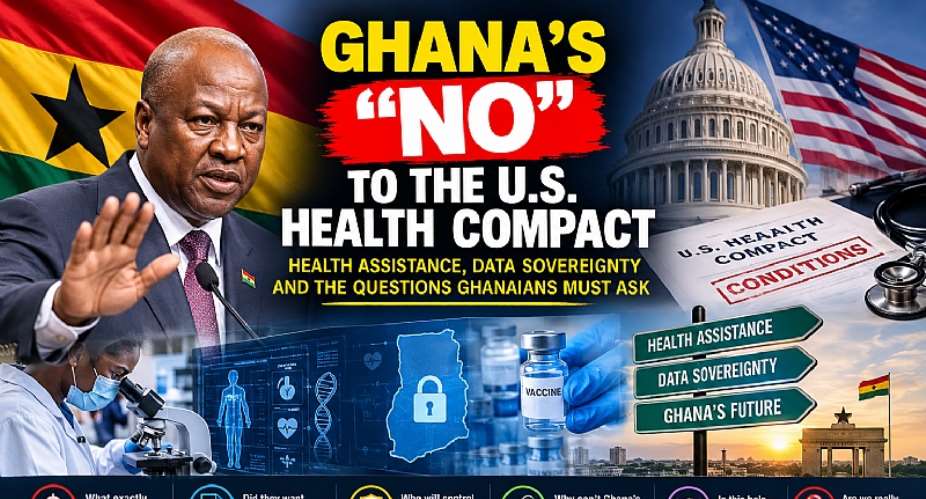
Ghana has accepted American health assistance for decades. From malaria prevention and HIV/AIDS treatment to maternal and child health, laboratory capacity and disease surveillance, U.S.-supported programmes have played a significant role in Ghana's public-health system.
So when Ghana rejected a proposed new U.S. health compact in 2026, the question was not simply “Why did Ghana reject more than $100 million in health assistance?”
The deeper question is:
What exactly was Ghana being asked to give in return?
And perhaps even more importantly:
When foreign assistance comes with access to sensitive national health information, at what point does assistance become a question of sovereignty?
That is the debate Ghana must now have.
THE LONG HISTORY OF AMERICAN HEALTH ASSISTANCE TO GHANA
The United States has been an important development partner in Ghana's health sector for many years.
Through USAID, the President's Malaria Initiative (PMI), PEPFAR and other programmes, American assistance has supported malaria prevention, HIV/AIDS treatment, maternal and child health, nutrition, disease surveillance and health-system strengthening.
USAID's own Ghana health documentation records support for malaria prevention, HIV services, maternal and newborn health, nutrition programmes, laboratory and surveillance capacity, and training of health workers.
The U.S. President's Malaria Initiative alone has invested billions of dollars across Africa since its establishment in 2005.
Therefore, it would be historically inaccurate to portray American health assistance to Ghana simply as something sinister.
There have been real programmes.
There have been real medicines.
There have been real mosquito nets.
There have been real laboratories, training programmes and health interventions.
And there have undoubtedly been Ghanaians who benefited.
But the controversy surrounding the new health compact is different.
It concerns the conditions attached to a new model of American health financing.
SO WHAT WAS THE NEW U.S. HEALTH COMPACT?
In 2026, the Trump administration began restructuring American foreign health assistance under what was described as an “America First Global Health Strategy.”
The idea was to move away from the traditional model in which the United States financed large portions of health programmes through foreign assistance and toward bilateral agreements in which recipient countries would take greater responsibility for financing and implementing health programmes.
Reuters reported that the proposed Ghana agreement would have provided approximately $109 million over five years, while requiring Ghana to assume greater responsibility for fighting diseases including HIV/AIDS, malaria, tuberculosis and polio.
In other words, the proposal was not simply:
“Here is $109 million. Spend it on healthcare.”
It came with conditions.
And that is where the controversy began.
THE DATA QUESTION THAT CHANGED EVERYTHING
When news first emerged in April that Ghana had rejected the agreement, the central issue reported was sensitive health data.
Reuters reported that Ghanaian authorities objected to provisions requiring the sharing of sensitive health information.
But President John Dramani Mahama has now provided considerably more detail.
Speaking at the Council on Foreign Relations in New York on September 25, 2026, Mahama said Ghana's Ministry of Health examined the compact before submitting it to Cabinet.
According to the President, several provisions were flagged.
Among them were requirements concerning:
Ghana's pathogen profile;
Ghanaian medical records;
Ghana's financial contribution to the programme; and
the inspection of medicines and medical products entering Ghana under the programme.
Mahama said the medical-record and pathogen provisions were particularly troubling and questioned why another country would require another country's medical records.
The President also said the proposed arrangement would have restricted Ghana's Food and Drugs Authority from inspecting medicines or medical products supplied under the programme.
Those are substantially different questions from whether Ghana needs American help fighting malaria or HIV.
BUT WHY WOULD THE UNITED STATES WANT PATHOGEN INFORMATION?
This is where the discussion needs to become more sophisticated.
There is a legitimate global-health reason for countries to share pathogen information.
Diseases do not respect borders.
A new virus emerging in Ghana today could potentially reach Nigeria tomorrow, Europe next week and North America later.
Scientists therefore use pathogen surveillance and genomic information to identify mutations, track outbreaks and develop diagnostics, treatments and vaccines.
The World Health Organization explicitly says that timely sharing of pathogen genetic information and materials is important for detecting and responding to epidemics and pandemics.
The WHO's Pandemic Agreement negotiations are also built around a proposed Pathogen Access and Benefit-Sharing (PABS) system, under which countries would share pathogen materials and sequence information while also receiving fair and equitable benefits from resulting vaccines, diagnostics and therapeutics.
So pathogen data itself is not inherently suspicious.
There is a genuine public-health rationale.
But there is another question.
WHO GETS THE DATA?
WHO CONTROLS IT?
WHO CAN USE IT?
FOR HOW LONG?
CAN IT BE SHARED WITH THIRD PARTIES?
WHO OWNS THE RESULTING RESEARCH?
AND IF A VACCINE OR MEDICINE IS DEVELOPED FROM INFORMATION OR MATERIAL ORIGINATING IN GHANA, DOES GHANA RECEIVE FAIR ACCESS?
Those questions are not paranoid questions.
They are governance questions.
Indeed, the international debate surrounding pathogen-sharing exists precisely because developing countries have previously worried that they could provide biological information while wealthier countries capture most of the commercial and technological benefits.
The WHO's emerging PABS framework specifically attempts to address that problem through equitable benefit-sharing.
BUT MEDICAL RECORDS ARE A DIFFERENT MATTER
There is an important distinction between:
population-level public-health information
and
individual medical records.
Information showing that malaria cases increased in a particular region is one thing.
An identifiable person's:
HIV status,
medical history,
genetic information,
treatment history,
diagnosis,
medication,
reproductive-health information,
laboratory results,
is something else entirely.
Ghana's Data Protection Act treats certain categories of information as special personal data, with additional protections. The law provides specific conditions surrounding the processing of such information, including medical purposes and confidentiality obligations.
That makes the question raised by the Ghanaian government particularly serious.
If the United States genuinely needs information to help Ghana fight diseases, does it need identifiable medical records of Ghanaian citizens or does it need appropriately aggregated, anonymised public-health information?
Those are not the same thing.
DOES THIS MEAN THE U.S. WANTED EVERY GHANAIAN'S MEDICAL FILE?
Here we must be careful.
Public reporting and President Mahama's explanation indicate that the compact contained provisions concerning medical records.
But that does not, by itself, establish that Washington intended to obtain the complete medical file of every Ghanaian citizen.
The exact technical scope, categories, safeguards, retention periods, permitted uses and access mechanisms would need to be established from the actual agreement.
And this is precisely why transparency matters.
If the agreement is harmless, why shouldn't the public see exactly what was being requested?
If the information was intended only for legitimate disease surveillance, why not clearly define:
what data, whose data, in what format, under whose control and for what purpose?
DOES THE UNITED STATES HAVE “EVIL INTENTIONS”?
This is perhaps the most provocative question.
But it is also the question that requires the greatest discipline.
There is no evidence presented in the sources reviewed that establishes that the United States intended to biologically manipulate Ghanaian citizens, weaponise Ghanaian health data or deliberately cause disease in Ghana.
That conclusion would go far beyond the available evidence.
And there is an important reason not to make such an accusation without evidence.
The United States itself has enormous health-data systems, and American health institutions routinely use disease and genomic information for legitimate research, surveillance and medical development.
So the stronger question is not:
“Is America secretly planning to harm Ghanaians?”
The stronger question is:
“What legal and technical safeguards would prevent sensitive information obtained for legitimate health purposes from being misused now or in the future?”
That is a question any sovereign government should be willing to ask.
DATA CAN BE MORE POWERFUL THAN MONEY
This is perhaps the part of the debate that many ordinary citizens have not considered.
Money can be spent.
A hospital can be built.
Medicine can be consumed.
But data can remain valuable for decades.
Health data can reveal population vulnerabilities, disease patterns, genetic characteristics, health behaviours and emerging biological threats.
In the age of artificial intelligence, big-data analytics and advanced biotechnology, information has become a strategic resource.
That does not mean every request for health information is malicious.
It means the governance surrounding the information matters enormously.
The world learned this during COVID-19.
The WHO's post-COVID negotiations specifically acknowledge the need for faster pathogen sharing while simultaneously addressing questions of fairness, sovereignty and equitable access to resulting medical products.
So Ghana's concern cannot simply be dismissed as anti-Americanism.
Nor can every American request automatically be interpreted as hostile.
The real issue is whether the terms were sufficiently fair, transparent and protective of Ghanaian interests.
AND THEN THERE WAS THE FDA QUESTION
This may actually be one of the most consequential issues in the entire controversy.
President Mahama said the proposed compact would have meant that Ghana's Food and Drugs Authority would have no right to inspect medicines or medical products brought into Ghana under the programme.
If accurately reflected in the proposal, that raises an obvious question:
Why would Ghana receive medicines that its own regulator could not inspect?
A country may welcome foreign assistance while still insisting that imported medicines meet its own safety standards.
This is not merely about sovereignty in the abstract.
It is about the safety of the patient who eventually receives the medicine.
What happens if a product is defective?
What happens if a batch is contaminated?
What happens if a medicine is improperly stored?
What happens if Ghana's regulator identifies a safety problem?
Who has the final authority?
These are questions that deserve answers before not after a health agreement is signed.
GHANA WAS ALSO EXPECTED TO CONTRIBUTE MONEY
There is another element that complicates the language of “aid.”
According to Mahama, the proposed compact required Ghana to put a specified amount of its own money into healthcare.
That raises an uncomfortable but legitimate question:
If Ghana is providing counterpart funding while also surrendering certain regulatory or data rights, what exactly is the nature of the transaction?
Is it:
aid?
A partnership?
A co-investment?
A contractual exchange?
Or a new model of conditional assistance?
The terminology matters because expectations matter.
If two sovereign governments are entering a negotiated partnership, both sides should be able to identify clearly what each is contributing and what each is receiving.
IS THIS HELP OR BLACKMAIL?
That is perhaps the most emotionally powerful question being asked.
But “blackmail” has a specific meaning and should not be casually applied.
There is currently insufficient evidence to establish that the United States was blackmailing Ghana in the legal or criminal sense.
What can legitimately be examined is whether linking essential health financing to controversial conditions creates undue leverage over a recipient country.
That is a real policy question.
If a country desperately needs malaria medicines, HIV treatment or maternal-health support, how freely can it negotiate when the alternative is losing critical funding?
That is the uncomfortable power imbalance at the centre of international aid.
And it is not unique to America.
Aid relationships throughout history have sometimes involved political, economic, strategic and institutional interests alongside humanitarian objectives.
Therefore, Ghana should not ask only:
“Is America helping us?”
It should also ask:
“What does America gain from helping us, and are both sides gaining fairly?”
WHAT HAS THE UNITED STATES SAID?
The U.S. position, as reported during the negotiations, was not publicly presented as an admission of wrongdoing.
When Reuters asked about the Ghana negotiations in April, the U.S. State Department said it did not disclose details of bilateral negotiations.
That leaves an information gap.
Ghana has now publicly explained several of its objections.
But the public would benefit from hearing the American government's detailed explanation of:
1. Why pathogen information was required;
2. What categories of health data were sought;
3. Whether identifiable medical records were contemplated;
4. How the information would be protected;
5. Who could access it;
6. How long it would be retained;
7. Whether it could be transferred to private companies;
8. Whether Ghana would retain ownership and control;
9. What benefit Ghana would receive from research based on the information; and
10. Why Ghana's FDA would allegedly be restricted from inspecting supplied medical products.
Those are reasonable diplomatic questions.
AND GHANA IS NOT THE ONLY COUNTRY ASKING QUESTIONS
Ghana's concerns did not emerge in isolation.
Reuters reported that similar data-sharing concerns disrupted U.S. health negotiations with Zimbabwe and affected Kenya's agreement.
The Africa CDC's Director-General Jean Kaseya has also raised concerns about pathogen and data-sharing provisions in emerging U.S. health agreements with African countries, particularly where there are insufficient guarantees that countries providing pathogen information will share equitably in the resulting medical benefits.
That makes this larger than a Ghana-U.S. disagreement.
It is becoming a debate about who owns Africa's biological and health information in the twenty-first century.
BUT DID AMERICA DO THIS TO EUROPE TOO?
This question deserves an evidence-based answer.
There is no evidence in the material reviewed establishing that the United States imposed this same type of aid-for-data arrangement on European countries in the same manner.
And there is an important structural difference.
The agreements being discussed in 2026 are principally connected to the restructuring of U.S. foreign health assistance to lower- and middle-income partner countries.
Therefore, it would be misleading to say:
“America demands medical data from Ghana but never asks Europe for anything.”
International health-data sharing occurs in many forms among wealthy countries as well.
The relevant question is whether the particular conditions imposed on aid-dependent countries create a different power relationship.
That is a much stronger and more defensible question.
GHANA'S “NO” ALSO FITS INTO A BIGGER AFRICAN DEBATE
President Mahama has increasingly promoted what he calls health sovereignty.
Ghana lost substantial health financing after the closure of USAID programmes, and Mahama has argued that Africa must strengthen domestic financing, local pharmaceutical manufacturing and vaccine production rather than remain excessively dependent on foreign assistance.
That position has historical roots.
COVID-19 exposed Africa's vulnerability.
When vaccines became available, wealthy countries were able to secure supplies before many African countries.
Mahama himself referenced this experience at the Council on Foreign Relations, arguing that Africa does not want to be at the back of the queue during the next pandemic.
So the Ghanaian position appears to be part of a broader attempt to move from:
“Africa receives health assistance.”
to:
“Africa participates as an equal partner in global health.”
BUT THERE IS ANOTHER SIDE TO THE ARGUMENT
Ghana cannot simply reject foreign assistance and assume that domestic resources will immediately replace it.
The country still faces substantial health-financing pressures.
President Mahama said Ghana lost approximately $78 million following the closure of USAID programmes, affecting malaria, maternal and child health, nutrition and HIV/AIDS programmes.
That creates a difficult policy dilemma.
If Ghana rejects conditional foreign funding:
Who pays for the programmes?
If Ghana accepts it:
What conditions is Ghana willing to accept?
And if Ghana wants genuine health sovereignty:
Where is the money going to come from?
These questions cannot be answered with patriotism alone.
They require budgets.
THE QUESTIONS GHANAIANS SHOULD NOW BE ASKING
Perhaps the biggest failure would be for this controversy to end with politicians arguing over whether Mahama was right or wrong.
The public needs the actual document or as much of it as legally can be disclosed.
And then citizens should ask:
1. What exactly did the United States ask Ghana to provide?
Not headlines.
Not political speeches.
The actual categories of data.
2. Did “medical records” mean identifiable individual records or aggregated/anonymised information?
This distinction is fundamental.
3. Who would have controlled the data?
Ghana?
The U.S. government?
American agencies?
Contractors?
Universities?
Private pharmaceutical companies?
4. Could the information have been transferred to third parties?
And if so, under what conditions?
5. How long would the United States retain the information?
Five years?
Twenty-five years?
Indefinitely?
6. What would happen if Ghana later wanted the data returned or deleted?
Would Ghana have that power?
7. If Ghanaian pathogen information contributed to a successful vaccine, would Ghana receive preferential or guaranteed access?
This question becomes especially important given the global inequities exposed by COVID-19.
8. Why should Ghana's regulator surrender inspection powers over medicines entering Ghana?
Who would protect the Ghanaian patient?
9. Why was Ghana expected to contribute its own money while accepting these conditions?
10. Would Washington accept the same arrangement if the countries were reversed?
Would the United States permit Ghana to receive American citizens' medical records in exchange for Ghanaian health assistance?
That question may reveal more than a hundred political speeches.
AND ONE QUESTION FOR GHANA ITSELF
There is also a question that should be directed at Accra:
If Ghana believes its citizens' health data are strategically valuable, why are we not investing sufficiently in our own health-data infrastructure?
Why should foreign partners possess better analytical capabilities than the country generating the data?
Why should Ghanaian researchers depend on foreign institutions to study Ghanaian disease patterns?
Why shouldn't Ghana develop world-class national health-data systems with strong cybersecurity, anonymisation, research governance and African ownership?
The ultimate objective should not merely be:
“America must not take our data.”
It should also be:
“Ghana must become capable of generating, protecting, analysing and benefiting from its own data.”
That is genuine sovereignty.
SO, IS THE UNITED STATES REALLY HELPING GHANA?
The evidence does not support a simplistic answer.
The United States has unquestionably provided substantial health assistance to Ghana over many years, including programmes addressing malaria, HIV/AIDS, maternal health, nutrition and disease surveillance.
At the same time, the proposed 2026 compact introduced conditions that Ghana considered unacceptable.
President Mahama has specifically identified concerns over pathogen information, medical records, Ghana's financial contribution and FDA inspection powers.
There is no established evidence in the sources reviewed that the United States intended to biologically manipulate Ghanaians or deliberately harm Ghana's population.
But neither does the absence of evidence of malicious intent mean that Ghana should surrender sensitive information without rigorous safeguards.
Those two propositions can exist simultaneously.
America can genuinely want to help Ghana fight disease, while Ghana can legitimately insist that its data, regulatory authority and sovereignty are protected.
That is not hostility.
That is negotiation.
THE BIGGER QUESTION: WHO OWNS AFRICA'S HEALTH FUTURE?
This controversy may ultimately prove more important than the $109 million itself.
Because the real commodity at stake may not be money.
It may be information.
The world's future health battles will increasingly depend upon data, genomics, artificial intelligence, laboratories, surveillance networks, vaccines and biotechnology.
Countries that control those assets will possess enormous scientific and strategic power.
So perhaps Ghana's most important question is not:
“Why does America want our health data?”
Perhaps it is:
“Why should anyone else control information generated by the bodies and health experiences of Ghanaians?”
And another:
“If Ghana supplies biological information that helps somebody else develop the next billion-dollar vaccine, who owns the knowledge and who gets the vaccine?”
And another:
“Can foreign assistance remain genuinely humanitarian when access to money is conditional upon access to strategic national information?”
And perhaps the hardest question of all:
If Ghana cannot afford to finance its own healthcare without foreign assistance, how sovereign is Ghana's health system in the first place?
These are questions that go beyond President Mahama.
They go beyond Donald Trump.
They go beyond USAID.
They go beyond one $109 million agreement.
They concern the future of African sovereignty in an age when data may become as strategically important as oil, gold and other natural resources.
Ghana has said no to this particular compact.
The next challenge is much harder:
Can Ghana build a health system strong enough that it never has to choose between desperately needed healthcare assistance and control over the information of its own people?
That is the question history will ultimately ask.
By:
Patrick Belebang Yagsori
0240292414
[email protected]

 'Suing me won’t gag me, what did you do for NDC to continue to keep you in offic...
 'Ghana is now training lawyers illegally' — Former Bar president
 Akyem Hemang residents demand justice for alleged military shooting of 29-year-o...
 Adenta-Accra morning travel time improves significantly in just 23 minutes under...
 US 'steals' Bawumia’s idea, launches America.gov for public services five years ...
 “Disband Black Stars, sack FA and let FIFA ban us for two years” – Sam George af...
 South Africa summons US ambassador for 'record' third time
 Dangote to launch $16bn refinery in Kenya
 Ghana, Luxembourg to explore visa waiver agreement
 Tullow loses $393m tax arbitration case against Ghana – Finance Minister


