




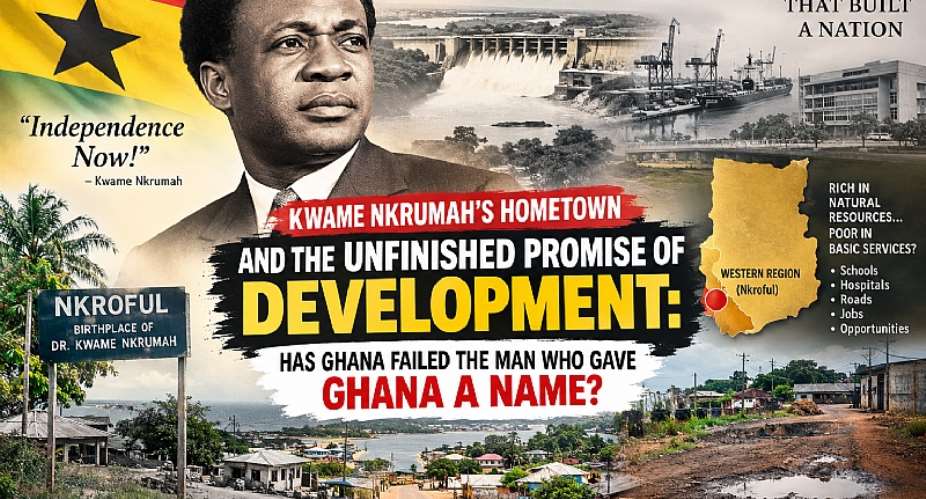
There is a question Ghana must confront without partisan anger, ethnic sentiment or nostalgia:
How can the birthplace of the man who led the Gold Coast to independence and became Ghana’s first Prime Minister and President still struggle with the very development ideals for which he devoted his life?
The question becomes even more uncomfortable when it is extended beyond Nkroful to the wider Western and Western North regions areas endowed with gold, cocoa, timber, oil, fertile land and other natural resources, yet still confronting serious infrastructure and social-service deficits.
But before blaming today's leaders, there is a historical correction that must be made.
Dr. Kwame Nkrumah’s hometown, Nkroful, is in the present-day Western Region not Western North Region. Western North became one of Ghana’s six new regions in 2019. Nkroful is in the Ellembelle area of the Western Region.
That distinction matters because Nkrumah's story belongs particularly to the Nzema area of the Western Region, even though the broader development questions raised by his legacy extend into Western North as well.
WHO WAS KWAME NKRUMAH BEFORE HE BECAME “OSAGYEFO”?
Kwame Nkrumah was born Francis Nwia-Kofi Ngonloma on 21 September 1909, according to the date he himself gave in his writings and repeated by Ghanaian historical sources.
The widely accepted historical account places his birth at Nkroful, then part of the Gold Coast. The Ghana News Agency identifies his father as Kofi Ngonloma, a goldsmith, and his mother as Elizabeth Nyaniba, a trader.
There has nevertheless been a historical dispute over his exact birthplace. Some traditional authorities in the Tarkwa-Nsuaem area have claimed that Nkrumah was born at Nsuaem and later moved to Nkroful. Nkrumah's family representatives rejected that account and maintained that he was born at Nkroful.
That disagreement itself demonstrates something important:
The history of Nkrumah is still contested and perhaps not studied enough by the generation that invokes his name most loudly.
WHO WERE HIS PARENTS?
Nkrumah came from relatively modest circumstances.
His father, Opanyin Kofi Nwiana Ngonloma, was a goldsmith. Historical accounts also describe him as a respected elder whose advice was sought on traditional and domestic matters. He died in 1927.
His mother, Elizabeth Nyaniba, was a trader and fishmonger. She is reported to have lived until 1979 surviving her famous son by several years.
Think about that for a moment.
The man who would eventually become one of Africa's most influential independence leaders did not emerge from a wealthy political dynasty.
He came from a goldsmith and a trader.
His rise was built largely through education, political organisation, intellectual development, international exposure and an extraordinary commitment to the question of African freedom.
His early education began in the Catholic mission system at Half Assini, after which his academic journey eventually took him to Achimota, the United States and Britain. He earned degrees in the United States and became deeply involved in Pan-African political organising.
DID NKRUMAH HAVE BROTHERS AND SISTERS?
This is another area where caution is necessary.
Nkrumah was his mother's only biological child, according to historical accounts. However, because his father had other family relationships, there were paternal half-siblings.
A University of Ghana-hosted historical text identifies John Nkrumah, an elder half-brother, who was working as a storekeeper for the United Africa Company.
This is different from the children Nkrumah later had with his Egyptian wife, Fathia Nkrumah.
His publicly recognised children included Gamal, Samia and Sekou, while the status of another claimant, Onsy Nkrumah, has been publicly disputed within the family.
Therefore, it would be historically irresponsible to simply produce a definitive list of all alleged Nkrumah siblings without distinguishing between documented family relationships and disputed claims.
FROM NKROFUL TO THE WORLD
What happened after the boy left his hometown is extraordinary.
Nkrumah became a teacher, travelled to the United States for further education in 1935, obtained university degrees, became involved in Pan-African politics and later worked in Britain.
He returned to the Gold Coast in 1947.
Initially associated with the United Gold Coast Convention (UGCC), he eventually broke away and formed the Convention People's Party (CPP) in 1949.
His political strategy differed significantly from the more gradual constitutional approach of some earlier nationalist leaders.
His movement mobilised ordinary people around the demand for “Independence Now.”
In 1957, the Gold Coast became independent as Ghana, with Nkrumah as Prime Minister. He became President when Ghana became a republic in 1960.
And this is where the historical argument becomes important.
It is inaccurate to say Nkrumah single-handedly created Ghana's independence movement.
Others had been fighting for political reform, self-government and independence before and alongside him.
But it is equally difficult to write the history of Ghana's independence without acknowledging that Nkrumah became the central political figure who transformed the independence struggle into a mass movement and ultimately led the country into independence.
WHAT DID NKRUMAH ACTUALLY DO FOR GHANA?
Nkrumah's record should neither be worshipped blindly nor dismissed politically.
It should be examined.
His government pursued an ambitious programme of industrialisation, infrastructure development, education, healthcare and national institution-building.
Among the major projects associated with the Nkrumah era were:
The Volta River Project/Akosombo Dam
Tema Harbour
Tema industrial development
expansion of education
development of technical and higher education
roads and public infrastructure
state-owned industries
agricultural development programmes
expansion of health and social services
Ghana's contribution to Pan-African political organisation.
The University of Ghana, for example, became an independent university by Act of Parliament in 1961, with Nkrumah becoming its first Chancellor.
The Volta River Project was explicitly connected to Nkrumah's vision of industrialisation and modernisation.
Recent historical analysis by Ghana News Agency likewise identifies the Akosombo project, Tema Harbour, roads, electricity, Tema Township, industrial estates and education expansion among the major components of the development strategy of the Nkrumah era.
But Nkrumah's government also had serious shortcomings.
Its rapid-industrialisation strategy placed heavy financial demands on the state. Some agricultural programmes failed to achieve their objectives, while the political system became increasingly centralised. In 1964 Ghana became a one-party state, and Nkrumah was declared President for Life.
So history should not turn Nkrumah into a saint.
But neither should political disagreement erase his documented achievements.
AND THEN CAME 1966
On 24 February 1966, Nkrumah was overthrown in a military coup while he was abroad.
The overthrow ended the First Republic.
Historical scholarship continues to examine the domestic and international circumstances surrounding the coup. What is beyond dispute is that the coup fundamentally changed Ghana's political trajectory.
The more important question today, however, is not simply:
“Was the coup justified?”
The deeper question is:
What did Ghana build after Nkrumah that was greater than the ambition he left behind?
That question should be asked by every generation.
THE STRANGE PARADOX OF NKROFUL
Here is where Ghana's conscience should become uncomfortable.
Nkroful is not simply another Ghanaian village.
It is the birthplace of the man who became Ghana's first Prime Minister and President and one of Africa's most internationally recognised anti-colonial leaders.
Yet development concerns surrounding Nkroful have existed for decades.
In 2009, residents complained that they were not receiving an adequate share of economic benefits associated with Nkrumah's legacy and tourism. They argued that after Nkrumah's remains were moved from Nkroful to Accra, the community lost an important tourism-related economic opportunity.
In 2019, the then Western Regional Minister publicly challenged mining companies to think beyond small corporate-social-responsibility projects and help transform Tarkwa and Nkroful into major economic and tourism centres.
And the issue has not disappeared.
In 2026, the government announced an 800-acre land restoration project around Nkroful after illegal mining severely degraded land around the community.
That creates a painful irony.
The hometown of the man who dreamed of industrialising Ghana is today dealing with the environmental consequences of an extractive economy.
BUT WHO IS RESPONSIBLE?
This is where we must be careful.
It would be too easy to blame only politicians.
Development is a shared institutional responsibility.
Government carries responsibility for national infrastructure, roads, schools, hospitals, water, electricity and economic policy.
Regional and district assemblies have responsibilities for local development.
Members of Parliament have roles in legislation, representation and advocacy.
Traditional authorities control or influence significant customary land and community affairs.
Mining companies have corporate and statutory obligations.
Civil society and professional associations have oversight roles.
And citizens themselves have responsibilities including demanding accountability, protecting public facilities and rejecting the politics of patronage.
So the question should not simply be:
“Which politician failed Nkroful?”
It should be:
“For more than six decades, which combination of governments, assemblies, traditional authorities, private companies, political representatives, community leaders and citizens failed to create a sustainable development strategy for this historic community?”
That is a much harder question.
And a more honest one.
IS IT POLITICAL NEGLECT?
There is not enough evidence to establish that Nkroful's development challenges are the result of a deliberate national policy of political punishment because of Nkrumah's political identity.
Such a conclusion would require evidence.
But there is evidence of persistent infrastructure and development complaints.
There have also been government projects and interventions in the wider area, including roads and other infrastructure. For example, the Esiama–Nkroful Road was among projects inspected during a 2020 presidential tour.
Therefore, the issue is more complicated than simply saying:
“Government has done nothing.”
The more defensible question is:
“Have successive governments done enough, and have the interventions matched the historical, economic and tourism potential of Nkroful and its surrounding communities?”
That question remains legitimate.
THE WESTERN REGION'S BIG CONTRADICTION
The Western Region possesses extraordinary economic assets.
The Ministry of Food and Agriculture describes the region as a major producer of cocoa, rubber, coconut and oil palm, while its forests support timber production. The region also has gold, bauxite, iron, diamond and manganese deposits and commercially significant oil resources.
The Western Regional Coordinating Council also identifies gold, manganese, crude oil, natural gas, kaolin, limestone, sand and stone among the region's economic resources.
Yet resource wealth does not automatically produce local prosperity.
That is one of Africa's oldest development paradoxes.
A community can sit on gold and still lack good roads.
It can produce cocoa and still have poor rural infrastructure.
It can host mining operations and still complain about unemployment.
It can possess oil and still struggle with basic services.
The problem is therefore not simply how much wealth exists.
The question is:
Who captures the value?
AND WHAT ABOUT WESTERN NORTH?
Western North is a separate region, created in 2019.
It has its own development challenges and its own institutional responsibilities.
The region's natural-resource base includes cocoa, timber, mining and agriculture.
Its infrastructure problems are also documented.
In 2025, President John Mahama announced major road interventions under the government's Big Push programme after chiefs and residents highlighted deteriorating roads connecting farming communities and markets.
In the same period, government announced plans for a regional hospital and discussed establishing a public university in the region.
This tells us something important:
The development deficit is real, but it is not static. Projects are being announced and implemented. The real test is whether they are completed, maintained and translated into measurable improvements in people's lives.
ARE THE LEADERS GREEDY?
This is where public debate often becomes dangerously simplistic.
There may be individual cases of corruption, patronage, misuse of public resources or conflicts of interest in Ghana. But it would be irresponsible to declare that all politicians, chiefs, MMDCEs, MPs or opinion leaders in the Western Region and Western North are greedy without evidence against each person or institution.
The better question is much more devastating:
What systems allow leaders to accumulate political and economic influence without delivering measurable development outcomes?
And another:
Why do citizens sometimes reward leaders with votes, praise and traditional honours even when roads remain poor, schools struggle and healthcare access remains inadequate?
And perhaps the hardest:
Do Ghanaians demand accountability only when the politician belongs to the opposing party?
That question does not belong to NPP supporters.
It does not belong to NDC supporters.
It belongs to all Ghanaians.
THE MOST UNCOMFORTABLE QUESTION: HAVE WE FAILED NKRUMAH?
Perhaps.
But not because Nkroful is poor.
Nkrumah himself understood that national development could not depend on the development of one hometown.
His vision was much larger.
He wanted Ghana to become an industrial and politically independent country capable of contributing to African liberation.
Therefore, honouring him cannot simply mean:
naming roads after him;
organising September 21 commemorations;
erecting statues;
quoting his speeches;
wearing his portraits;
fighting over whether Nkrumah or another nationalist deserves greater historical recognition.
Those things are easy.
Building the Ghana he imagined is much harder.
WHY ARE WE STILL FIGHTING ABOUT WHO STARTED INDEPENDENCE?
The historical record contains many people and movements that contributed to Ghana's independence.
The UGCC played an important role.
The Big Six became part of the nationalist narrative.
Traditional authorities, lawyers, intellectuals, workers, journalists, students and ordinary citizens all contributed in different ways.
But Nkrumah's role became distinctive because he transformed the political struggle into a mass movement and ultimately led Ghana into independence in 1957.
Instead of endlessly asking:
“Who did more?”
perhaps Ghana should ask:
“What did they build, and what have we built since?”
That is the question history will eventually ask us.
THE COUP DID NOT END HISTORY GHANA DID NOT END WITH NKRUMAH
It is tempting to say that everything went downhill after 1966.
History is more complicated.
Different governments after Nkrumah built roads, schools, hospitals, industries, universities and other institutions.
Ghana has also experienced significant democratic and economic changes.
But the larger Nkrumah-era ambition of structural transformation and industrialisation has remained an unfinished project.
Recent Ghanaian economic commentary has again called attention to the relevance of Nkrumah's development planning, particularly industrialisation, agriculture, infrastructure and human-capital development.
The question therefore isn't whether Ghana should literally recreate the 1960s.
It cannot.
The question is whether Ghana can recover the principle behind Nkrumah's ambition:
Use Ghana's resources to build productive capacity inside Ghana.
That principle remains relevant.
THE GOLD, THE OIL AND THE PEOPLE
Here is the paradox that Ghana has not solved.
We export resources.
We celebrate production figures.
We announce royalties.
We talk about foreign investment.
We praise mining companies.
We debate oil revenues.
But ordinary citizens ask:
Where is the transformation?
If gold leaves the ground but young people leave the community looking for jobs, what exactly has been transformed?
If cocoa leaves the farm but farmers struggle to afford decent housing and healthcare, where is the value chain?
If oil generates revenue but communities still demand basic infrastructure, what happened between extraction and development?
If Nkrumah's birthplace attracts historians but cannot attract enough tourists, hotels, investors and sustainable businesses, what are we doing wrong?
AND WHAT ABOUT NKROFUL ITSELF?
Perhaps Ghana needs to stop thinking about Nkroful merely as Nkrumah's birthplace.
It should be developed as a heritage, educational, tourism and economic destination.
Imagine Nkroful with:
a world-class Nkrumah heritage centre;
a properly developed historical museum;
a digital archive of Nkrumah's life;
research facilities;
conference and cultural spaces;
hotels and guesthouses;
modern roads;
reliable water and electricity;
quality schools;
a modern health facility;
tourism enterprises owned substantially by local people;
historical walking routes;
River Subri ecological tourism;
annual international Pan-African conferences;
technology-enabled museums;
scholarships and research programmes focused on Nkrumah's ideas.
That would be a more meaningful monument than another statue.
AND HERE IS THE QUESTION GHANA MUST ANSWER
If the birthplace of Ghana's first President remains economically marginal decades after independence, what does that say about our understanding of national heritage?
If communities sitting beside gold remain poor, what does that say about resource governance?
If politicians repeatedly promise roads but citizens continue to complain about roads, where exactly is the accountability mechanism?
If chiefs possess influence but development remains slow, how effectively are traditional institutions using that influence?
If citizens complain about politicians but continue rewarding political patronage, are politicians the only problem?
If governments change but the structural problems remain, is the problem really one political party or is it the Ghanaian system itself?
If Nkrumah could think about industrialisation when Ghana had just become independent, why can't today's Ghana think beyond exporting raw materials?
And perhaps the most painful question:
If Nkrumah returned to Nkroful today, what would he ask us?
Would he ask why Ghana has failed to develop?
Or would he ask why Ghanaians have failed to continue developing what previous generations started?
THE LEGACY SHOULD NOT BE A POLITICAL WEAPON
Nkrumah belongs to Ghanaian history.
He does not belong exclusively to the CPP.
He does not belong exclusively to Nzema.
He does not belong exclusively to the Western Region.
And he certainly does not belong exclusively to one political tradition.
His legacy should be subjected to serious historical examination including his successes, failures, authoritarian turn, economic difficulties and political mistakes.
But his achievements should also be recognised.
Ghana's development challenge is not solved by pretending Nkrumah was perfect.
Neither is it solved by pretending he achieved nothing.
Both are distortions of history.
The mature position is to study what worked, understand what failed and build something better.
NKROFUL'S PROBLEM IS REALLY GHANA'S PROBLEM
The tragedy of Nkroful is therefore larger than Nkroful.
It represents a national question.
Can Ghana convert historical memory into economic development?
Can we turn our natural resources into industries?
Can we turn historical personalities into tourism economies?
Can we turn political promises into completed infrastructure?
Can chiefs, politicians, assemblies, businesses, civil society and citizens work together instead of waiting for somebody else?
Can Ghana stop treating development as something that happens only in Accra and Kumasi?
And can we finally stop fighting endlessly over the past long enough to build the future?
THE FINAL QUESTION
On 21 September, Ghana will once again remember Kwame Nkrumah.
There will be speeches.
There will be wreaths.
There will be political statements.
There will be photographs.
There will be arguments about who loved Nkrumah more.
But when the ceremonies are over, Nkroful will still be there.
The roads will still need attention.
The schools will still need investment.
The health facilities will still need strengthening.
The tourism potential will still need development.
The youth will still need jobs.
The natural resources will still be underground or extracted and transported away.
And Ghana will still face the question that has followed the country for generations:
Are we merely celebrating Nkrumah or are we finally prepared to build?
Because perhaps the greatest way to honour the man is not to shout his name louder.
Perhaps it is to finish the work.
And that responsibility does not belong to one president, one political party, one chief, one MMDCE or one region.
It belongs to Ghana.
Nkroful is asking the question. Western Region is asking the question. Western North is asking the question. And eventually, history will ask all of us.
What did you do with the Ghana Nkrumah helped to create?
By:
Patrick Belebang Yagsori
0240292413
[email protected]
 Ghana, Panama sign MoU to deepen bilateral political consultations
 Founder’s Day: NAPO urges Ghanaians to uphold Kwame Nkrumah’s legacy
 Founder’s Day: Mahama urges Ghanaians to draw inspiration from Nkrumah’s vision
 Mahama to build 400-bed Mother and Child Block at Korle Bu – Kwakye Ofosu
 GES threatens sanctions against SHS heads imposing unauthorised charges
 Betting could destroy future of Ghana’s youth in 3–5 years – Akim Swedru MP
 Zimbabwe Suspends Journalist for One Year Over ‘Unethical’ Reporting on Chinese ...
 Third Drug Mule in 3 Weeks: R2m Heroin Found in SA Man’s Luggage at OR Tambo
 NACOC Debunks MP’s Claim as France’s €225m Cocaine Case Deepens
 Putin party retains majority in first vote since 2022 invasion of Ukraine


