




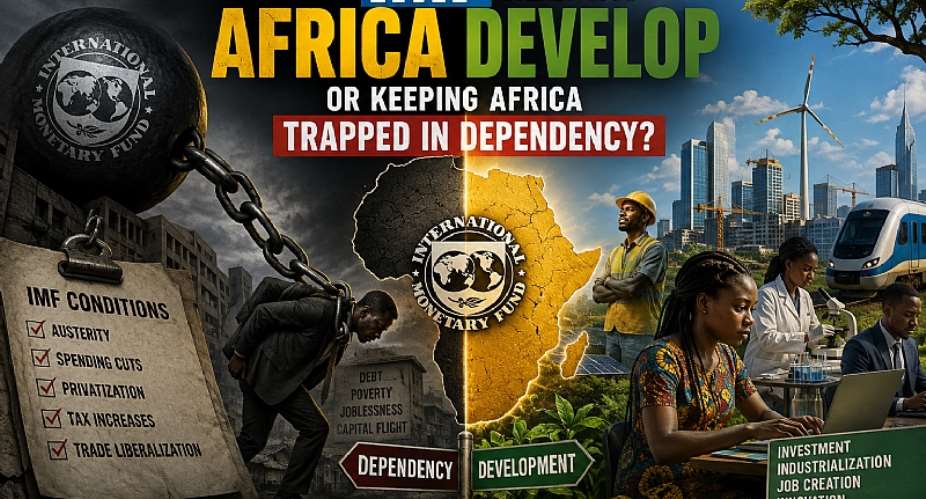
Ghana’s 17 IMF programmes, the history of the Fund, the price of “stability,” and the uncomfortable questions Africa must now ask
For nearly seven decades, Ghana has belonged to the International Monetary Fund (IMF).
Yet one uncomfortable question refuses to disappear:
If IMF programmes are designed to restore economic stability and put countries on a sustainable path, why has Ghana had to return to the same institution 17 times since independence?
And Ghana is not alone.
Across Africa, governments repeatedly confront the same cycle: debt rises, foreign-exchange reserves fall, currencies weaken, inflation accelerates, government finances deteriorate, access to international capital markets disappears and eventually the IMF arrives with financing, conditions and a reform programme.
The IMF says its purpose is to help countries correct economic imbalances and restore stability.
Critics ask a more uncomfortable question:
Is the medicine curing the disease or merely stabilising the patient long enough for the disease to return?
That question deserves neither blind anti-IMF rhetoric nor unquestioning faith in the Fund.
It deserves facts.
HOW DID THE IMF BEGIN — AND WHY WAS IT CREATED?
The IMF was not created specifically for Africa.
In July 1944, representatives of 44 Allied countries gathered in Bretton Woods, New Hampshire, in the United States, while the Second World War was still raging.
The world had experienced the Great Depression, competitive currency devaluations, trade restrictions, financial instability and ultimately another devastating global war.
The architects of the post-war economic system wanted to prevent a repeat.
Two major personalities played particularly important roles in shaping the economic thinking behind the institution: British economist John Maynard Keynes and American Treasury official Harry Dexter White.
The IMF's Articles of Agreement were adopted on July 22, 1944, and entered into force in December 1945. The Fund began operations in 1947. Its original purpose was to promote international monetary cooperation, exchange-rate stability, international trade and economic stability.
In other words, the IMF was supposed to be a financial safety mechanism for the international monetary system.
It was not originally designed as an institution whose primary mission was to build roads, schools, factories, hospitals or industrial parks.
That distinction is critical.
The IMF is principally a macroeconomic stabilisation institution.
The World Bank and development banks have historically had more direct development-financing roles.
So when Africans ask:
“What has the IMF built for us?”
the IMF can legitimately respond:
“That is not primarily our mandate.”
But that answer creates another question:
If IMF policies profoundly influence taxation, public expenditure, subsidies, wages, interest rates, exchange rates and economic policy, can the Fund really say it has nothing to do with a country's development trajectory?
That is where the debate becomes complicated.
GHANA AND THE IMF: HOW DID WE GET HERE?
Ghana became an IMF member on 20 September 1957, shortly after independence. The country's first IMF financial arrangement came in 1966.
By 2026, Ghana had entered 17 IMF financial programmes since independence. Ghana officially completed its latest IMF-supported programme in 2026.
The historical record of Ghana's IMF arrangements illustrates just how long this relationship has lasted.
The IMF's own lending records show arrangements beginning in:
1966
1967
1968
1969
1979
1983
1984
1986
1987
1987 another facility
1988
1995
1999
2003
2009
and subsequent programmes, including the 2015 arrangement and the 2023 programme.
The exact number can sometimes look different depending on whether one counts individual facilities within a broader adjustment episode or formal programmes, but Ghanaian government and public sources consistently describe the post-independence total as 17 IMF bailouts/programmes.
And that should make every Ghanaian pause.
Seventeen times.
Not seventeen years.
Not seventeen governments.
Seventeen separate episodes of turning to an external financial institution for assistance.
THE 1983 IMF EXPERIENCE: THE IMF DID HELP GHANA BUT AT WHAT PRICE?
Any serious discussion about the IMF in Ghana must acknowledge something that political arguments sometimes conveniently ignore:
The 1983 Economic Recovery Programme produced significant macroeconomic improvements.
Ghana entered the 1980s in severe economic distress.
Inflation had reached extraordinary levels. Production had collapsed. Foreign-exchange shortages were severe. The country faced shortages of basic goods, deteriorating infrastructure and major economic dislocation.
In 1983, Ghana launched its Economic Recovery Programme, supported by the IMF, World Bank and other external partners.
The IMF's historical assessment says the programme helped bring severe fiscal imbalances under control, liberalise distorted exchange and trade systems and significantly reduce inflation.
Inflation fell from around 123 percent in 1983 to 33 percent in 1986, while real economic growth recovered. Another IMF account reports inflation falling from approximately 142 percent in 1983 to about 10 percent by the end of 1991, with real GDP growth averaging roughly 5 percent annually.
That is not insignificant.
It means the argument that “the IMF has never helped Ghana” is historically inaccurate.
The Fund-assisted adjustment helped stabilise an economy that was in extraordinary trouble.
But there is another side.
The same adjustment programme involved currency devaluation, liberalisation, fiscal discipline, reduced government intervention and major structural reforms.
The IMF itself acknowledges that private investment and savings remained uneven and that growth of around 5 percent was not enough to put Ghana rapidly on a path to eliminating poverty.
So the question should not be:
“Did the IMF help Ghana?”
The better question is:
“Did the IMF help Ghana stabilise and did Ghana convert that stability into structural economic transformation?”
Those are two completely different questions.
STABILITY IS NOT THE SAME AS DEVELOPMENT
This may be the most important distinction in the entire IMF debate.
Imagine a country with:
50 percent inflation;
collapsing currency;
insufficient foreign reserves;
massive budget deficits;
unsustainable debt;
inability to borrow internationally.
An IMF programme can help restore:
foreign-exchange reserves;
fiscal discipline;
monetary credibility;
debt sustainability;
access to international financing;
investor confidence.
Those are valuable achievements.
But suppose five years later the same country still has:
weak manufacturing;
youth unemployment;
dependence on imported goods;
low domestic tax collection;
raw-material exports;
inadequate industrial capacity;
weak public institutions;
electricity-sector problems;
dependence on foreign financing.
Has the country truly developed?
Or has it simply become better at surviving its next crisis?
That is the uncomfortable distinction Africa must confront.
WHAT DID GHANA'S MOST RECENT IMF PROGRAMME ACTUALLY ACHIEVE?
Ghana's latest IMF programme was approved in May 2023 as a US$3 billion Extended Credit Facility arrangement after the country experienced a severe economic and debt crisis.
The programme was intended to restore macroeconomic stability, debt sustainability and create the foundations for inclusive growth.
By 2026, the IMF reported substantial improvements.
According to the Fund:
Ghana's inflation fell sharply;
international reserves increased substantially;
the primary fiscal balance moved from a large deficit to a surplus;
debt sustainability improved;
comprehensive debt restructuring progressed;
real GDP grew by about 6 percent in 2025;
reserves reached about US$11.9 billion at the end of 2025;
Ghana's risk of debt distress returned to moderate.
These are real achievements.
But again, the difficult question remains:
Did the IMF create Ghana's gold, cocoa, oil, entrepreneurs, farmers, engineers, businesses and workers?
No.
Much of Ghana's recovery was also influenced by domestic policy decisions, monetary policy, fiscal measures, debt restructuring, economic activity and exceptionally strong gold prices.
The IMF itself notes that historically high gold prices supported reserve accumulation and exchange-rate stability.
Therefore, it would be intellectually dishonest for either side to claim:
“Everything good came from the IMF.”
Equally dishonest would be:
“The IMF achieved nothing.”
Reality is more complicated.
SO WHAT DOES THE IMF ACTUALLY DO?
The IMF essentially provides countries with financial support when they experience serious balance-of-payments or macroeconomic problems.
But the money is not simply free cash.
When a country borrows, it agrees to an economic programme.
The IMF calls this conditionality.
The Fund explains that countries borrowing from it agree to adjust economic policies to address the problems that led them to seek assistance. These conditions are also intended to protect IMF resources and ensure that countries are capable of repaying the Fund.
Conditions can involve issues such as:
fiscal deficits;
taxation;
public spending;
monetary policy;
state-owned enterprises;
energy-sector reforms;
debt management;
public financial management;
governance;
subsidies;
structural reforms.
And this is where the political controversy begins.
DOES THE IMF GIVE AFRICA DIFFERENT RULES FROM EUROPE?
This is one of the most important questions in the debate.
The answer is:
The IMF's formal framework is not supposed to be based on a rule saying “Africa gets austerity and Europe gets flexibility.”
European countries have also faced tough IMF conditionality.
Greece, Ireland, Portugal and Cyprus all participated in IMF-supported programmes during Europe's debt crisis.
The IMF itself acknowledges that its European programmes generated enormous controversy over the scale of lending, debt restructuring, private creditor losses and the balance between external financing and domestic adjustment.
Greece, in particular, experienced extremely painful fiscal adjustment.
So it is wrong to claim that Europe has never been subjected to IMF austerity.
But there is a legitimate question about power.
IMF voting power is largely linked to quotas.
As of August 31, 2026, the United States alone held about 16.49 percent of total IMF voting power, while many African countries individually held tiny fractions of one percent.
That creates an unavoidable political question:
Can an institution be genuinely equal when its members possess dramatically unequal voting power?
The IMF would answer that quota shares reflect members' positions in the global economy and financial contributions.
Critics respond:
But shouldn't the voices of countries most affected by IMF programmes carry more weight in designing those programmes?
That debate is legitimate.
AFRICA'S PROBLEM IS NOT SIMPLY THE IMF
This is where the conversation must become uncomfortable for Africans themselves.
It is easy to blame the IMF.
But who accumulated the debt?
Who approved the expenditure?
Who negotiated the loans?
Who mismanaged state-owned enterprises?
Who allowed tax exemptions to multiply?
Who borrowed for consumption instead of productive investment?
Who financed politically attractive projects without sufficient economic returns?
Who failed to build adequate reserves during periods of high commodity prices?
Who repeatedly enters elections with unfunded spending promises?
African governments cannot blame the IMF for problems they created before the IMF arrived.
Professor John Gatsi has argued that Ghana's recurring IMF dependence reflects poor economic management and that Ghana needs stronger financial buffers, better revenue collection and smarter investment to avoid future bailouts.
That may be one of the most important parts of the debate.
The IMF does not force a government to spend recklessly before requesting assistance.
BUT DOES IMF CONDITIONALITY CREATE ANOTHER PROBLEM?
Absolutely worth asking.
When a government is instructed to reduce deficits during an economic crisis, it may need to:
reduce spending;
increase taxes;
remove subsidies;
control public-sector wages;
raise utility prices;
restructure debt;
tighten monetary conditions.
These measures may improve the government's balance sheet.
But what happens to an ordinary citizen?
What happens to:
the unemployed graduate;
the nurse;
the teacher;
the small trader;
the farmer;
the factory worker;
the pensioner;
the low-income family?
This is why IMF programmes can be economically necessary and socially painful at the same time.
ActionAid has strongly criticised austerity associated with IMF-supported policies, arguing that fiscal consolidation can undermine public services and disproportionately affect vulnerable groups. Its research covers Ghana and several other African countries.
The criticism should not simply be dismissed.
But neither should it be accepted automatically.
Interestingly, the IMF itself has changed over time.
The Fund says experience in the 1980s showed that adjustment was unlikely to succeed if the effects on poor people and resulting social unrest were ignored. Its programmes subsequently incorporated greater attention to social spending, health and education.
A 2025 IMF study of Sub-Saharan African programmes found that social spending targets have increasingly been incorporated and that spending on health and education has generally been preserved or increased during programmes.
So the IMF of 2026 is not exactly the IMF of 1983.
BUT HERE IS THE QUESTION NOBODY WANTS TO ASK
If the IMF has spent decades telling African governments to improve:
fiscal discipline;
taxation;
public-sector management;
debt management;
monetary policy;
governance;
why are so many African economies still repeatedly returning to the Fund?
Is the problem that IMF programmes are badly designed?
Or is the problem that African governments implement only enough reforms to exit the programme but not enough to fundamentally transform their economies?
Or is the deeper problem that African economies remain structurally dependent on:
raw materials → foreign currency → imported manufactured goods → external borrowing → debt → IMF programme → austerity → recovery → borrowing again?
That cycle deserves serious examination.
IS AFRICA TRAPPED IN A DEBT-AND-RAW-MATERIAL ECONOMY?
Consider the basic economic structure of many African countries.
A country exports:
cocoa;
gold;
oil;
copper;
lithium;
bauxite;
coffee;
crude agricultural commodities.
It earns foreign exchange.
Then it imports:
machinery;
pharmaceuticals;
cars;
refined petroleum;
technology;
processed foods;
industrial equipment.
When commodity prices fall, export earnings decline.
The currency weakens.
Imports become expensive.
Inflation rises.
Government revenue falls.
Debt becomes harder to service.
Foreign reserves decline.
Investors become nervous.
The government returns to the IMF.
Could the IMF stabilise this cycle without actually breaking it?
That is perhaps the strongest criticism that can be made of the current international financial system.
WHAT ARE AFRICANS SAYING?
There is no single African position.
Some economists and policymakers believe IMF programmes are necessary emergency instruments.
Others believe repeated IMF interventions demonstrate that the existing economic architecture has failed.
Some civil-society organisations argue that austerity disproportionately harms poorer citizens.
In Ghana, former Speaker of Parliament Professor Aaron Mike Oquaye has argued that repeated IMF programmes have not produced the lasting transformation Ghana needs and that the country should instead strengthen its management of natural resources and domestic finances.
Meanwhile, economist Professor John Gatsi has argued that Ghana must build sufficient financial buffers to avoid returning to the Fund.
These views point toward an important conclusion:
The real debate is no longer simply “IMF or no IMF.”
The deeper debate is:
What kind of economic system should African countries build so that the IMF becomes an emergency option rather than a recurring destination?
THE IMF HAS HELPED AFRICA — BUT HAS IT TRANSFORMED AFRICA?
This distinction deserves emphasis.
The Fund can help a country:
stabilise.
It can help:
restore confidence.
It can help:
rebuild reserves.
It can help:
restructure debt.
It can provide:
technical expertise.
It can help governments regain access to international financing.
But industrialisation requires something else.
It requires:
productive investment;
reliable electricity;
technology;
infrastructure;
education;
skilled labour;
manufacturing;
agricultural processing;
regional trade;
innovation;
patient long-term capital;
strong institutions.
An IMF stabilisation programme cannot substitute for those things.
AND THERE IS ANOTHER IRONIC QUESTION
The IMF often tells African governments to increase domestic revenue.
Fair enough.
But what if African governments actually became exceptionally good at collecting taxes?
Would that not reduce their dependence on the IMF?
What if Ghana could efficiently tax its enormous informal economy?
What if African countries stopped losing billions through corruption, illicit financial flows, tax avoidance and inefficient public procurement?
What if African countries processed their minerals locally?
What if cocoa-producing countries produced chocolate at scale?
What if oil-producing countries built refineries and petrochemical industries?
What if bauxite became aluminium inside Ghana?
What if lithium became batteries?
What if African countries manufactured pharmaceuticals instead of importing them?
Would Africa still need the same level of external financing?
Perhaps not.
And that may be the real solution.
THE IMF SHOULD ALSO ANSWER SOME HARD QUESTIONS
If the Fund wants Africans to trust it, these questions deserve serious answers:
1. Why have repeated IMF programmes not eliminated recurring crises in countries such as Ghana?
2. How does the IMF measure development beyond inflation, deficits, reserves and debt ratios?
3. When fiscal consolidation reduces government spending, how does the Fund calculate the long-term economic cost of weaker public investment?
4. How much policy space should a heavily indebted African country retain to industrialise?
5. Why should an African country with enormous infrastructure deficits prioritise debt reduction over certain productive investments?
6. When IMF programmes require reforms that raise the cost of electricity, fuel or taxation, how does the Fund measure the burden on low-income households?
7. Why does an institution designed to promote balanced global growth operate under a voting system in which economic powers have vastly greater influence than most African states?
8. Should debt sustainability models account more heavily for Africa's infrastructure and development financing needs?
9. Why should African countries borrow to stabilise economies instead of receiving more long-term development financing?
10. If IMF programmes are successful, why do countries repeatedly return?
That last question may be the most uncomfortable of all.
BUT AFRICA MUST ALSO ANSWER ITS OWN QUESTIONS
Africa cannot demand answers from Washington while refusing to interrogate Accra, Abuja, Nairobi, Lusaka, Harare, Dakar and other capitals.
African governments must answer:
Why do we repeatedly spend more than we collect?
Why do we borrow during good economic times?
Why don't we save more during commodity booms?
Why are tax revenues so low relative to economic activity?
Why do governments repeatedly inherit unpaid bills?
Why do election cycles repeatedly produce fiscal pressure?
Why do countries export raw resources instead of processing them?
Why do African pension funds and sovereign funds not finance more domestic productive investment?
Why do we continue borrowing foreign currency to finance projects that generate local-currency revenues?
Why do we wait until the economy collapses before implementing reforms that should have been implemented years earlier?
These questions are uncomfortable because they shift part of the responsibility from international institutions to African leadership.
SHOULD AFRICAN COUNTRIES LEAVE THE IMF?
This is where I would caution against an emotionally attractive but economically simplistic answer.
No Africa does not necessarily need to abandon the IMF.
It needs to change the nature of the relationship.
The IMF can be useful when a country genuinely faces an external financing crisis.
The problem is not necessarily the existence of the IMF.
The problem is dependency.
There is a profound difference between:
“We are using the IMF because an extraordinary crisis has occurred.”
and:
“We have no credible economic system without the IMF.”
The first is financial assistance.
The second is structural dependency.
AFRICA NEEDS A DIFFERENT FINANCIAL STRATEGY
Instead of asking only:
“How do we get another IMF programme?”
African governments should increasingly ask:
How do we build enough reserves that we don't need emergency financing?
How do we mobilise domestic capital?
How do we strengthen African capital markets?
How do we make African pension funds invest more productively?
How do we strengthen the African Development Bank?
How do we make AfCFTA create genuinely integrated continental markets?
How do we process African resources in Africa?
How do we build African manufacturing capacity?
How do we reduce unnecessary import dependence?
How do we prevent political cycles from destroying fiscal discipline?
That is the conversation Africa needs.
GHANA'S 17TH PROGRAMME SHOULD NOT JUST BE ANOTHER NUMBER
Ghana completed the latest IMF programme in 2026, and the Fund reports major improvements in inflation, reserves, fiscal balances and debt sustainability.
But Ghana's real test begins after the IMF programme.
Can Ghana maintain fiscal discipline without IMF surveillance?
Can governments resist election-year spending?
Can Ghana build reserves during good times?
Can it diversify beyond gold, cocoa and other commodities?
Can it increase domestic production?
Can it industrialise?
Can it create millions of productive jobs?
Can it strengthen public financial management?
Can it prevent another debt crisis?
If the answer to those questions is yes, then the 17th programme may become a turning point.
If the answer is no, Ghana may eventually find itself asking for an 18th programme.
And that would mean that the fundamental problem was never the IMF.
The fundamental problem was that Ghana had not fixed the system that keeps taking it back to the IMF.
THE FINAL QUESTION: WHO IS REALLY KEEPING AFRICA DEPENDENT?
Perhaps this is the question Africans have avoided for too long.
Is Africa being trapped by international financial institutions?
Yes, some aspects of the global financial architecture can constrain African policy space, and Africa has legitimate grounds to demand greater representation, better debt restructuring mechanisms and financing that supports development.
But is the IMF deliberately preventing Africa from developing?
There is not sufficient evidence to make that sweeping claim.
The IMF's formal mandate is financial and macroeconomic stability, not preventing African development. Its own programmes have sometimes produced measurable improvements, including in Ghana. Its European interventions also demonstrate that tough conditionality is not exclusively imposed on African countries.
Yet the criticism cannot simply be dismissed.
The IMF's policies can influence the amount of fiscal space available to governments.
Its voting structure gives powerful economies disproportionately large influence.
And fiscal adjustment can impose real social costs.
Therefore, the honest conclusion is neither:
“The IMF is Africa's enemy.”
Nor:
“The IMF is Africa's saviour.”
The truth is much more uncomfortable.
AFRICA DOES NOT NEED TO RUN AWAY FROM THE IMF AFRICA NEEDS TO OUTGROW ITS NEED FOR BAILOUTS
That should be the ambition.
The objective should not be to prove that Africa can survive without the IMF at any cost.
The objective should be to build economies so resilient that IMF financing becomes an emergency tool rather than a development strategy.
Ghana's 17 IMF engagements should therefore not simply be remembered as 17 occasions when politicians “went for money.”
They should be treated as 17 warnings.
Warnings about fiscal indiscipline.
Warnings about weak domestic revenue mobilisation.
Warnings about debt.
Warnings about excessive import dependence.
Warnings about inadequate productive capacity.
Warnings about election-year economics.
Warnings about the failure to save during good times.
Warnings about the consequences of depending on commodities.
And perhaps most importantly:
Warnings that economic independence is not achieved by refusing foreign assistance.
It is achieved by building an economy strong enough not to need emergency assistance.
So the question Africa should now ask is not simply:
“Should we continue belonging to the IMF?”
It should ask something far more powerful:
“What must we build, produce, save, reform and protect so that the next generation of African leaders does not have to keep asking the IMF to rescue economies that should have become financially independent decades ago?”
Because if Africa keeps returning to the same institution every few years, eventually we must stop asking only why the IMF keeps lending.
We must also ask:
WHY DO WE KEEP NEEDING TO BORROW?
And that is a question no IMF programme can answer for Africa.
The answer must ultimately come from Africa itself.
Editorial note: This analysis distinguishes between IMF-supported stabilisation and long-term development. Claims about the IMF's effects are contested: the Fund's own evaluations report some growth benefits from programmes, while independent and civil-society research has raised serious concerns about austerity and development costs. Readers should therefore treat neither “IMF always helps” nor “IMF deliberately keeps Africa poor” as established facts.
IS THE IMF HELPING AFRICA DEVELOP OR KEEPING AFRICA TRAPPED IN DEPENDENCY?
Ghana’s 17 IMF programmes, the history of the Fund, the price of “stability,” and the uncomfortable questions Africa must now ask
For nearly seven decades, Ghana has belonged to the International Monetary Fund (IMF).
Yet one uncomfortable question refuses to disappear:
If IMF programmes are designed to restore economic stability and put countries on a sustainable path, why has Ghana had to return to the same institution 17 times since independence?
And Ghana is not alone.
Across Africa, governments repeatedly confront the same cycle: debt rises, foreign-exchange reserves fall, currencies weaken, inflation accelerates, government finances deteriorate, access to international capital markets disappears and eventually the IMF arrives with financing, conditions and a reform programme.
The IMF says its purpose is to help countries correct economic imbalances and restore stability.
Critics ask a more uncomfortable question:
Is the medicine curing the disease or merely stabilising the patient long enough for the disease to return?
That question deserves neither blind anti-IMF rhetoric nor unquestioning faith in the Fund.
It deserves facts.
HOW DID THE IMF BEGIN AND WHY WAS IT CREATED?
The IMF was not created specifically for Africa.
In July 1944, representatives of 44 Allied countries gathered in Bretton Woods, New Hampshire, in the United States, while the Second World War was still raging.
The world had experienced the Great Depression, competitive currency devaluations, trade restrictions, financial instability and ultimately another devastating global war.
The architects of the post-war economic system wanted to prevent a repeat.
Two major personalities played particularly important roles in shaping the economic thinking behind the institution: British economist John Maynard Keynes and American Treasury official Harry Dexter White.
The IMF's Articles of Agreement were adopted on July 22, 1944, and entered into force in December 1945. The Fund began operations in 1947. Its original purpose was to promote international monetary cooperation, exchange-rate stability, international trade and economic stability.
In other words, the IMF was supposed to be a financial safety mechanism for the international monetary system.
It was not originally designed as an institution whose primary mission was to build roads, schools, factories, hospitals or industrial parks.
That distinction is critical.
The IMF is principally a macroeconomic stabilisation institution.
So when Africans ask, “What has the IMF built for us?”, the IMF can legitimately respond that direct infrastructure development is not primarily its mandate.
But that creates another question:
If IMF policies profoundly influence taxation, public expenditure, subsidies, wages, interest rates, exchange rates and economic policy, can the Fund really say it has nothing to do with a country's development trajectory?
That is where the debate becomes complicated.
GHANA AND THE IMF: HOW DID WE GET HERE?
Ghana became an IMF member on 20 September 1957, shortly after independence. The country's first IMF financial arrangement came in 1966.
By 2026, Ghana had entered 17 IMF financial programmes since independence.
The historical record illustrates just how long this relationship has lasted.
The IMF's lending records show arrangements beginning in 1966, 1967, 1968, 1969, 1979, 1983, 1984, 1986, 1987, another facility in 1987, 1988, 1995, 1999, 2003, 2009 and subsequent programmes including 2015 and 2023.
The exact number can sometimes look different depending on whether one counts individual facilities within a broader adjustment episode or formal programmes, but Ghanaian government and public sources consistently describe the post-independence total as 17 IMF programmes.
And that should make every Ghanaian pause.
Seventeen times.
Not seventeen years.
Not seventeen governments.
Seventeen separate episodes of turning to an external financial institution for assistance.
THE 1983 IMF EXPERIENCE: THE IMF DID HELP GHANA BUT AT WHAT PRICE?
Any serious discussion about the IMF in Ghana must acknowledge something political arguments sometimes conveniently ignore:
The 1983 Economic Recovery Programme produced significant macroeconomic improvements.
Ghana entered the 1980s in severe economic distress.
Inflation had reached extraordinary levels. Production had collapsed. Foreign-exchange shortages were severe. The country faced shortages of basic goods, deteriorating infrastructure and major economic dislocation.
In 1983, Ghana launched its Economic Recovery Programme, supported by the IMF, World Bank and other external partners.
The programme helped bring severe fiscal imbalances under control, liberalise distorted exchange and trade systems and significantly reduce inflation.
Inflation fell dramatically while economic growth recovered.
That is not insignificant.
It means the argument that “the IMF has never helped Ghana” is historically inaccurate.
The Fund-assisted adjustment helped stabilise an economy that was in extraordinary trouble.
But there is another side.
The same adjustment programme involved currency devaluation, liberalisation, fiscal discipline, reduced government intervention and major structural reforms.
Private investment and savings remained uneven, and growth of around 5 percent was not enough to put Ghana rapidly on a path to eliminating poverty.
So the question should not be:
“Did the IMF help Ghana?”
The better question is:
“Did the IMF help Ghana stabilise and did Ghana convert that stability into structural economic transformation?”
Those are two completely different questions.
STABILITY IS NOT THE SAME AS DEVELOPMENT
This may be the most important distinction in the entire IMF debate.
Imagine a country with 50 percent inflation, collapsing currency, insufficient foreign reserves, massive budget deficits, unsustainable debt and inability to borrow internationally.
An IMF programme can help restore foreign-exchange reserves, fiscal discipline, monetary credibility, debt sustainability, access to international financing and investor confidence.
Those are valuable achievements.
But suppose five years later the same country still has weak manufacturing, youth unemployment, dependence on imported goods, low domestic tax collection, raw-material exports, inadequate industrial capacity and weak public institutions.
Has the country truly developed?
Or has it simply become better at surviving its next crisis?
That is the uncomfortable distinction Africa must confront.
WHAT DID GHANA'S MOST RECENT IMF PROGRAMME ACTUALLY ACHIEVE?
Ghana's latest IMF programme was approved in May 2023 as a US$3 billion Extended Credit Facility after the country experienced a severe economic and debt crisis.
The programme was intended to restore macroeconomic stability, debt sustainability and create the foundations for inclusive growth.
By 2026, the IMF reported substantial improvements.
According to the Fund, Ghana's inflation fell sharply, international reserves increased substantially, the primary fiscal balance moved from a large deficit to a surplus, debt sustainability improved, comprehensive debt restructuring progressed and real GDP grew strongly.
These are real achievements.
But again, the difficult question remains:
Did the IMF create Ghana's gold, cocoa, oil, entrepreneurs, farmers, engineers, businesses and workers?
No.
Much of Ghana's recovery was also influenced by domestic policy decisions, monetary policy, fiscal measures, debt restructuring, economic activity and exceptionally strong gold prices.
Therefore, it would be intellectually dishonest for either side to claim:
“Everything good came from the IMF.”
Equally dishonest would be:
“The IMF achieved nothing.”
Reality is more complicated.
SO WHAT DOES THE IMF ACTUALLY DO?
The IMF provides countries with financial support when they experience serious balance-of-payments or macroeconomic problems.
But the money is not simply free cash.
When a country borrows, it agrees to an economic programme.
The IMF calls this conditionality.
Conditions can involve fiscal deficits, taxation, public spending, monetary policy, state-owned enterprises, energy-sector reforms, debt management, public financial management and structural reforms.
And this is where the political controversy begins.
DOES THE IMF GIVE AFRICA DIFFERENT RULES FROM EUROPE?
This is one of the most important questions in the debate.
The IMF's formal framework is not supposed to operate on a rule saying “Africa gets austerity and Europe gets flexibility.”
European countries have also faced tough IMF conditionality.
Greece, Ireland, Portugal and Cyprus all participated in IMF-supported programmes during Europe's debt crisis.
Greece, in particular, experienced extremely painful fiscal adjustment.
So it is wrong to claim that Europe has never been subjected to IMF austerity.
But there is a legitimate question about power.
IMF voting power is largely linked to quotas.
As of August 31, 2026, the United States alone held about 16.49 percent of total IMF voting power, while many African countries individually held tiny fractions of one percent.
That creates an unavoidable political question:
Can an institution be genuinely equal when its members possess dramatically unequal voting power?
The IMF would answer that quota shares reflect members' positions in the global economy and financial contributions.
Critics respond:
But shouldn't the voices of countries most affected by IMF programmes carry more weight in designing those programmes?
That debate is legitimate.
AFRICA'S PROBLEM IS NOT SIMPLY THE IMF
It is easy to blame the IMF.
But who accumulated the debt?
Who approved the expenditure?
Who negotiated the loans?
Who mismanaged state-owned enterprises?
Who allowed tax exemptions to multiply?
Who borrowed for consumption instead of productive investment?
Who failed to build adequate reserves during periods of high commodity prices?
Who repeatedly enters elections with unfunded spending promises?
African governments cannot blame the IMF for problems they created before the IMF arrived.
The real challenge is to build financial systems capable of surviving shocks without repeatedly seeking external rescue.
BUT DOES IMF CONDITIONALITY CREATE ANOTHER PROBLEM?
Absolutely worth asking.
When a government is instructed to reduce deficits during an economic crisis, it may need to reduce spending, increase taxes, remove subsidies, control public-sector wages, raise utility prices, restructure debt and tighten monetary conditions.
These measures may improve the government's balance sheet.
But what happens to an ordinary citizen?
What happens to the unemployed graduate, the nurse, the teacher, the small trader, the farmer, the factory worker or the pensioner?
This is why IMF programmes can be economically necessary and socially painful at the same time.
Civil-society organisations such as ActionAid have strongly criticised austerity associated with IMF-supported policies, arguing that fiscal consolidation can undermine public services and disproportionately affect vulnerable groups.
The criticism should not simply be dismissed.
But neither should it be accepted automatically.
Interestingly, the IMF itself has changed over time. The Fund says experience in the 1980s showed that adjustment was unlikely to succeed if the effects on poor people and resulting social unrest were ignored. Its programmes subsequently incorporated greater attention to social spending, health and education.
So the IMF of 2026 is not exactly the IMF of 1983.
BUT HERE IS THE QUESTION NOBODY WANTS TO ASK
If the IMF has spent decades telling African governments to improve fiscal discipline, taxation, public-sector management, debt management, monetary policy and governance:
Why are so many African economies still repeatedly returning to the Fund?
Is the problem that IMF programmes are badly designed?
Or is the problem that African governments implement only enough reforms to exit the programme but not enough to fundamentally transform their economies?
Or is the deeper problem that African economies remain structurally dependent on:
raw materials → foreign currency → imported manufactured goods → external borrowing → debt → IMF programme → austerity → recovery → borrowing again?
That cycle deserves serious examination.
IS AFRICA TRAPPED IN A DEBT-AND-RAW-MATERIAL ECONOMY?
Consider the basic economic structure of many African countries.
A country exports gold, oil, cocoa, copper, lithium or other raw materials.
It earns foreign exchange.
Then it imports machinery, pharmaceuticals, cars, refined petroleum, technology, processed foods and industrial equipment.
When commodity prices fall, export earnings decline.
The currency weakens.
Imports become expensive.
Inflation rises.
Government revenue falls.
Debt becomes harder to service.
Foreign reserves decline.
Investors become nervous.
The government returns to the IMF.
Could the IMF stabilise this cycle without actually breaking it?
That is perhaps the strongest criticism that can be made of the current international financial system.
WHAT ARE AFRICANS SAYING?
There is no single African position.
Some economists and policymakers believe IMF programmes are necessary emergency instruments.
Others believe repeated IMF interventions demonstrate that the existing economic architecture has failed.
Some civil-society organisations argue that austerity disproportionately harms poorer citizens.
In Ghana, former Speaker of Parliament Professor Aaron Mike Oquaye has argued that repeated IMF programmes have not produced the lasting transformation Ghana needs and that the country should instead strengthen its management of natural resources and domestic finances.
Economist Professor John Gatsi has similarly argued that Ghana must build sufficient financial buffers to avoid returning to the Fund.
These views point toward an important conclusion:
The real debate is no longer simply “IMF or no IMF.”
The deeper debate is:
What kind of economic system should African countries build so that the IMF becomes an emergency option rather than a recurring destination?
THE IMF HAS HELPED AFRICA BUT HAS IT TRANSFORMED AFRICA?
This distinction deserves emphasis.
The Fund can help a country stabilise.
It can help restore confidence.
It can help rebuild reserves.
It can help restructure debt.
It can provide technical expertise.
It can help governments regain access to international financing.
But industrialisation requires something else.
It requires productive investment, reliable electricity, technology, infrastructure, education, skilled labour, manufacturing, agricultural processing, regional trade, innovation, patient long-term capital and strong institutions.
An IMF stabilisation programme cannot substitute for those things.
AND THERE IS ANOTHER IRONIC QUESTION
The IMF often tells African governments to increase domestic revenue.
Fair enough.
But what if African governments actually became exceptionally good at collecting taxes?
Would that not reduce their dependence on the IMF?
What if African countries stopped losing billions through corruption, illicit financial flows, tax avoidance and inefficient public procurement?
What if African countries processed their minerals locally?
What if cocoa-producing countries produced chocolate at scale?
What if oil-producing countries built refineries and petrochemical industries?
What if bauxite became aluminium inside Ghana?
What if lithium became batteries?
What if African countries manufactured pharmaceuticals instead of importing them?
Would Africa still need the same level of external financing?
Perhaps not.
And that may be the real solution.
THE IMF SHOULD ALSO ANSWER SOME HARD QUESTIONS
If the Fund wants Africans to trust it, these questions deserve serious answers:
1. Why have repeated IMF programmes not eliminated recurring crises in countries such as Ghana?
2. How does the IMF measure development beyond inflation, deficits, reserves and debt ratios?
3. When fiscal consolidation reduces government spending, how does the Fund calculate the long-term economic cost of weaker public investment?
4. How much policy space should a heavily indebted African country retain to industrialise?
5. Why should an African country with enormous infrastructure deficits prioritise debt reduction over certain productive investments?
6. When IMF programmes require reforms that raise the cost of electricity, fuel or taxation, how does the Fund measure the burden on low-income households?
7. Why does an institution designed to promote balanced global growth operate under a voting system in which economic powers have vastly greater influence than most African states?
8. Should debt sustainability models account more heavily for Africa's infrastructure and development financing needs?
9. Why should African countries borrow to stabilise economies instead of receiving more long-term development financing?
10. If IMF programmes are successful, why do countries repeatedly return?
That last question may be the most uncomfortable of all.
BUT AFRICA MUST ALSO ANSWER ITS OWN QUESTIONS
Africa cannot demand answers from Washington while refusing to interrogate Accra, Abuja, Nairobi, Lusaka, Harare, Dakar and other capitals.
African governments must answer:
Why do we repeatedly spend more than we collect?
Why do we borrow during good economic times?
Why don't we save more during commodity booms?
Why are tax revenues so low relative to economic activity?
Why do governments repeatedly inherit unpaid bills?
Why do election cycles repeatedly produce fiscal pressure?
Why do countries export raw resources instead of processing them?
Why do African pension funds and sovereign funds not finance more domestic productive investment?
Why do we continue borrowing foreign currency to finance projects that generate local-currency revenues?
Why do we wait until the economy collapses before implementing reforms that should have been implemented years earlier?
These questions are uncomfortable because they shift part of the responsibility from international institutions to African leadership.
SHOULD AFRICAN COUNTRIES LEAVE THE IMF?
I would caution against an emotionally attractive but economically simplistic answer.
No Africa does not necessarily need to abandon the IMF.
It needs to change the nature of the relationship.
The IMF can be useful when a country genuinely faces an external financing crisis.
The problem is not necessarily the existence of the IMF.
The problem is dependency.
There is a profound difference between:
“We are using the IMF because an extraordinary crisis has occurred.”
and:
“We have no credible economic system without the IMF.”
The first is financial assistance.
The second is structural dependency.
AFRICA NEEDS A DIFFERENT FINANCIAL STRATEGY
Instead of asking only:
“How do we get another IMF programme?”
African governments should increasingly ask:
How do we build enough reserves that we don't need emergency financing?
How do we mobilise domestic capital?
How do we strengthen African capital markets?
How do we make African pension funds invest more productively?
How do we strengthen the African Development Bank?
How do we make AfCFTA create genuinely integrated continental markets?
How do we process African resources in Africa?
How do we build African manufacturing capacity?
How do we reduce unnecessary import dependence?
How do we prevent political cycles from destroying fiscal discipline?
That is the conversation Africa needs.
GHANA'S 17TH PROGRAMME SHOULD NOT JUST BE ANOTHER NUMBER
Ghana completed the latest IMF programme in 2026, and the Fund reports major improvements in inflation, reserves, fiscal balances and debt sustainability.
But Ghana's real test begins after the IMF programme.
Can Ghana maintain fiscal discipline without IMF surveillance?
Can governments resist election-year spending?
Can Ghana build reserves during good times?
Can it diversify beyond gold, cocoa and other commodities?
Can it increase domestic production?
Can it industrialise?
Can it create millions of productive jobs?
Can it strengthen public financial management?
Can it prevent another debt crisis?
If the answer to those questions is yes, then the 17th programme may become a turning point.
If the answer is no, Ghana may eventually find itself asking for an 18th programme.
And that would mean that the fundamental problem was never the IMF.
The fundamental problem was that Ghana had not fixed the system that keeps taking it back to the IMF.
THE FINAL QUESTION: WHO IS REALLY KEEPING AFRICA DEPENDENT?
Perhaps this is the question Africans have avoided for too long.
Is Africa being trapped by international financial institutions?
Yes, some aspects of the global financial architecture can constrain African policy space, and Africa has legitimate grounds to demand greater representation, better debt restructuring mechanisms and financing that supports development.
But is the IMF deliberately preventing Africa from developing?
There is not sufficient evidence to make that sweeping claim.
The IMF's formal mandate is financial and macroeconomic stability, not preventing African development. Its programmes have sometimes produced measurable improvements, including in Ghana. Its European interventions also demonstrate that tough conditionality is not exclusively imposed on African countries.
Yet the criticism cannot simply be dismissed.
The IMF's policies can influence the amount of fiscal space available to governments.
Its voting structure gives powerful economies disproportionately large influence.
And fiscal adjustment can impose real social costs.
Therefore, the honest conclusion is neither:
“The IMF is Africa's enemy.”
Nor:
“The IMF is Africa's saviour.”
The truth is much more uncomfortable.
AFRICA DOES NOT NEED TO RUN AWAY FROM THE IMF AFRICA NEEDS TO OUTGROW ITS NEED FOR BAILOUTS
That should be the ambition.
The objective should not be to prove that Africa can survive without the IMF at any cost.
The objective should be to build economies so resilient that IMF financing becomes an emergency tool rather than a development strategy.
Ghana's 17 IMF engagements should therefore not simply be remembered as 17 occasions when politicians “went for money.”
They should be treated as 17 warnings.
Warnings about fiscal indiscipline.
Warnings about weak domestic revenue mobilisation.
Warnings about debt.
Warnings about excessive import dependence.
Warnings about inadequate productive capacity.
Warnings about election-year economics.
Warnings about the failure to save during good times.
Warnings about the consequences of depending on commodities.
And perhaps most importantly:
Warnings that economic independence is not achieved by refusing foreign assistance.
It is achieved by building an economy strong enough not to need emergency assistance.
So the question Africa should now ask is not simply:
“Should we continue belonging to the IMF?”
It should ask something far more powerful:
“What must we build, produce, save, reform and protect so that the next generation of African leaders does not have to keep asking the IMF to rescue economies that should have become financially independent decades ago?”
Because if Africa keeps returning to the same institution every few years, eventually we must stop asking only why the IMF keeps lending.
We must also ask:
WHY DO WE KEEP NEEDING TO BORROW?
And that is a question no IMF programme can answer for Africa.
The answer must ultimately come from Africa itself.
By:
Patrick Belebang Yagsori
+233240292413
[email protected]

 Obuasi SHTS alleged sexual abuse: Kwasi Kwarteng criticises Education Minister o...
 ECOWAS’ $250,000 flood relief donation arrives in Ghana – Ablakwa
 Kennedy Agyapong has not resigned from NPP – Kwasi Kwarteng
 State failure, not GoldBod, driving galamsey – Daryl Bosu
 A Rocha Ghana raises alarm over human rights abuses in mining communities
 ECOWAS, AfDB discuss ways to advance West Africa’s development priorities
 October 16: Cedi gains against dollar, sells at GHS12.25 on forex market, GHS11....
 Galamsey: Ghana’s rivers now run chocolate and milk colour — Sam Jonah
 A nation of job-seekers will always be poor — Sir Sam Jonah
 “If you attack us with pepper spray, we’ll fight back” — NDC Yakubu Tony Aidoo w...


