




There are questions that deserve answers not because they are politically convenient, but because they concern the daily lives, finances and dignity of millions of ordinary citizens.
One of those questions is this:
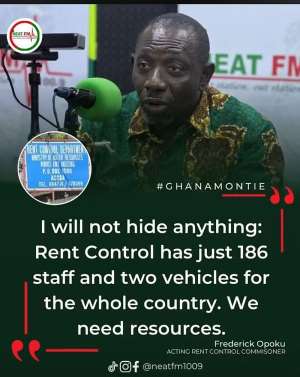
How can Ghana expect the Rent Control Department to effectively regulate the country's rental sector when the department reportedly has only two vehicles nationwide and about 186 staff?
This is not merely a question about vehicles.
It is a question about capacity, accountability, public policy and whether Ghana genuinely wants its rent laws enforced.
The Acting Rent Control Commissioner, Frederick Opoku, has publicly spoken about the department's operational challenges. Earlier reports also documented that the department had only two vehicles nationwide. In 2025, Principal Rent Manager Ishmael Essien similarly disclosed that the department had moved from one vehicle to two.
Even more striking is that this is not a new problem.
Ghana's own 2024 budget estimates acknowledged that the Rent Control Department had 177 staff working across 56 rent offices and specifically identified lack of vehicles and other logistical challenges, dilapidated office structures and inadequate office accommodation among its challenges.
So the uncomfortable question is no longer whether the government knows.
The evidence suggests that the resource problem has been known for years.
The real question is: What has been done about it?
A Department With a National Mandate but Almost No Mobility
The Rent Control Department is not an ordinary office where citizens simply walk in, submit paperwork and leave.
According to the Ministry's own budget documents, its responsibilities include:
- Investigating complaints
- Assessing recoverable rent
- Examining landlords and tenants to determine compliance
- Maintaining rent registers
- Investigating breaches of the Rent Act
- Making complaints to Rent Magistrates
- Prosecuting offenders
- Educating the public about their rights and responsibilities
These functions require mobility.
Officers must inspect properties. They must investigate complaints. They must visit landlords and tenants. They must gather evidence. They must conduct public education. They must respond to disputes. They must monitor compliance. They must enforce the law.
Now imagine trying to perform these functions across Ghana with two vehicles.
Two. Not two vehicles in one region. Not two vehicles for one office. Two vehicles for a national department.
That raises an extraordinary operational question:
How are officers expected to reach the people they are legally mandated to protect?
The Mathematics Alone Should Concern Ghana
If the department has approximately 186 staff and only two vehicles, that is roughly one vehicle for every 93 staff members.
But the real problem is even greater.
Staff are spread across offices and regions.
The Ministry's 2024 budget documentation described the department as operating through 56 rent offices.
So the issue is not simply:
“How many staff does Rent Control have?”
The question should be:
How many officers actually have the logistical capacity to leave their offices and enforce the law where violations occur?
Because a law that cannot be enforced in practice can quickly become nothing more than words on paper.
And What Exactly Is Government Expecting Them to Do?
Government tells citizens to obey the law. Government creates institutions to enforce those laws. Government appoints officials to administer those institutions. Government pays public servants to perform those functions.
But if the same government does not provide the institution with adequate operational resources, where does responsibility for failure ultimately lie?
Suppose a tenant reports an illegal rent advance. An officer needs to investigate.
Suppose a landlord violates a statutory requirement. An officer needs to establish the facts.
Suppose an inspection is required. Someone must travel.
Suppose a regional officer receives multiple complaints in different communities. How does that officer move?
Does the officer wait for one of the two national vehicles?
And if another region needs the same vehicle at the same time, who gets priority?
These are not theoretical questions. They go directly to the credibility of enforcement.
Does Ghana Want Rent Control to Work or Merely Exist?
This may be the hardest question of all.
Perhaps the problem is not that government wants Rent Control to fail.
But government must answer a different and equally important question:
What concrete measures is it taking to ensure that Rent Control succeeds?
There is a fundamental contradiction when a government tells citizens:
“Obey the law.”
while the enforcement institution is struggling to obtain the basic logistics necessary to enforce that law.
The 2024 budget estimates explicitly recorded the department's vehicle and logistical shortages.
And reports in 2025 still described the department as operating with only two vehicles nationwide.
This is not a sudden logistical problem.
It is a persistent institutional problem.
The Rent Crisis Makes This Even More Serious
Ghana's rental market is under enormous pressure.
For many households, rent is one of the largest expenses they face.
Illegal or excessive rent advances remain a major public concern.
The Rent Act restricts rent advance to six months, yet widespread demands for much longer periods continue.
The Acting Rent Control Commissioner has urged tenants to report landlords demanding rent advances beyond six months.
But here is the question:
How aggressively can a regulator enforce the law if its own operational capacity is severely constrained?
You cannot build a credible enforcement regime on public announcements alone.
You need officers. You need offices. You need vehicles. You need technology. You need investigators. You need legal support. You need data. You need funding. You need leadership willing to demand those resources.
Has Digitisation Solved the Problem? Not Entirely
There has been progress.
In 2021, government announced plans to digitise Rent Control operations, acknowledging inadequate budgetary allocations and logistical constraints.
Digitisation can improve service delivery:
- Online complaints
- Electronic records
- Digital case management
But digitisation cannot replace physical enforcement.
A computer cannot inspect a property. A digital platform cannot knock on a landlord's door. Software cannot gather physical evidence.
Technology can make enforcement smarter. It cannot make an under-resourced enforcement institution magically stronger.
The Government Must Explain the Disconnect
The 2026 Budget includes allocations for the Rent Control Department.
This raises critical accountability questions:
- What proportion reaches frontline enforcement?
- How much is allocated for vehicles, fuel and maintenance?
- How many offices have operational vehicles?
- How many inspections occur monthly?
- How many complaints remain unresolved due to logistics?
- How many cases are delayed because officers cannot travel?
- What performance indicators measure adequate resourcing?
- Has a logistics assessment been conducted?
- If yes, where is the report?
- If not, why not?
Citizens should not merely be told there is a budget.
They should be told what the budget buys and what results it produces.
Questions for the Minister and Ministry of Works and Housing
The Ministry should answer, publicly and transparently:
- Is the Ministry aware Rent Control has only two vehicles nationwide?
- Why has this persisted?
- What corrective action followed the Ministry’s own documentation of logistical shortages?
- How many vehicles are needed for effective national enforcement?
- What funds are allocated specifically for vehicles and field operations?
- How many offices have dedicated operational vehicles?
- How many inspections occur monthly?
- How many complaints remain unresolved due to logistics?
- How many cases are delayed because officers cannot travel?
- What is the current staff establishment?
- Why should citizens expect effective enforcement under these constraints?
- What performance indicators measure adequate resourcing?
- Has a logistics assessment been conducted?
- If yes, where is the report?
- If not, why not?
And What About the Rent Commissioner?
Leadership must confront institutional weaknesses.
Key questions include:
- What is the Commissioner demanding from government?
- Is there a formal logistics plan?
- Has a written request for vehicles been submitted?
- Has the department calculated regional vehicle needs?
- Has it documented cases delayed due to logistics?
- Has it quantified financial consequences of poor enforcement?
- How often are these constraints formally reported to the Ministry?
- Is the Commissioner prepared to publicly disclose limitations?
Silence can create the impression that everything is functioning normally.
Citizens Also Have a Role to Play
The public conversation should not become simply:
“Government is bad.”
The deeper question is:
What happens when citizens demand enforcement but do not demand that enforcement institutions be properly resourced?
A functioning regulatory institution depends not only on laws, but on public confidence that reporting violations will lead to action.
If confidence disappears, people begin to ask:
“Why should I report anything if nothing will happen?”
That is dangerous.
The Bigger Question: Is Rent Control Being Asked to Perform a Miracle?
There is something troubling about demanding results from public servants while failing to provide the tools required to achieve those results.
Imagine asking:
- Fire service to respond without fire engines
- Police investigators to investigate without transport
- Health workers to conduct outreach without mobility
Then telling them:
“You must perform.”
That is the dilemma Rent Control appears to be facing.
The department is expected to regulate a complex national rental market.
Yet its own leadership has highlighted serious resource limitations.
We should ask:
Has Ghana given Rent Control what it needs to do more?
The Silence Is What Makes This Story More Troubling
What should concern citizens is not merely the number of vehicles.
It is the normalisation of the situation.
If a department responsible for protecting tenants has operated under acknowledged constraints for years, why has this not generated a national policy emergency?
Where are:
- Parliamentary questions?
- Public expenditure hearings?
- A logistics plan?
- A national enforcement strategy?
- Published measurable targets?
Why should the public accept a situation where enforcement depends partly on access to just two vehicles?
This Is Bigger Than Rent Control
This debate is ultimately about institutional capacity.
A government can pass laws. A Parliament can amend laws. A Minister can announce policies. A Commissioner can issue directives.
But without capacity, enforcement becomes selective.
And when enforcement is selective, the strongest actors gain advantage over the weakest.
This is dangerous in the rental market, where bargaining power is unequal.
The Question Ghana Must Now Ask
Perhaps the most uncomfortable question is not whether Rent Control has two vehicles.
Perhaps it is this:
If government knows Rent Control is under-resourced, knows rental disputes are widespread, knows illegal rent practices continue, and knows the department has a national mandate—why has adequate resourcing not become an urgent national priority?
That question deserves an answer.
Not a political answer. Not a press statement. Not another promise to digitise. Not another committee.
An answer backed by:
- Budgets
- Vehicles
- Staff
- Offices
- Technology
- Measurable results
If Ghana wants citizens to respect rent laws, the state must respect the institutions responsible for enforcing those laws.
The Rent Control Department should not have to beg for the tools necessary to perform its mandate.
Ghanaian taxpayers should not have to choose between asking:
“Why isn’t Rent Control enforcing the law?” and “Why isn’t government giving Rent Control the capacity to enforce it?”
We should be asking both.
Because an under-resourced regulator is not merely an institutional problem. It is a public-policy problem. And when the consequences reach millions of tenants and landlords, it becomes a national problem.
Ghana deserves to know: Is Rent Control being properly resourced to succeed, or are we expecting an under-equipped department to carry the weight of a national housing crisis?
That is the question the Ministry of Works and Housing, the Rent Control Commissioner, the Ministry of Finance and the Government of Ghana should answer.
Not tomorrow. Now.
By: Patrick Belebang Yagsori
0240292413
[email protected]

 President Mahama calls for five permanent UN Security Council seats for Africa
 GRIDCo announces 15-hour power interruption in parts of Greater Accra
 Wenchi Traditional Council suspends Twafohene
 Nine Blue Water Guards arrested over alleged bribery, mpersonation of NAIMOS at ...
 Less than 20km of clearing work remains on Accra-Kumasi expressway – Roads Minis...
 My father predicted family feud, church division before his death – Adwoa Safo
 Afenyo-Markin knows why I called him ‘extortionist’; I dare him to sue me – Samm...
 45-year-old man accused of assaulting 90-year-old woman over witchcraft allegati...
 50 aspirants pick NPP national executive election forms; filing begins August 23
 'Contrary to law': US judge strikes down Trump's 75-country visa ban

