




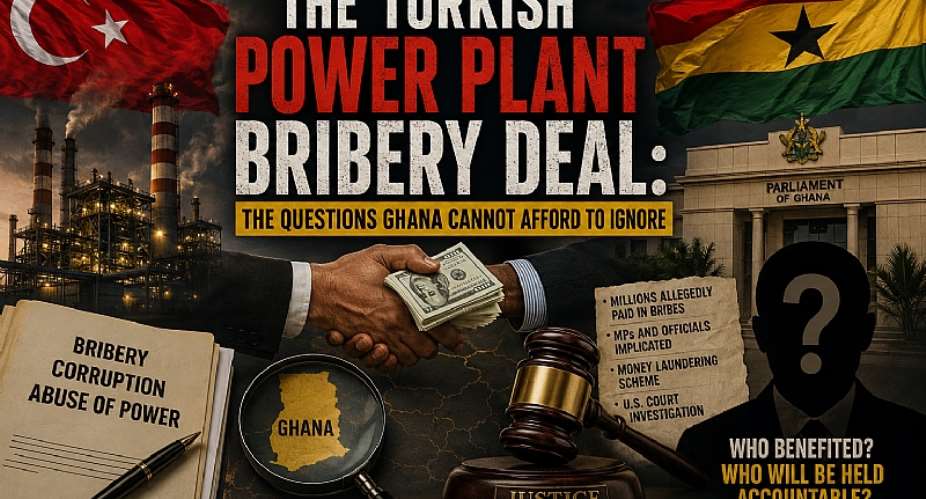
For years, Ghana's energy sector has attracted billions of dollars in foreign investment to solve electricity shortages. Yet one of those investments has become the subject of a major corruption prosecution in the United States, raising uncomfortable questions about governance, accountability, parliamentary oversight, and the integrity of public procurement.
It is important to separate allegations from proven facts. The U.S. criminal case remains before the courts, and the accused, Asante Kwaku Berko, is presumed innocent unless proven guilty. However, the allegations contained in U.S. court filings are detailed enough to deserve careful public scrutiny.
The Historical Background
The controversy traces back to Ghana's electricity crisis popularly known as dumsor between 2014 and 2016. Faced with crippling power shortages, Ghana sought emergency power generation from independent power producers.
One proposal involved a Turkish energy company seeking approval to construct and operate a power plant in Ghana. According to the U.S. Department of Justice, Asante Berko, then an executive director at a Goldman Sachs subsidiary in London, helped arrange financing and approvals for the project.
The U.S. indictment alleges that between December 2014 and March 2017, Berko and others conspired to bribe Ghanaian public officials to secure the necessary governmental approvals for the project.
What the U.S. Court Documents Allege
The U.S. government alleges that:
Bribes were paid to influence government approvals.
Money moved through U.S. and international banking systems, giving U.S. authorities jurisdiction under the Foreign Corrupt Practices Act (FCPA).
False consultancy invoices were allegedly used to disguise the payments.
The alleged conspiracy included money laundering through several bank accounts.
These are allegations presented by prosecutors and are yet to be determined at trial.
How Much Money Was Allegedly Involved?
Different U.S. proceedings refer to different figures because they address different parts of the alleged scheme.
According to the SEC's civil complaint:
Between US$3 million and US$4.5 million was allegedly intended for bribery.
At least US$2.5 million was allegedly transferred to a Ghanaian intermediary.
Berko allegedly personally paid more than US$60,000 to Members of Parliament and other officials.
More than US$200,000 was allegedly distributed to additional government officials.
The later criminal indictment specifically alleges numerous individual payments, including:
Five Ghanaian officials allegedly received US$5,000 each during an all-expenses-paid trip to Turkey.
Emails allegedly discussed another US$250,000 in planned or completed payments, including US$20,000 for individuals described as "MoP Girls" within Ghana's Ministry of Power.
Were Members of Parliament Named?
This is where public discussion must remain accurate.
The U.S. filings do not publicly identify individual Members of Parliament by name. Instead, they allege that bribes were paid to members of Ghana's Parliament and other officials but leave many individuals unidentified in the publicly available documents.
Therefore, it would be inaccurate to state that specific MPs have been publicly named by the U.S. court documents.
How Were the Alleged Bribes Paid?
According to prosecutors, the scheme allegedly involved:
consultancy agreements,
intermediary companies,
international bank transfers,
reimbursements disguised as consulting fees,
cash payments,
and an all-expenses-paid overseas trip to Turkey during which officials allegedly received cash allowances.
How Did U.S. Authorities Discover the Alleged Scheme?
Many Ghanaians have asked why U.S. investigators uncovered the alleged misconduct before Ghanaian authorities.
The answer lies largely in jurisdiction.
The alleged transactions reportedly passed through the U.S. financial system while involving an executive working for a U.S.-linked financial institution. That brought the conduct within the reach of the U.S. Foreign Corrupt Practices Act and prompted investigations by the FBI, the U.S. Department of Justice, and the SEC.
That does not necessarily mean Ghanaian authorities knew nothing; it means the U.S. had an independent legal basis to investigate because of the use of its financial system and the nationality of the accused.
Why Has the Case Returned to the Headlines?
In July 2024, Berko was extradited from the United Kingdom to the United States to face criminal charges after fighting extradition. He pleaded not guilty, and the criminal proceedings continue.
Public Reaction
Across Ghana, commentators, civil society organisations, and citizens have expressed concerns about:
whether Ghana's procurement system is sufficiently protected;
whether Parliament's approval processes can be influenced;
whether anti-corruption institutions have enough investigative capacity; and
whether Ghana depends too heavily on foreign authorities to expose corruption involving Ghanaian public officials.
The TOR Appointment Question
One of the most debated public issues is that Berko was later appointed to lead the Tema Oil Refinery (TOR).
This naturally raises questions such as:
Were adequate background checks conducted before the appointment?
Did appointing authorities have access to all relevant information at the time?
Were any allegations already known?
If concerns existed, how were they evaluated?
These are legitimate governance questions. However, without official evidence, it would be speculative to conclude that the appointing authorities knowingly ignored wrongdoing.
What Parliament Should Be Asking Itself
If Parliament's own approval process can allegedly become a target for bribery, then Parliament must ask difficult questions:
Are parliamentary approval systems sufficiently insulated from improper influence?
How are conflicts of interest identified?
Should declarations of gifts and sponsored foreign travel become mandatory and publicly disclosed?
How often are procurement approvals independently audited?
Should MPs involved in approving billion-dollar agreements undergo enhanced financial disclosure?
These questions are about strengthening institutions rather than assuming guilt.
The Bigger National Consequences
If corruption influences major energy contracts, the consequences extend beyond politics.
Citizens may ultimately pay through:
higher electricity costs,
expensive contracts,
increased public debt,
reduced investor confidence,
weakened trust in democratic institutions,
and fewer resources for education, healthcare, roads, and social services.
Corruption is not only a legal issue it is an economic one.
The Hard Questions Nobody Wants to Ask
Perhaps the most important questions are these:
Why do foreign investigators repeatedly uncover alleged corruption involving Ghana before Ghana's own institutions do?
If foreign prosecutors can trace international money flows, why can't domestic agencies?
Are Ghana's due diligence systems strong enough for appointments to strategic state institutions?
Should Parliament investigate whether its own procedures need reform?
How many major contracts have never been independently reviewed?
If no Ghanaian public official has been charged domestically, does that reflect a lack of evidence, limited investigative capacity, or something else?
What lessons should Ghana learn to reduce the risk of future corruption in strategic infrastructure projects?
Conclusion
The Turkish power plant case is ultimately about more than one individual. It is a test of Ghana's institutions.
The U.S. prosecution alleges a sophisticated bribery scheme involving international financial transactions and efforts to influence public decision-making. Those allegations remain to be tested in court, and all defendants are entitled to the presumption of innocence.
For Ghana, however, the broader challenge is institutional: ensuring that procurement, parliamentary oversight, and appointments to key public offices are transparent, accountable, and resilient against corruption. Whatever the outcome of the U.S. proceedings, the case underscores the importance of robust governance and the need for continual strengthening of anti-corruption systems.
By:
Patrick Belebang Yagsori
+233240292413
[email protected]

 Government upholds Adamus mine lease revocation, assures workers of job security
 SDA partners government to complete selected Agenda 111 projects
 I never met Asante Berko or received money from him — Kwabena Donkor denies brib...
 Cabinet grants approval for resumption of work on stalled theatre projects in Ku...
 IGP promotes 25 police officers who helped bust robbery syndicates, intercept co...
 Will President Mahama Stop Deceiving Ghanaians And Tell Us What Happened To The ...
 Ghana Maritime Authority facilitates repatriation of 12 stranded seafarers
 Invite me to Parliament and let me expose your lies about GoldBod — Sammy Gyamfi...
 Atronie community goes berserk, performs night rituals in worsened Amoma river t...
 Let's not make former TOR MD bribery case NDC-NPP issue — Vicky Bright

