




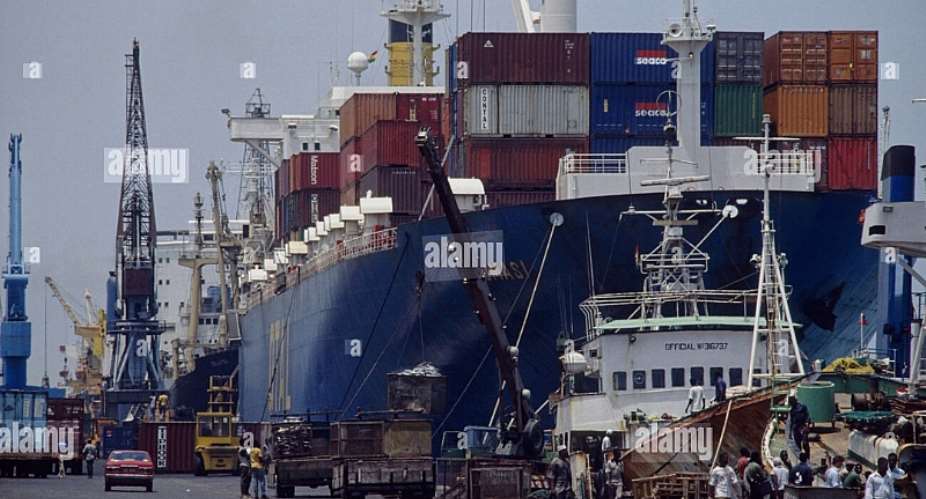
Across Ghana’s ports from Tema to Takoradi a quiet but explosive economic question continues to echo among traders, clearing agents, and ordinary citizens:
How did we get to a point where clearing a car or container costs more than the item itself?
And more importantly:
Who is benefiting from this system? Who is accountable for it? And why does it still exist despite repeated political promises?
The Reality at the Ports: A System of Layers Upon Layers
Importing goods into Ghana is not a simple “pay duty and collect” process. Instead, it is a multi-layered structure of taxes, levies, and administrative charges.
A typical import bill may include:
Import Duty (5%–35% depending on goods)
VAT and NHIL
ECOWAS Levy
African Union Import Levy
Special Import Levy
EXIM Levy
Examination and Processing Fees
Network Charges
Destination inspection charges
And other statutory or administrative fees
According to Ghana Revenue Authority structures, these charges are often stacked in a way that tax is calculated on tax, increasing the final bill significantly.
This is where the problem begins:
When multiple levies are applied on a single CIF value (Cost, Insurance, Freight), the cumulative effect multiplies the burden beyond normal trade expectations.
The Shock Factor: 20+ Levies on a Single Item
Even former President John Mahama has publicly expressed shock at the number of charges imposed at Ghana’s ports.
In one example, a single imported vehicle was subjected to more than 20 different levies, including AU levy, ECOWAS levy, COVID-related charges, and multiple institutional fees.
This raises a disturbing question:
At what point does taxation stop being revenue mobilization and start becoming economic punishment?
The AU and ECOWAS Question: Are Regional Levies Still Fit for Purpose?
Two of the most controversial charges are:
ECOWAS Levy
African Union (AU) Levy
Originally, these were designed to support regional integration, infrastructure, and economic cooperation.
But citizens are now asking:
What tangible benefits are visible on the ground?
Why do these levies still exist in the era of economic hardship?
Are citizens funding institutions they barely benefit from?
And the harder question:
If regional integration is the goal, why does trade within Africa still feel more expensive than trade with Europe or Asia?
Why Clearing Becomes More Expensive Than the Goods
This is the economic paradox frustrating traders:
1. Tax stacking effect
Each layer is calculated on top of another, inflating total cost.
2. Cedi depreciation
As exchange rates rise, import bills automatically increase.
3. Administrative fragmentation
Multiple agencies collect different charges instead of a unified system.
4. Informal cost pressure
Clearing agents often cite “delays and facilitation costs” that indirectly increase total expense (a widely discussed issue among traders and logistics operators).
What People Are Saying: The Ground Reality
Across Ghana, especially among youth traders and small importers, the sentiment is consistent:
“Importing is now a luxury.”
“It’s cheaper to buy locally even if it’s imported already.”
“Ports are for revenue, not trade facilitation.”
“You clear a car for 100,000 cedis and wonder if you bought the car twice.”
Online discussions and trader associations repeatedly highlight frustration over unpredictability and cost escalation.
One recurring concern is:
The lack of transparency in final landed cost before goods arrive.
Is Ghana Discouraging Imports or Managing Revenue?
Governments argue that port charges are necessary for:
Revenue generation
Infrastructure development
Debt servicing
Public services financing
But critics argue:
The structure has shifted from “facilitating trade” to “maximizing extraction.”
And that raises a bigger question:
Is Ghana building an economy of production or an economy of import taxation?
Political Promises vs Reality
During opposition campaigns, many political leaders including current President Mahama at the time criticized excessive port charges and promised reforms.
However, citizens now ask:
What has changed structurally?
Why are multiple levies still active?
Why is clearing still unpredictable and expensive?
This creates a trust gap:
When political promises meet institutional inertia, citizens begin to doubt whether reform is even possible.
Impact on the Ghanaian Economy
The consequences are far-reaching:
1. Inflation of goods
Imported goods become significantly more expensive.
2. Youth economic exclusion
Young entrepreneurs struggle to import goods for resale.
3. Growth of informal markets
People bypass formal import channels or under-declare goods.
4. Smuggling incentives
High legal costs push illegal alternatives.
5. Vehicle affordability crisis
Even used cars become unreachable for average young people.
Is This Why Cars and Goods Are So Expensive?
Yes partly.
But not only because of taxes alone:
Exchange rate pressure
Freight costs
Global inflation
And most critically: domestic port charges stacking system
Together, they create a pricing structure where:
A used car can attract taxes and levies that rival or exceed its market value abroad.
The Hard Questions No One Wants to Ask
Here is where the national conversation becomes uncomfortable:
Why are there over 20 separate levies instead of one transparent import tax?
Why are regional AU/ECOWAS levies still charged without visible impact?
Why is port clearance still unpredictable in 2026?
Why do clearing agents often act like “gatekeepers” instead of facilitators?
Who benefits from complexity citizens or systems?
If reform was promised years ago, why does the structure feel unchanged?
And perhaps the most important question:
Is the system designed for trade efficiency or revenue extraction at all costs?
Conclusion: A System at a Crossroads
Ghana’s ports remain one of the most critical gateways to the economy but also one of its most controversial pressure points.
The debate is no longer just about taxes.
It is about:
Transparency
Economic fairness
Youth opportunity
Regional policy relevance
And the future of trade competitiveness in West Africa
Until these questions are addressed openly, the same reality will persist:
A country where importing is essential but increasingly unaffordable.
By:
Patrick Belebang Yagsori
+233240292413
[email protected]
 GTEC questions dismissal of Bolgatanga Technical University Vice Chancellor
 'You can't come and abuse Ghana's resources and run away to avoid accountability...
 Dr. Adutwum Campaign Aide appeals for calm as Ken Agyapong row deepens
 Mahama demands strict quality checks before road payments
 Turmoil in NPP as Ken Agyepong supporters blast executives over alleged dismissa...
 June 27: Cedi sells at GHS12.30 on forex market, GHS11.30 on BoG interbank
 Odaw River dredging to be completed by December 2027 — Works Minister
 Appointees must stay in Ghana for one year after office — Kofi Bentil proposes
 2026 World Cup: Africa sets new record with seven teams reaching knockout stage
 2026 World Cup: Black Stars secure Round of 32 qualification ahead of Croatia cl...


