




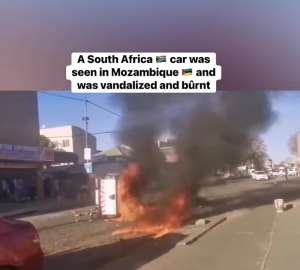
When a South African-registered vehicle was reportedly vandalized and set ablaze by a group of youths in Mozambique, the incident immediately sparked outrage, concern, and speculation across social media. Images and videos circulated rapidly, with many people asking a simple question: Why would a car be attacked simply because it came from South Africa?
But beneath the flames lies a much deeper story—one that touches on history, politics, economics, crime, migration, border security, and growing frustrations among ordinary citizens on both sides of the border.
The destruction of a vehicle may appear to be an isolated act of vandalism. Yet history teaches us that such incidents often reveal tensions that have been building for years beneath the surface.
The First Question Nobody Wants to Ask: Why Was the Car There?
Before emotions take over, investigators must establish the facts.
Why was the South African vehicle in Mozambique?
Was it being used for tourism?
Was it transporting goods?
Was it crossing through a legal border post?
Was it connected to commercial activities?
Or was it simply in the wrong place at the wrong time?
These questions matter because Southern Africa has long struggled with cross-border vehicle theft and smuggling operations. South African authorities have repeatedly reported the recovery of stolen vehicles being trafficked into Mozambique through criminal syndicates operating across borders. Authorities have also made numerous arrests connected to vehicle smuggling networks.
If the vehicle was legitimately owned and legally present, then its destruction represents a serious attack on property and public order.
If investigators discover other circumstances, then understanding those circumstances becomes equally important.
Facts must come before assumptions.
The Historical Background
Mozambique and South Africa share one of Africa's most important economic and social relationships.
For decades, Mozambicans have traveled to South Africa seeking employment opportunities in mining, agriculture, construction, and domestic work.
Likewise, South African businesses, tourists, and investors have maintained a significant presence in Mozambique.
The two countries are deeply interconnected.
However, the relationship has not always been smooth.
Over the years, allegations of cross-border crime, vehicle smuggling, illegal migration, corruption, and border insecurity have periodically strained relations. South African police and border authorities have repeatedly reported cases involving stolen vehicles allegedly transported into Mozambique through criminal networks.
This background creates an atmosphere where suspicion can sometimes replace evidence.
What Are People Saying?
Social media reactions have been divided.
One group argues that the burning of the vehicle was criminal and unjustifiable regardless of its origin.
Another group claims that frustrations over crime, economic hardship, and political tensions are increasingly fueling hostility toward outsiders.
Others warn against jumping to conclusions before authorities complete their investigations.
Some South Africans see the attack as anti-South African sentiment.
Some Mozambicans argue that isolated acts should not be used to judge an entire nation.
The truth is that both countries have millions of law-abiding citizens who continue to cross borders peacefully every year.
What Is the Police Saying?
At the time of writing, any official police conclusions should be treated carefully until verified through formal investigations.
The most important responsibilities of law enforcement are:
- Identifying the individuals involved.
- Determining the motive.
- Establishing whether the attack was spontaneous or organized.
- Confirming whether the vehicle was legally present.
- Assessing whether any criminal networks were connected to the incident.
Without these facts, speculation can easily inflame tensions.
The Question Nobody Wants to Ask: Did Rumors Fuel the Violence?
Across the world, mobs have often acted based on rumors rather than evidence.
Was the vehicle targeted because of verified information?
Or because someone claimed something without proof?
How many people participating in the destruction actually knew who owned the car?
How many knew why it was there?
How many simply followed the crowd?
History repeatedly shows that crowds can become dangerous when emotions outrun facts.
Reactions from South Africans
Many South Africans are likely to view the incident as alarming.
For business owners, truck operators, tourists, and transport companies, such images raise concerns about safety.
Some will ask whether South African vehicles are becoming targets.
Others will question whether authorities are doing enough to protect cross-border travelers.
Many South Africans may also fear retaliation narratives that could further damage regional relationships.
What Is the Government Saying?
Governments generally seek to prevent incidents like these from escalating into diplomatic disputes.
Mozambique and South Africa have strong economic ties and significant shared interests.
Authorities in both countries understand that inflammatory rhetoric could harm trade, tourism, and regional cooperation.
Historically, both governments have worked together on issues involving border security, vehicle theft, organized crime, and migration.
The expectation will be for authorities to investigate thoroughly and ensure accountability where necessary.
The Economic Consequences
The destruction of a single vehicle may appear minor.
Yet symbols matter.
Investors watch.
Tourists watch.
Transport companies watch.
Foreign governments watch.
If incidents of mob violence become normalized, confidence suffers.
Questions emerge:
Will tourists feel safe crossing borders?
Will businesses increase security costs?
Will transport routes become more expensive?
Will insurance premiums rise?
Even isolated incidents can create lasting perceptions.
A Region Already Under Pressure
The timing is particularly sensitive.
Southern Africa has recently witnessed political tensions, protests, migration debates, and episodes of xenophobia.
Both Mozambique and South Africa have experienced periods of unrest that have affected movement, trade, and public confidence.
Against this backdrop, any attack involving nationality can quickly become bigger than the incident itself.
The Most Dangerous Question of All
What happens when ordinary citizens begin acting as investigators, judges, and executioners?
Today it is a vehicle.
Tomorrow could it be a truck driver?
A tourist?
A business owner?
An innocent traveler?
Mob justice rarely stops where it starts.
Once people believe suspicion is enough to justify punishment, everyone becomes vulnerable.
The Bigger Lesson
The burning of a South African vehicle in Mozambique is not merely a story about a car.
It is a story about trust.
Trust in police.
Trust in institutions.
Trust between neighboring countries.
Trust between ordinary citizens.
The vehicle can be replaced.
The deeper challenge is rebuilding confidence that disputes, suspicions, and grievances will be resolved through law rather than through flames.
And perhaps the question Southern Africa must ask itself is this:
If people no longer trust the justice system to uncover the truth, what prevents every rumor from becoming the next act of violence?
That question may matter far more than the fate of a single vehicle.
 Mexican archaeologists unearth 'unprecedented' ancient ruins with Mayan features
 Trans-Saharan Gas Pipeline: an African dream that could reshape world energy mar...
 Israel, Hezbollah agree to ceasefire in Lebanon as attacks strain US-Iran interi...
 DR Congo's deadly Ebola outbreak is 'evolving fast', WHO warns
 NACOC raids Central University, arrests 5 students in possession of wee-infused ...
 Ireland deports 42 South Africans
 Chief Justice Baffoe-Bonnie's Canada trip self-funded — Judicial Service
 Boakye Agyarko is best suited to lead NPP as National Chairman – Kpandai MP
 African Union condemns deadly Niamey airport attack, pledges support to Niger
 Ghana invests too little in early childhood despite 80% poverty rate among under...


