




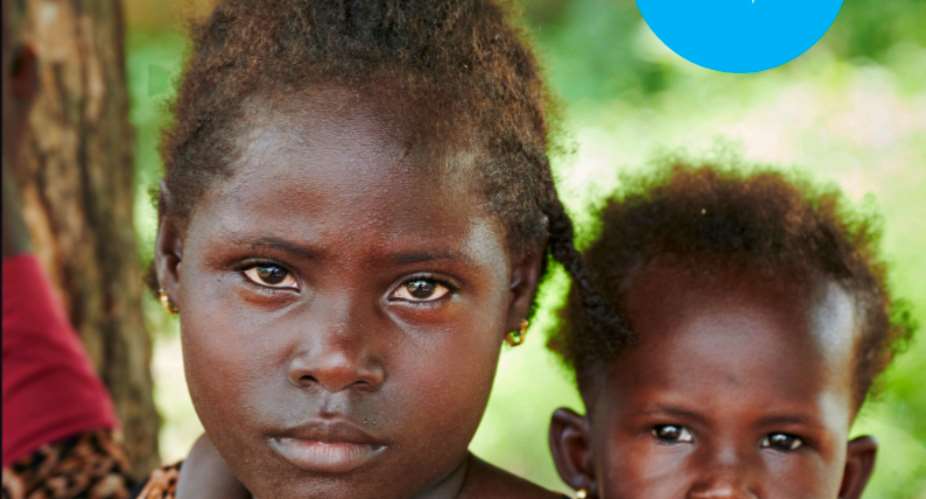
A new UNICEF Ghana report has revealed that public investment in Ghana's youngest children remains significantly low despite evidence that the early years of life offer the greatest opportunity to improve child development and reduce poverty.
The report, launched at a media engagement in Accra on Wednesday, June 17, found that children from conception to age five receive only about 13 per cent of total public spending on children, even though they make up roughly one-third of the country's child population.
It also highlighted inequalities in public investment, showing that children from wealthier households receive nearly twice as much public spending per capita as those from poorer families.
Speaking to ModernGhana News on the sidelines of the engagement, UNICEF Ghana's Chief of Social Policy and Inclusion, Pauliina Sarvilahti, urged Ghana to prioritise investment in early childhood development, noting that the country's youngest children are also the most vulnerable.
“In Ghana, we have 73% of kids who are multidimensionally poor, and from that group we have from zero to five who are poor. It's 80% who are poor. So it's actually the most vulnerable group. We need to be intentional to address that group, bring them on board, every child of that group,” she said.
The study, titled "Unlocking Potential Early: Rebalancing Public Spending for Children in Ghana," is the first age-based analysis of public spending on children in the country, covering the period from pregnancy to age 17.
According to the report, Ghana mirrors a wider trend across Sub-Saharan Africa where governments invest heavily in older children, particularly through education, while spending in the earliest years remains limited.
“Currently Ghana invests too little, too late, and unevenly in children, particularly in the earliest years when investment has the greatest impact on lifelong outcomes,” the report stated in part.
The analysis found that although Ghana has made progress in areas such as immunisation, under-five mortality reduction and pre-primary education enrolment, major gaps remain in nutrition, child protection, birth registration, childcare services and income support for families with young children.
The report noted that education accounted for 3.1 per cent of Ghana's Gross Domestic Product (GDP) in 2023, compared to just 0.23 per cent for social protection and about 2.0 per cent for health.
It further observed that Ghana had no statutory child grants in either 2015 or 2021, forcing many families to rely on private resources to access services intended for children.
UNICEF said the recently approved Early Childhood Care and Development (ECCD) Policy provides an opportunity for Ghana to redirect investment towards the first years of life and address inequalities before they become entrenched.
The organisation is recommending increased funding for early childhood interventions, including child grants, parental leave, childcare services, health, nutrition and family support programmes.
“A comprehensive and balanced investment package estimated at only 7.2% of GDP could eliminate child poverty within three years, prevent up to 18,000 premature child deaths, significantly reduce stunting, achieve full vaccination coverage, achieve near universal birth registration, improve school readiness and enrolment,” the report said.
Mrs Sarvilahti stressed that implementing the ECCD Policy effectively could generate long-term benefits for both children and the country's development.


 'Systemic failure due to NACOC removal from port inspections' – Inusah Fuseini o...
 Akyem Oda commercial drivers raise fares arbitrarily amid commuter concerns
 Two arrested over alleged GH¢22,000 SHS placement scam
 Police uncover alleged network behind Ghana Jollof videos
 NACOC says cocaine suspects were under surveillance for up to two years
 Suhuyini assures Accra-Kumasi Expressway won’t miss December 2028 deadline
 Foreign Affairs Ministry releases 200-page RTI response on GH¢49.7m South Africa...
 Chartered flights account for GH¢27.18m of South Africa evacuation cost
 Foreign Affairs Ministry requests special audit of emergency evacuations since 2...
 France calls on Moscow to reverse takeover of European assets


