




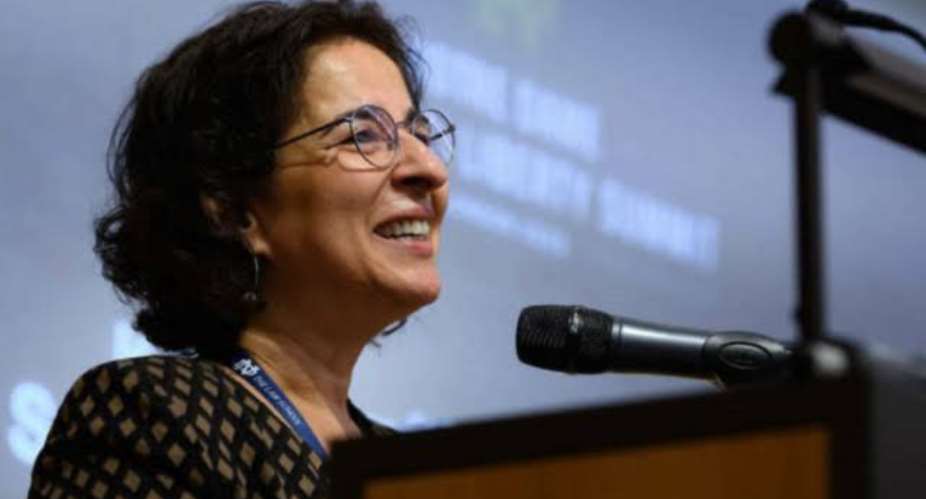
When the United Nations Special Rapporteur on Freedom of Religion or Belief, Dr. Nazila Ghanea, visited Zambia in April 2025, she met with a wide range of stakeholders, including government officials, religious leaders, academics, civil society organisations, and representatives of diverse belief communities. The purpose of the mission was to gain a deeper understanding of the state of freedom of religion or belief in Zambia and to identify challenges that may affect the enjoyment of this fundamental human right. ( Latest Nigerian News )
Among those consulted during the visit was Larry Tepa, the founder and president of the Ethical Society of Zambia (ESZ), a secular humanist organisation he established in 2022. Since its founding, ESZ has sought to promote ethical living, human rights, critical thinking, education, community development, and freedom of conscience for people of all beliefs and none.
Tepa's participation in the consultations was significant because he represented a perspective that is often absent from national conversations about religious freedom. While Zambia's discussions on religion frequently focus on relationships between different Christian denominations and other faith communities, the rights and experiences of nonreligious citizens are rarely examined with the same level of attention.
As an atheist leader and one of the country's most visible secular activists, Tepa was uniquely positioned to provide insight into what freedom of religion or belief looks like from the perspective of someone outside the religious majority. His experiences offered a practical example of the challenges that can arise when nonreligious individuals seek equal recognition within a society that strongly identifies with a particular faith tradition.
One of the reasons his perspective was particularly relevant to the UN inquiry was his own experience with public controversy. Years before meeting the Special Rapporteur, Tepa found himself at the center of a national debate when plans for a humanist and atheist gathering generated intense criticism from religious groups and commentators. Some critics openly called on the government to intervene and prevent the event from taking place. Others questioned whether atheists should be allowed to organize publicly in a country that constitutionally identifies itself as a Christian nation.
The controversy attracted attention both inside and outside Zambia. For supporters of freedom of belief, the incident became a test of whether constitutional protections applied equally to all citizens regardless of their worldview. For critics, it raised questions about the place of atheism and secularism within Zambian society.
Although the conference itself became the subject of heated debate, the larger issue was never simply about one event. The controversy highlighted broader concerns about social acceptance, equal treatment, and the ability of minority belief groups to participate openly in public life. It demonstrated that while legal protections for freedom of conscience may exist, social and cultural barriers can still make exercising those freedoms difficult.
These are precisely the kinds of issues that fall within the mandate of the UN Special Rapporteur on Freedom of Religion or Belief. International human rights standards recognize that freedom of religion or belief protects not only religious communities but also atheists, agnostics, humanists, freethinkers, and others who do not subscribe to a religion. The right includes the freedom to adopt, change, reject, or express beliefs without fear of discrimination or coercion.
During her visit, Dr. Ghanea emphasized that Zambia possesses constitutional provisions that could provide stronger protections than have thus far been realized in practice. She observed that the scope of freedom of religion or belief has often been interpreted too narrowly and stressed the importance of ensuring equal protection for all communities, including minorities. She also noted that countries with a strong religious majority have a heightened responsibility to ensure that minority beliefs are respected and protected. ( eu-africa-chamber.org )
For Tepa, the consultation represented an opportunity to bring attention to concerns that are often overlooked in discussions about religious freedom. Rather than speaking solely as an individual, he was able to share experiences gathered through years of engagement with Zambia's secular and humanist communities. These experiences included accounts of social stigma, misunderstanding, exclusion, and the broader challenge of creating space for diverse worldviews within a religiously conservative environment.
The meeting also marked an important milestone for the Ethical Society of Zambia. Just three years after its establishment, the organisation had become part of an international conversation on human rights and freedom of conscience. What began as a local initiative had grown into a platform capable of contributing to discussions taking place at the highest levels of global human rights advocacy.
The significance of this moment extends beyond Larry Tepa or the Ethical Society of Zambia. It reflects a broader principle that freedom of religion or belief belongs to everyone. It is not a right reserved for the majority, nor is it limited to those who hold religious beliefs. It applies equally to people of faith and to those who choose a secular path.
As Zambia continues to navigate questions of identity, diversity, and constitutional rights, the participation of voices like Tepa's in international human rights consultations serves as a reminder that a truly free society is one in which every person can live according to their conscience. The fact that an atheist leader who once faced calls for government intervention against his activities could later contribute to a United Nations assessment of religious freedom is itself evidence of the importance of protecting that principle.
The journey from public controversy to a consultation with the United Nations illustrates not only the persistence of one activist, but also the continuing evolution of the conversation about freedom of belief in Zambia.

 New York mayor to ask Trump for ICE withdrawal after agents shoot man in car wit...
 Ukraine takes Russia fight to 'scorching sands' of Sahel
 Clashes lead South Africa to withdraw asylum processing order
 Brazil’s Flavio Bolsonaro wins third-place candidate’s support against Lula
 OpenAI bans Russian, Iranian ChatGPT propaganda networks
 Mahama to cut sod for Accra Convention Centre project – Kwakye Ofosu
 Mahama administration committed to stamping out cybercrime – Sam George
 Africa must strengthen strategic positioning amid global power shifts – ECOWAS
 PAC grills GHS over transport officer who allegedly sold seven state vehicles wi...
 Pentecost Church elder was arrested over GH¢200,000 fraud case, not kidnapped – ...


