




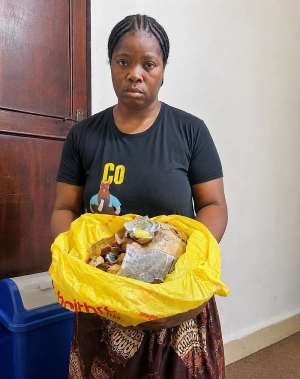
The conviction of 37-year-old South African national Asandra Denise by the High Court of Sierra Leone has sparked intense debate across Africa.
On 18 June 2026, Justice Andrew S.C. Johnson sentenced Denise to a cumulative 130 years in prison after she was found guilty on five cocaine trafficking charges. Although the sentences will run concurrently, reducing the effective sentence to 30 years, the case has nevertheless sent shockwaves through South Africa and beyond.
Authorities say she was arrested at Freetown International Airport after being found with 365 pellets of compressed cocaine weighing approximately 5.4 kilograms. She pleaded not guilty, but the court ruled that the prosecution had proved its case beyond reasonable doubt.
Yet beyond the courtroom lies a larger story—one that forces uncomfortable questions about crime, migration, xenophobia, and truth.
WHO IS ASANDRA DENISE?
Publicly available information identifies her as a South African citizen from the Eastern Cape Province. Beyond that, little is known.
What led her to Sierra Leone?
Was she acting alone?
Who recruited her?
Was she a courier, a trafficker, or a small piece of a much larger transnational drug network?
These are questions that have received far less attention than the nationality of the accused.
A QUESTION SOUTH AFRICA MAY NOT WANT TO ANSWER
For years, many South Africans have argued that foreign nationals are largely responsible for drug trafficking, organized crime, and social instability.
Political activists, anti-immigration groups, and some community organizations have repeatedly pointed fingers at Nigerians, Zimbabweans, Mozambicans, Ethiopians, Somalis, and other African migrants.
But what happens when a South African citizen is convicted abroad for trafficking a large quantity of cocaine?
Does this case challenge the narrative that drugs are primarily a "foreign problem"?
Or will it simply be dismissed as an isolated incident?
If a Nigerian, Ghanaian, or Zimbabwean woman had been arrested with 5.4 kilograms of cocaine, would the public conversation look different?
Would headlines have been harsher?
Would social media reactions have been more aggressive?
These are difficult questions, but they deserve answers.
ARE SOUTH AFRICANS TELLING THE WORLD THE FULL STORY?
South Africa has witnessed repeated waves of xenophobic violence over the past two decades.
Foreign-owned businesses have been looted.
Migrants have been assaulted.
Lives have been lost.
The justification often presented is that foreigners are taking jobs, running criminal enterprises, and flooding communities with drugs.
But does the evidence support such sweeping claims?
Or are entire communities being blamed for crimes committed by individuals?
The arrest and conviction of Asandra Denise raises a troubling possibility: perhaps the drug trade is not simply an imported problem. Perhaps it is also being sustained by local actors, local demand, and local networks.
If South Africans accuse foreigners of bringing drugs into their communities, who was Asandra Denise allegedly working for?
Who was expected to receive the cocaine?
Who was expected to profit from it?
Who creates the demand that makes trafficking profitable in the first place?
WHO WAS THE COCAINE FOR?
This may be the most important question of all.
Drug traffickers do not move kilograms of cocaine without a market.
Someone was expected to buy it.
Someone was expected to distribute it.
Someone was expected to consume it.
When authorities arrest a courier, society often celebrates a victory. But the larger network frequently remains hidden.
Was Denise transporting the drugs to Sierra Leone?
Was Sierra Leone merely a transit point?
Were there buyers waiting elsewhere in Africa?
Who financed the operation?
Who stands to gain financially?
Without answers to these questions, the public sees only the face of the courier while the architects of the trade remain invisible.
WHAT DOES THIS MEAN FOR HER FAMILY?
Behind every conviction is a human story.
A 30-year prison sentence is not merely a punishment for the offender. It also affects parents, siblings, children, and loved ones.
How are her family members coping?
Did they know anything about her activities?
Were they shocked by the allegations?
Do they believe she is innocent?
Do they feel abandoned?
As of now, there is little public information about statements from her relatives.
Yet they too will carry the burden of this case for decades.
WHAT ARE OTHER AFRICANS SAYING?
Across the continent, reactions have been mixed.
Some see the conviction as proof that crime has no nationality and that Africans should stop stereotyping one another.
Others argue that the case exposes the hypocrisy of blaming foreigners for problems that are often homegrown.
Still others insist that one criminal case should not be used to generalize about South Africans any more than crimes committed by foreigners should be used to condemn entire migrant communities.
Perhaps that is the lesson Africa needs most.
Crime is individual.
Nationality is collective.
Confusing the two has often led to injustice.
WHAT DID THE COURT SAY?
The High Court of Sierra Leone concluded that the prosecution successfully established its case beyond reasonable doubt.
Forensic testing confirmed that the substance recovered from the accused was cocaine.
The court therefore convicted her on charges of possession, dealing, collecting, importing, and transporting prohibited drugs.
The sentence sends a clear message that Sierra Leone intends to take a tough stance against drug trafficking.
THE BIGGER QUESTION
The conviction of Asandra Denise is undoubtedly a criminal justice story.
But it is also a mirror.
A mirror held up to South Africa.
A mirror held up to Africa.
A mirror held up to every society that rushes to blame outsiders before examining itself.
When foreigners are accused of drug trafficking, communities often ask, "Where did they come from?"
Perhaps the more important question is:
Who is buying the drugs?
Who is funding the networks?
Who is protecting the kingpins?
Who benefits from the narrative that only foreigners are responsible?
Until those questions are answered honestly, Africa may continue fighting symptoms while ignoring the disease.
And perhaps that is the most uncomfortable revelation of all.
By:
Patrick Belebang Yagsori
+233240292413
[email protected]
 Trump unveils new Air Force One converted from luxury jet gifted by Qatar
 Mexican archaeologists unearth 'unprecedented' ancient ruins with Mayan features
 Trans-Saharan Gas Pipeline: an African dream that could reshape world energy mar...
 Israel, Hezbollah agree to ceasefire in Lebanon as attacks strain US-Iran interi...
 DR Congo's deadly Ebola outbreak is 'evolving fast', WHO warns
 NACOC raids Central University, arrests 5 students in possession of wee-infused ...
 Ireland deports 42 South Africans
 Chief Justice Baffoe-Bonnie's Canada trip self-funded — Judicial Service
 Boakye Agyarko is best suited to lead NPP as National Chairman – Kpandai MP
 African Union condemns deadly Niamey airport attack, pledges support to Niger


