




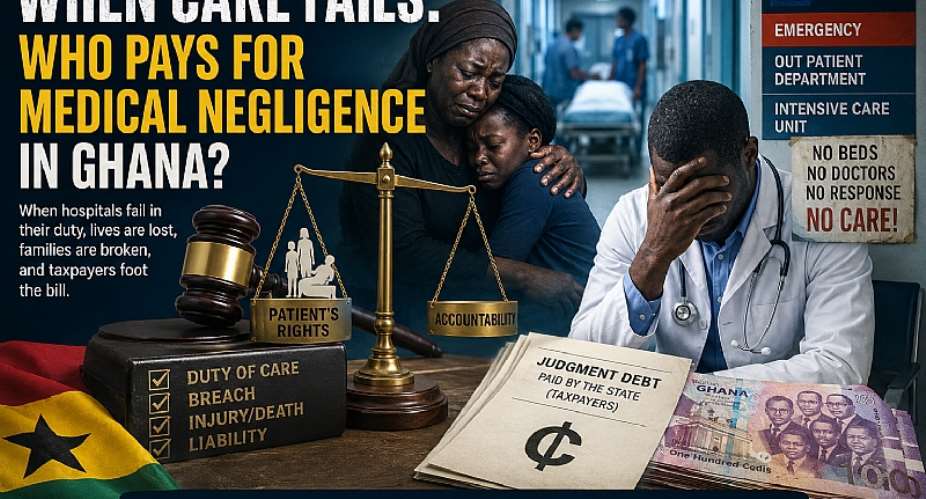
Hospitals are built on trust. Every day, thousands of Ghanaians walk through their doors believing that the doctors, nurses, and healthcare professionals they encounter will do everything within their power to preserve life and restore health. It is a trust born out of necessity, vulnerability, and hope.
But what happens when that trust is broken?
The recent death of Charles Henry Amissah has sparked a national conversation about the quality of healthcare delivery in Ghana and the responsibilities of healthcare institutions toward patients in distress. Reports suggesting that he was unable to receive timely medical attention from multiple health facilities have left many Ghanaians asking difficult questions. While investigations and facts must guide public judgment, the incident has once again drawn attention to a troubling issue that continues to surface in our healthcare system medical negligence.
Years ago, Justice Kweku T. Ackaah-Boafo warned of this growing concern. In Captain J.K. Nyamekye v Attorney-General (GJ/378/2016), he observed that medical negligence was becoming an increasingly significant issue in Ghana and urged healthcare practitioners to pay greater attention to their professional obligations.
His warning remains relevant today.
Medical practitioners occupy one of the most respected professions in society. Their work demands long hours, difficult decisions, and enormous sacrifices. Most healthcare professionals perform their duties diligently and deserve recognition for their commitment to saving lives. However, the respect accorded to the profession cannot shield it from scrutiny when standards fall below what patients reasonably expect.
The law recognizes that healthcare providers owe a duty of care to their patients. This duty requires them to exercise reasonable skill, competence, and diligence in the diagnosis, treatment, and management of medical conditions. When that duty is breached and a patient suffers harm as a result, the law may hold the healthcare provider liable for negligence.
Ghanaian courts have increasingly demonstrated their willingness to enforce this principle.
In Mohammed Mustapha v Attorney-General, Ministry of Health & 2 Others (2024), the High Court awarded damages of GH¢3 million after finding that negligent medical management contributed to the death of the plaintiff's wife following a Caesarean Section. The court determined that appropriate pre-operative and post-operative procedures had not been adequately followed.
Similarly, in Captain J.K. Nyamekye v Attorney-General, substantial damages were awarded against 37 Military Hospital after negligence was found to have contributed to the death of a young woman.
These cases illustrate a critical reality: medical negligence is not merely a legal concept discussed in courtrooms and law schools. It has real consequences for real families. Behind every lawsuit is a grieving spouse, a devastated parent, or children forced to grow up without a loved one.
Yet the legal consequences of medical negligence raise another important question who ultimately bears the financial burden?
In many instances involving public hospitals, compensation awarded by the courts is paid by the State. In effect, taxpayer funds are used to satisfy judgment debts arising from negligent acts committed within public healthcare institutions.
This means that ordinary citizens including victims and their families may indirectly pay for failures that caused their suffering in the first place.
The situation presents a significant policy dilemma. While the State has an obligation to ensure that victims are compensated, it is equally important to consider whether public funds should continuously bear the cost of serious professional lapses.
Should taxpayers be expected to finance the consequences of gross negligence?
Should healthcare professionals whose actions amount to reckless disregard for accepted standards bear a greater share of responsibility?
Should existing disciplinary mechanisms within the healthcare sector be strengthened to improve accountability and deterrence?
These are uncomfortable questions, but they are necessary ones.
The purpose of discussing medical negligence is not to demonize healthcare professionals. Medicine is not an exact science, and not every unfortunate outcome results from negligence. Patients may die despite receiving the highest standard of care. Complications can occur even where every procedure is correctly followed.
However, society cannot ignore situations where established professional standards are disregarded and preventable harm occurs.
The courts often rely on what is known as the Bolam Test, which asks whether a healthcare professional acted in accordance with a practice accepted as proper by a responsible body of medical professionals in that field. The principle protects practitioners who act reasonably and competently. At the same time, it exposes conduct that falls below acceptable professional standards.
Ultimately, accountability strengthens rather than weakens public confidence in healthcare institutions. Patients are more likely to trust a system that acknowledges mistakes, addresses failures, and takes meaningful steps to prevent their recurrence.
The death of Charles Henry Amissah should not merely provoke public outrage for a few news cycles. It should inspire deeper reflection on patient safety, professional responsibility, and the future of healthcare delivery in Ghana.
Every patient who enters a hospital does so with the expectation that their life matters. Every healthcare professional who wears the white coat assumes a profound responsibility toward those entrusted to their care.
When that responsibility is fulfilled, lives are saved and trust is strengthened.
But when care fails, the consequences can be devastating.
And when negligence occurs, the question remains: Who should pay the price?
Author Bio
Emmanuel Twum Barimah is a Senior Administrative Manager with the Ghana Health Service, holds a BA and an MBA in Health Service Management, and is currently a Law student at Pentecost University, Ghana. His research interests include health law, healthcare administration, public policy, and governance.
Email: [email protected]
References
Bolam v Friern Hospital Management Committee [1957] 1 WLR 582.
Captain J.K. Nyamekye v Attorney-General (GJ/378/2016).
Constitution of the Republic of Ghana, 1992.
Ghana Health Service. (2020). National Health Policy: Ensuring Healthy Lives and Promoting Well-Being for All at All Ages. Accra: Ministry of Health.
Mohammed Mustapha v Attorney-General, Ministry of Health & 2 Others (2024).
World Health Organization. (2024). Patient Safety: Global Action on Preventable Harm in Healthcare. Geneva: WHO.

 NDC sets October 20 to open nominations for national executive elections
 Police intercept 866 parcels of suspected cocaine hidden in Gari at Tema Port; a...
 GES condemns assault on Obuasi SHTS headmaster, vows sanctions against students
 Ghana spent over GH¢52bn on diesel and petrol imports in 2025 as fuel dependence...
 I don’t feel safe because I talk; I feel that my mouth will put me into trouble ...
 NPP supporters gather at Supreme Court for 'Democracy Under Attack' protest
 Russian strikes target Ukraine's Kharkiv and Sumy regions, killing at least six
 Iran says Hormuz deal with Oman in final stage as Trump signals breakthrough
 FIFA backs Infantino but apologises over World Cup investment plan
 Fire destroys part of late Murtala Mohammed’s family house in Tamale

