




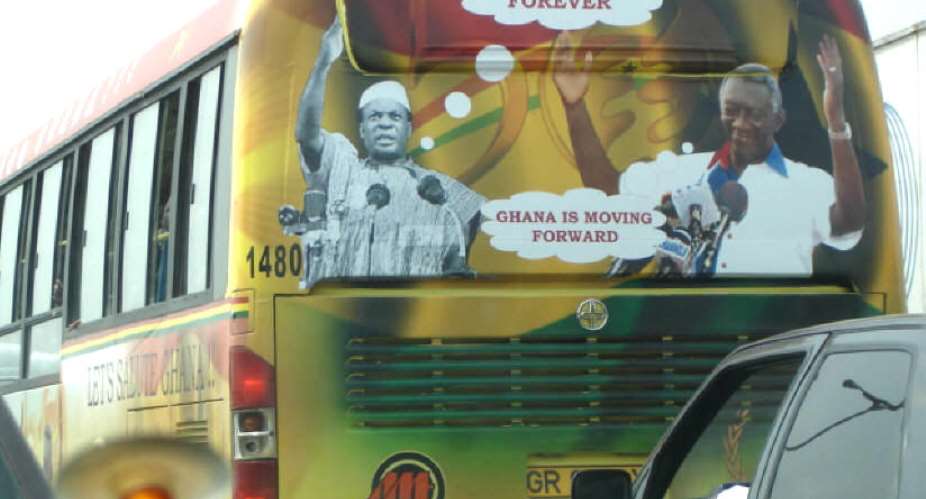
In this world, there is a factor that fuels one's passion to contribute selflessly to the development and progress of States. That is patriotism. It absence in a State leads to chaos, corruption, apathy, and ethnocentrism turning back its clock of development. This has necessitated the clarion calls of many world leaders on their fellow citizens to be patriotic. Famous among them is John F Kennedy, former American president on his inaugural speech to office on January 20, 1961. The former and late president told his fellow Americans "Ask not what your country can do for you. Ask what you can do for your country". Also, President Nana Addo Danquah Akuffo Addo in his august inaugural speech at the Blackstar square in Accra on 7th January 2017 in reiterating the former president of America, George W. Bush, stated, " I urge you to be citizens, not spectators; citizens, not subjects. Responsible citizen building our communities and our nation.." . This was premised on his call on fellow citizens to be at the center the change they voted for. President Akuffo Addo used the medium to set the tone for patriotism with this call on Ghanaians to be active partakers in the running of the country. What then is patriotism? Patriotism is an attachment to a homeland. This attachment can be viewed in terms of different features relating to one's own homeland including ethnic, cultural, political or historical aspects. Patriotism can be defined as the loyalty, dedication, respect, love and sense of duty one has towards a nation and the preparedness to die for the good of that nation. Patriotism is closely related to nationalism. An excess of patriotism in defense of a nation is known as chauvinism.
The enviable sense of patriotism bequeathed to us which is evident in the composition of the national Anthem and the Pledge by forefathers of the Ghanaian society is fast depleting due to failure on the part of political leaders and other public service holders to exhibit exemplary leadership. This is because many of our leaders are so much engrossed with deep seated taste for corruption. Ghana has become a commonplace for corruption since independence. The 2016 edition of the Corruption Perception Index scored Ghana43 points. Although, comparably, Ghana performed better than other countries but the canker of corruption is still prevalent. In the erstwhile Mills- Mahama administration, Ghana witnessed very serious scandals such as the Police recruitment scandal, Ghana Youth Employment and Entrepreneurial Development Authority (GYEEDA), The flying-to-Burkina fowls Savannah Accerelated Development Authority, Subah scandal, the Smarty's bus rebranding deal and the infamous Wayome GHC51 million saga. Currently, the SSNIT $72 Operational Business Suite (OBS) scandal. These unfortunate incidence quench the sense of patriotism of the citizenry as some leaders enrich themselves at the expense of the public good. This creates bad impression on the minds of the people and motivates them to scramble dubiously for the limited national wealth meant for development without cognizant of the repercussion of their corrupt practices on the national kitty and development. Hence, losing their sense of patriotism.
Music they say is the food of the soul. It also remains a powerful tool for communication. Concomitantly, it's role in achieving unity cannot be overlooked. It is not for no reason that national heros like Ephraim Amu and Philip Gbeho sat and composed goods bump-inviting patriotic songs such as Yen Ara Asaase Ni, the national Anthem, the Pledge, Ma Oman Ho Hia Wo, and Ghana Ne Ba. These songs teach us to be selfless, hardworking, and show commitment and dedication to the cause of the nation. All these aimed at injecting a sense of patriotism in the Ghanaian child. One can recall the good old days when patriotic songs were played on GBC radio airwaves early in the morning to awaken our sense of patriotism and nationalism as we step out to our various places of work. This helped many Ghanaians by placing national interest at the center of all their dealings throughout the day, week and the month. Today, with the influx of radio and television stations in the country, it is sad to state that hardly does one hear these patriotic songs been aired on these radio and television stations annihilating our sense of patriotism among Ghanaian.
Again, the missing sense of patriotism in the fabric of the Ghanaian society can be attributed to the prevalence of ethnocentrism fanned by some nation-wrecking political leaders. Ethnicity is not bad in itself, for everyone in this world or here on earth belongs to one ethnic group or another. If you are not a Guan, you may be an Akan, Ga, Ewe, or Dagati. But ethnocentrism or tribalism is very detrimental to national cohesion and development and its debilitating effects cannot be quantified in a nation inhabited by different ethnic groups. Therefore, it is sad to hear some political leaders at rallies consciously deciding to exploit the ethnic differences among the people by uttering ethnocentric speeches that has the potency of plunging the nation into constant chaos and anarchy and derailing our bid to achieve national cohesion and unity. In this regard, it makes people lose sight of the fact that we are one nation with one goal and destiny and as such, ethnocentric statements breed divisiveness among the people in the nation. This in turn corrupt our sense of duty to the nation as a patriotic citizen.
Malfunctioning and malnourished National Commission for Civic Education cannot be spared in discussing the lack of patriotism in the fabric of the Ghanaian society. The 1992 constitution of Ghana (Article233) stipulates unequivocally the functions of the N.C.C.E and they are:
- (a) to create and sustain within the society the awareness of the principles and objectives of this constitution as the fundamental law of the people of Ghana;
- (b) to educate and encourage the public to defend this constitution at all times, against all forms of abuse and violation;
- (c) to formulate for the consideration of Government, from time to time, programmes at the national, regional and district levels aimed at realizing the objectives of this constitution;
- (d) to formulate, implement and oversee programmes intended to inculcate in the citizens of Ghana awareness of their civic responsibilities and an appreciation of their rights and obligations as free people; and
- (e) such other functions as parliament may prescribe.
For the purpose of this discussion, reference will be made to Article 233(a) and (d). These clauses seeks to invoke the sense of patriotism and promote civic competence among the people of Ghana. However, this daunting task placed on the shoulders of the Commission cannot be achieved, if it is not strengthened financially, logistically, materially and staffed with qualified and motivated personnel. Unfortunately, this is not the case, to our dismay. This has culminated to the poor performance of the N.C.C.E with its resultant effect of their inability to instil patriotism in the citizens of mother Ghana.
Failure of Ghana Education Service (GES) and headmasters to recruit trainned and qualified Social Studies teachers. Every nation educates its young people for the long term needs of that country. According to Ayaaba(2009) Social Studies has a crucial role to play in the socio-economic development of the country. Citing the National Council for the Social Studies, Ayaaba opines that the primary purpose of Social Studies is to train the youth to develop the ability to make informed and reasoned decisions for the public good. In this regard, it can be said that the citizenship ideals can be better promoted through the teaching of Social Studies by trained and professional Social Studies teachers. This view goes to accentuate the definition of National Council for the Social Studies which states that Social Studies is an integrated study of the social sciences and humanities to promote civic competence. Blege cited in Ayaaba and Odumah(2007) in support of this definition asserts that Social Studies is citizenship education. And for one to be a good citizen, he or she must be a patriotic citizen first. However, it is unfortunate that our educational system does not insist and ensure teachers specialised in the field of Social Studies are recruited to teach the subject in our various schools. This influx of untrained and unqualified Social Studies teachers in our schools have led to our inability to instil patriotism in the youth of today.
Gideon Adubofuor
0545002012
 Death toll in South Africa bar shooting rises to 18
 Appiah Adomako Writes: Why DVLA Must Stop Treating Every Expired Licence Holder ...
 Ghana renews solidarity with Cuba, calls for unconditional lifting of sanctions
 Ethiopia accuses Eritrea, Sudan of backing Tigray rebels amid clashes
 Israel revokes credentials of Dutch diplomats in West Bank over settlement goods...
 Russian attacks kill eight in Ukraine after Moscow vows to continue war
 Trump expects Iran talks next week after rejecting seven-day truce proposal
 Gov’t to develop policy for Ghanaian sign language in education
 Two Ada SHS students plead guilty to assault, slapped with 12-month bond
 Enlistment: GAF begins documentation, body selection from September 28



Comments
Indeed We lost..Ghanaians A Great Master Piece🤛