




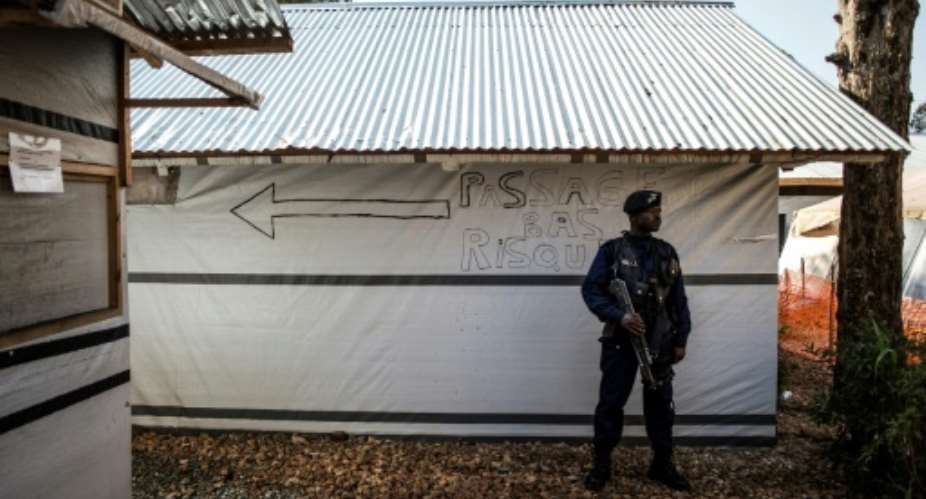
The deadly Ebola outbreak raging in eastern Democratic Republic of Congo should be over within six months, the head of the World Health Organization said Thursday.
Seven months since the outbreak erupted in DRC's violence-torn North Kivu province, WHO Director-General Tedros Adhanom Ghebreyesus told reporters there were clear signs the spread of the virus was "contracting".
"Our target is now to finish it in the next six months," he told reporters in Geneva, warning though that increased unrest in the affected area could reverse the progress being made.
"It's always good to plan beyond the horizon to prepare for any eventualities," he said, while voicing optimism that massive efforts to rein in the outbreak are working.
The ongoing Ebola outbreak, the 10th in DRC's history, emerged in North Kivu in August 2018 and then spread to neighbouring Ituri province.
It has claimed 584 lives out of nearly 1,000 believed to have been infected, WHO said.
Security in eastern DRC, a region rampant with rebel fighters, has dramatically complicated the response, with numerous attacks on Ebola treatment centres.
The Doctors Without Borders (MSF) medical charity has also sounded the alarm over increasingly "toxic" relations with local communities, whose resistance to Ebola response efforts have also fuelled the spread.
MSF pointed out that 40 percent of deaths from the extremely contagious virus are occurring in communities rather than in Ebola treatment centres.
'Contracting'
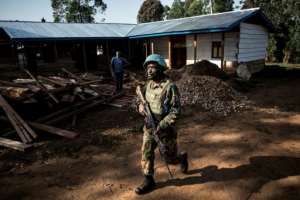 A soldier (pictured March 9, 2019) from the UN Organisation Stabilisation Mission patrols outside an Ebola Treatment Centre in Butembo, as rebel fighters in the region have dramatically complicated the response to the disease. By JOHN WESSELS (AFP/File)
"The Ebola response is failing to bring the epidemic under control," MSF chief Joanne Lieu told reporters in Geneva last week.
But Tedros denied Thursday that this was the case.
"That's not true," he said. "You cannot say it's failing when the outbreak is contracting. It's contracting."
He stressed that over the past seven months, the virus had been contained to North Kivu and Ituri.
"It hasn't spread to other parts of the country and it hasn't spread to neighbouring countries," he said, adding that transmission had been halted in a number of places, including in Beni and Mangina.
"So the cases are now shrinking in certain geographic areas," he said.
Tedros also stressed that the number of new cases had been cut in half since January, with an average of 25 new cases reported each week now compared to 50 at the beginning of the year.
He acknowledged though that violence, unrest and community resistance remained a challenge in Butembo especially, which along with Katwa is where the spread of the virus is now concentrated.
"I don't want to undermine the risk, because it may again (resurge) if the security situation continues to deteriorate," he said, acknowledging that there is still a chance Ebola could spread to other parts of DRC and neighbouring countries.


 Deadly border mine collapse exposes risks behind Central Africa's gold rush
 France, Germany, UK and Italy slam Israel's 'E1' West Bank settler project
 First US deportees land in Liberia
 President Paul Biya back in Cameroon after 73 days away
 Accra-Kumasi return flight now costs up to GH¢5,000 despite lower inflation — Ak...
 NDC using 24-hour markets to cover failure to implement 24-hour economy — Okyere...
 'No African country can solve the problem of road crashes alone' — Transport Min...
 ORC announces temporary disruption to e-Registrar services
 NDC’s GoldBod is a copy of NPP’s plan but implementation has failed — Ocquaye Jr
 Sammy Gyamfi’s words on Afenyo-Markin were harsh; I wouldn’t use them on such pl...

