




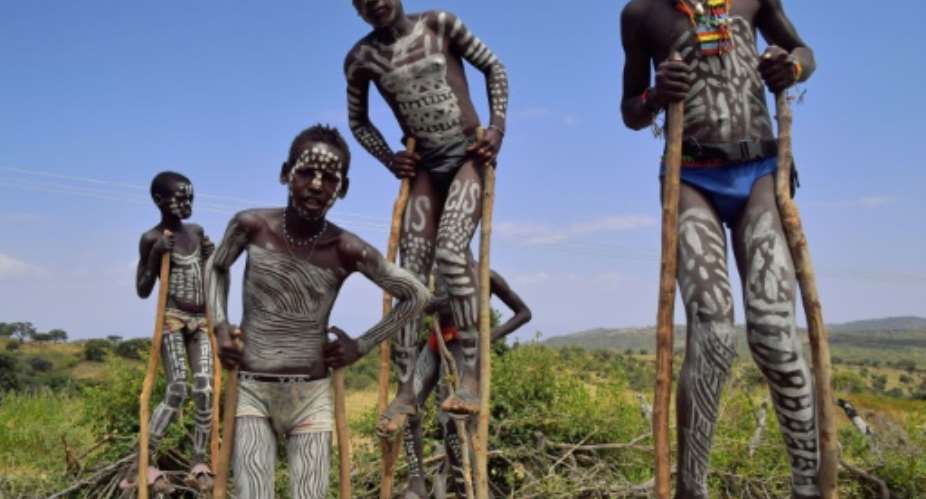
Traditional white-striped bodypainting practiced by indigenous communities mimics zebra stripes to reduce the number of potentially harmful horsefly bites a person receives by up to 10-fold, according to new research published Wednesday.
Tribes in Africa, Australia and southeast Asia have practiced bodypainting in cultural ceremonies for generations.
Traditionally mixed from clay, chalk, ash and cattle dung, the white or grey paint is widely thought to help individuals moderate body heat in soaring bush and savanna temperatures.
But scientists now believe that the striking striped patterns also slash the amount of biting insects attracted to the naked flesh of people living in Nature.
It is known that zebras get bitten far less than animals with a single fur colour, so a team of researchers decided to see if the light stripes painted on humans would have a similar deterrent effect.
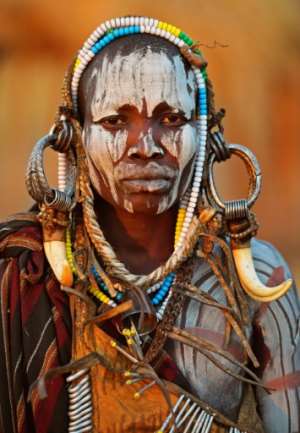 Scientists believe the striped patterns make dark-skinned people less visually attractive to horseflies and other biting insects. By CARL DE SOUZA (AFP/File)
They used three shop mannequins -- one with dark skin, one with lighter skin, and a dark-skinned model painted with white stripes -- and coated each with a thin layer of adhesive to capture creepy crawlies.
They then stuck them in the middle of a meadow for eight weeks in summer, and counted the number of horseflies and other biting insects each one attracted.
The results were startling: the dark-skinned mannequin was 10 times more attractive to horseflies than the striped model and twice as attractive than the light-skinned dummy.
The team behind the study believe that the stripes disrupt the polarisation of light reflected off human bodies, making them less delicious-looking to horseflies and other bugs.
"Traditional bodypaintings with their typical white-striped patterns on a brown body surface have the advantage of deterring blood-sucking horseflies as these patterns are unattractive to these parasitic insects," the authors wrote in the journal Royal Society Open Science.
Bites from horseflies and other pests can be dangerous as well as irritating, as they suck a host's blood, transmitting diseases such as the potentially deadly swamp fever.
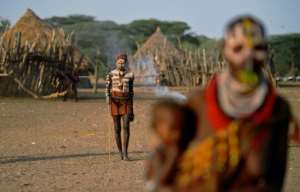 Indigenous communities using bodypaint include the Karo tribe in Ethiopia's southern Omo Valley region. By CARL DE SOUZA (AFP/File)
Because of their need to lay their larvae in ponds and lakes, they often come into contact with indigenous people seeking reliable water sources.
Gabor Horvath, from the Department of Biological Physics at Hungary's Eotvos Lorand University, told AFP that the fly-repellant effect was a happy by-product of the cultural significance of bodypainting: the purpose of the paint is not to stop fly bites, it just happens to be good at doing so.
"We are however convinced that these people know well the horsefly-repelling characteristic of their bodypaintings," he told AFP.
"Essentially, the use of white-striped bodypaintings can be considered as an example for behavioural evolution/ecology and an adaptation to the environment."

 Rubio assures Gulf allies US will protect interests in Iran peace talks
 Trump says NATO allies ‘let down’ US by not backing Iran war
 President Mahama to cut sod for Phase 2 of Sentuo Oil Refinery Project
 EC confirms plans to conduct by-election in Anyako electoral area
 Nima Police arrest truck driver after crash leaves many injured
 Here are NPP MPs seeking action against Ken Agyapong over Afari Hospital comment...
 There is no financial clearance to expand school feeding programme this year — G...
 Government to sanction caterers serving substandard meals under school feeding p...
 Rawlings’s legacy extends beyond political leadership — Vice President
 MFWA opens applications for Africa-China relations training for West African jou...


