




Artists use artifices to make human beings seem more wonderful than they really are, dancers show us human beings who move much more gracefully than human beings really move.
In the same manner films, books and plays show us people talking much more entertainingly than people really talk that makes paltry human enterprises seem indispensable and so as singers and musicians show us human beings making sounds far lovely than human beings really make,
Architects designs temples that exceed the imaginations of the congregations that make Christian worship more attractive and none of these achievements is done without the word architecture from those various professional fields.
Architecture is the word derived from the Latin word “ architectura ”, which is both the process and the product of planning , designing , and constructing of buildings and other physical structures.
In other words it refers to the profession of designing buildings, open areas, communities, and other artificial constructions and environments, usually with some regard to aesthetic effect. Architecture often includes design or selection of furnishings and decorations, supervision of construction work, and the examination, restoration, or remodeling of existing buildings.
The temple in the other words is also derived from the Latin word 'templum' meaning the structure usually built for the purpose of, and always dedicated to, religious or spiritual activities including prayer, meditation, sacrifice and worship whilst others also refer it to the central place of worship for the Israelites or Christians.
Historically, the first Temple was built in Jerusalem by King Solomon after his father Divide that even the stone tablets received by Moses on Mount Sinai on which the Ten Commandments were written were kept in the central chamber of Solomon's Temple.
Temple plays significant roles in modern Christianity as a place of worship that is why the President, Nana Addo Dankwa cut sod for the construction of a national cathedral to mark the 60th Anniversary of the country Ghana’s independence day at the National Scholarship Secretariat.
That event was religiously imperative, hence, it was attended by notable various men of God in the country including Archbishop Nicolas Duncan-Williams, Pastor Mensah Otabil, Palmer Buckle, Rev Victor Kusi, Past Moderator of the Presbytarian Church of Ghana, Prof Emmanuel Martey, Prof Cephas Narh Omenyo and several others.
Temples speak not in an audible voice, but in a way that communicates to others nonverbally or symbolically about the churches. In other understanding, it does not against the background for one to tell or evaluate lot of significant information about the doctrine of a church by their facilities.
This is because temple, have been traditionally designed to highlight certain aspects of the churches theology and believes for example you cannot talk about other temples without mentioning steeple, church bell, nave, chancel, altar, pulpit among others which other temples does not have and as soon as one moves through these edifices, the important and distinct aspects of that particular congregation become apparent.
Randall Coy, director of development at Visioneering Studios at united state, once said churches should think about what their facilities say. “When new family drives by, what do your facilities tell them in those few seconds?” he asks. Temple tell a story, he says, and the job of church architects and designers is to make sure those buildings are telling the truth.
In some instances too, I have observed in our society that Christians may have employed a borrowed or rented facility by individuals, uncompleted houses, cinemas, sport centers, classrooms among others depending of the sizes of the congregation, the number of years the Church has been in the area, the way of their teachings and doctrines among others and such circumstance likely was the case relative to their daily meetings in the school of Tyrannus in (Acts 19:9) in the bible.
Here, the most important questions is that is it the responsibility of the local branches of the Churches especially in Ghana, whose all their offerings, tithes and other dues are being send to the headquarters, to build their own temple or it is the responsibility of the headquarters to build the local Church temples as New Apostolic Church is doing especially in the rural areas, to serve as seed capitals for the new branches to build on their own capacities?.
This reminds me of an incident between Wesley Methodist Church at Gomoa Afransi and their headquarters where they locally enforced to build their own temple within more than at least 20 years but they could not due to the fact that all their money resources were sent to the headquarters and was anticipated to assist the local branch to build the temple but their ambition was always turn down by the headquarters.
This local branch rather took pragmatic decision to suspend themselves from the headquarters for some time so that they can complete their local temple. This brought a lot of polemics between them but the question is without the temple where will be the church. In this modern world as one will say without capital, how can one establish a business? This happens in so many Churches where the resources are sometimes used for things that cannot be important than the temples and therefore, these churches especially the new ones depends on especially schools as their places of worship that was ban by GES on occasions.
The success story of Gomoa Afransi Wesley Methodist Church was that within less than three years, they were able to build a beautiful edifice for God and later resolve the conflicts and went back from their own suspension to the headquarters again.
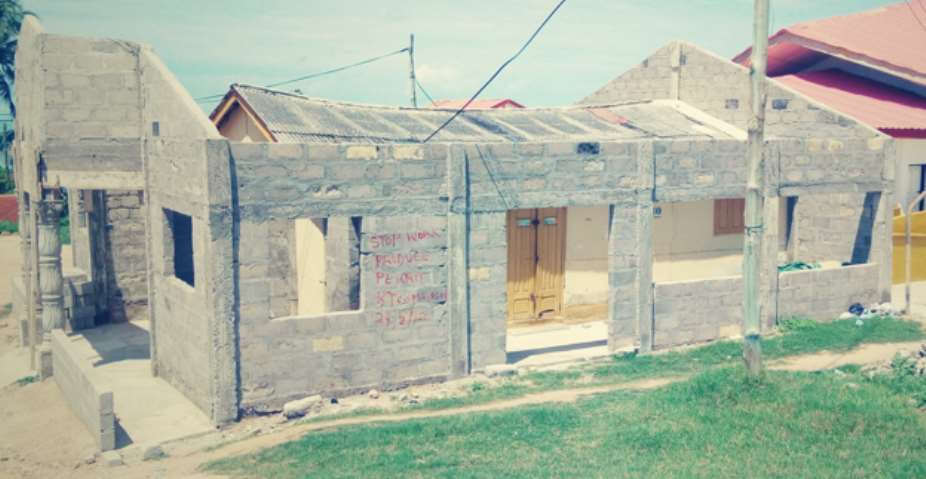
Another important incident I want to share is also between Afransi Church Of Pentecost where their congregation numbers has been increased beyond the capacity of their old temple and to me alone, instead of them to also buy another land somewhere to start a new one, so that the old temple can be converted to similar important projects like rooms for rent to generate another income, they build the new temple around the old one like the picture above as I have also observed around the country about the various churches has been doing nowadays because of sometimes the location, the availability of land, funds among others.
Fundamentally, their plan was to build a story building to serve now and the future congregations. It got to a time where any suggestion they make about that temple, the then pastor did not agree with the members and information was sent to the higher quarters and lather, that pastor was posted to other region.
Their unsuccessful story was that because the pastor’s influence was very high, later, in the process, the plan was changed for different thing all together and obviously, the due architectural processes could also not be achieved or followed accordingly as it is in the plan.
I agree that temple can be a major barrier to exponential congregational growth and that attract some massive temple buildings initiatives in the country but sometimes because these architecture is not managed by professionals as other institutions has, as result, leads to wastage of money and other resources that put massive burden on the local branches in the country.
Though history has proven over and over that future generations never fill the cavernous temples of previous generations but my problem is that due building regulations process should be followed by the Christians even irrespective of their circumstance because the temple belongs to God.
That is how it is important to know the one who is responsible to adhere the church architecture especially in Ghana because this ignorance of duties is causing a lot of harm and controversy among the various local branches and their headquarters. These needs to be checked and based on that sometimes steered to lawlessness of building regulations among these Christians and my evidence include the picture above where the building inspectorate has written Stop work.
It shows that they do not have permit and because they and other Churches do not respect the building regulations of the country, they normally takes their own steps to do their own things.
David Allan Coe once said “It is not the beauty of a building you should look at; it’s the construction of the foundation that will stand the test of time”.
I therefore wish to insist on the authority to check that menace in the country in a sense that the use of temples and Christianity cannot be ended and temples will continue to be a place where higher population always meets to worship God at the same time and when disaster ensued, it affect a lot of people.
Lest I forget that, it appears the collapse of temple in the contemporary times has become extremely alarming and such disasters should be looked at because that disaster retracts religious investments which obstruct future religious development that always resulting in making even innocent worshipers suffers and sometimes make some of the affected Christian victims’ permanent disabled.
I can refer to many such instances like the recent Christ Life Changing Ministry when the roofing collapsed on the congregation that led to15 people wounded included the pastor and the 2 people who were in the critical conditions published by Ghanaian Times Newspaper at Gbawe in Accra.
In a related development, on Sunday January 10, 2016 I recall when portions of a five-storey building belonging to the Fruit of Christ Church in Awoshie, a suburb of Accra, also collapsed onto their near-by house that was also reported by Class FM without forgetting the famous Synagogue Church of All Nations incident in Lagos when many people were reported to have died and many others injured after a temple collapsed at the headquarters of that church in Nigeria.
In all instances, others attributed it to poor architecture planning, materials, expertise, among others and the question here is that who is responsible to look at proper architecture of all church buildings is it the pastors, the mission of the church, the elders or the individual church members or the government.
Alain de Botton , said in the architecture of happiness that “It is in dialogue with pain that many beautiful things acquire their value. Acquaintance with grief turns out to be one of the more unusual prerequisites of architectural appreciation. We might, quite aside from all other requirements, need to be a little sad before buildings can properly touch us”.
By: Abraham Frank Eshun
P. R. O, Journalist and Communication Consultant
 Ukraine launches fresh drone attack on St. Petersburg region on final day of ‘Ru...
 US Ebola facility in Kenya fuels anger in a country with no cases
 Ghana considering legal action against South Africa over xenophobic attacks — Ab...
 There's no acrimony between Agric and Finance Ministers — Dafeamekpor
 Finance and Agric Ministries clash could create COVID-like effect — Bryan Acheam...
 Allow people to do their things in their rooms — Senyo Hosi on anti-LGBTQ bill
 Disregard news of ministerial reshuffle — NDC urges Ghanaians
 Awutu Senya East NDC Branch elections face uncertainty amid register controversy
 Flooding is now a festival in Ghana, we have it every year – Kamal-Deen Abdulai
 Mother, son arrested over alleged murder of husband at Nsawam-Adoagyiri


