




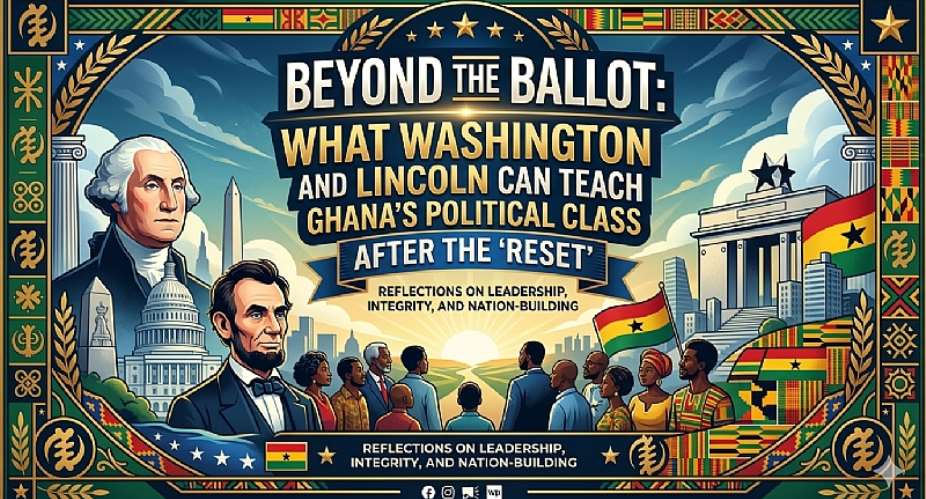
In the vibrant landscape of West African politics, Ghana has long worn its title as the "black star" of democratic stability with pride. Yet, as our nation navigates the mid-point of the current administration under the "Resetting Ghana Agenda" and political party structures quietly re-align themselves for the 2028 presidential race, we are forced to confront a sobering truth: a democracy cannot survive on peaceful elections alone. True democratic resilience requires a fundamental shift from the cult of personality to the strength of permanent state institutions.
A viral educational feature by the historical media channel The American recently highlighted the remarkable frontline survival of a young George Washington during the 18th-century French and Indian War. While his battlefield exploits are legendary, the structural lessons left behind by Washington—and later, Abraham Lincoln—offer an urgent masterclass for Ghana’s contemporary political elite.
The Washington Precedent: Eradicating "Winner-Takes-All" & Third-Termism
The historical snapshot reminds us that after defeating the British Empire, George Washington held absolute power. He could have easily declared himself a monarch or extended his military dominance indefinitely. Instead, he voluntarily walked away from his command in 1783, later cementing a strict two-term presidential limit that remains a global bedrock of democratic rotation.
In Ghana, while our Fourth Republic has successfully guarded the constitutional two-term limit, our governance still suffers under a localized version of absolute control: the "winner-takes-all" political paradigm.
Whenever power transitions between the National Democratic Congress (NDC) and the New Patriotic Party (NPP), the state undergoes a disruptive, partisan overhaul. State-sponsored developmental projects are abandoned, public sector heads are summarily replaced based on party loyalty, and national progress stalls.
Washington's legacy teaches our leaders that the ultimate measure of statesmanship is not how much power your party can hoard during its tenure, but how effectively you can build independent institutions that thrive long after you exit the Flagstaff House.
THE ARCHITECTURAL BLUEPRINT OF STATE | [ THE GEORGE WASHINGTON PILLAR ] [ THE ABRAHAM LINCOLN PILLAR ] - Power through Institutional Restraint - Unity via Political Inclusivity - Voluntary Relinquishment of Office - Defeating Ethno-Regional Polarization - Rejection of the "Winner-Takes-All" Mindset - Assembling a Cross-Party "Team of Rivals"
The Lincoln Strategy: Defeating Ethno-Regional Polarization
If Washington built the architectural frame of modern democracy, Abraham Lincoln saved it from imploding. Presiding over the bloody American Civil War of the 1860s, Lincoln faced a country violently fractured by regionalism and identity politics.
Lincoln’s political genius was defined by his radical inclusivity. Rather than isolating his detractors, he constructed a "Team of Rivals"—appointing his fiercest intra-party and cross-party opponents to the most powerful cabinet ministries. He operated under a rigid philosophy of national healing, famously declaring, "With malice toward none, with charity for all."
This is the exact antidote required for Ghana’s current political climate. As political parties mobilize internal delegates ahead of the 2028 elections, we see familiar, dangerous undercurrents of ethno-regional polarization and tribal voting alignments creeping back into public rhetoric.
Our leaders frequently treat political opponents as existential enemies rather than stakeholders in the Ghanaian project. To break this cyclical friction, Ghanaian presidents must adopt a Lincoln-style approach to governance. True economic and structural restoration cannot be achieved by a polarized house. Ruling governments must look past party cards and deliberately pull the finest technical minds from all sides of the aisle to manage our national recovery.
A Message for the Next Generation of Ghanaian Leaders
As contributors and readers on the Modern Ghana platform reflect on our nation's developmental trajectory, referencing historical icons like Washington and Lincoln should never be seen as an empty romanticization of Western history. Instead, it is an analytical look at the timeless mechanics of successful nation-building.
Ghana does not need more charismatic politicians who can sway crowds with election-year rhetoric. Ghana needs leaders with the character to protect state institutions over partisan gains, the discipline to step aside when their constitutional time is up, and the empathy to govern for all Ghanaians, regardless of regional or political allegiance.
✍️By A Concerned Senior Citizen
Retired Senior Citizen
For and on behalf of all Senior Citizens of the Republic of Ghana 🇬🇭
Teshie-Nungua
[email protected]

 Ukraine launches fresh drone attack on St. Petersburg region on final day of ‘Ru...
 US Ebola facility in Kenya fuels anger in a country with no cases
 Ghana considering legal action against South Africa over xenophobic attacks — Ab...
 There's no acrimony between Agric and Finance Ministers — Dafeamekpor
 Finance and Agric Ministries clash could create COVID-like effect — Bryan Acheam...
 Allow people to do their things in their rooms — Senyo Hosi on anti-LGBTQ bill
 Disregard news of ministerial reshuffle — NDC urges Ghanaians
 Awutu Senya East NDC Branch elections face uncertainty amid register controversy
 Flooding is now a festival in Ghana, we have it every year – Kamal-Deen Abdulai
 Mother, son arrested over alleged murder of husband at Nsawam-Adoagyiri


