




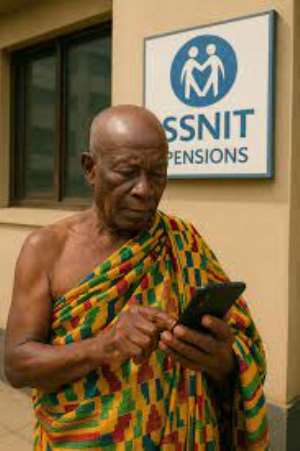
There is a troubling silence echoing through the halls of the National Pensioners Association (NPA). While the leadership remains curiously quiet, perhaps muted by the heavy hand of institutional pushback, the collective stomach of the Ghanaian retiree is rumbling.
Recently, the Social Security and National Insurance Trust (SSNIT) proudly rolled out its new Telehealth Service in partnership with the National Health Insurance Authority (NHIA). While digital doctor consultations are a welcome novelty, let us be ruthlessly clear: you cannot feed a family with a virtual stethoscope. You cannot pay skyrocketing ECG bills with a telehealth app. While SSNIT busies itself with public relations exercises, a burning question remains unanswered: Where is the money stolen from pensioners’ pockets between 2022 and 2025?
The 2022-2025 Shortchange: A Legacy of Denial
Let us look at the facts. Between 2022 and 2025, Ghana’s economic landscape resembled a financial warzone. Inflation decimated the purchasing power of the Ghanaian Cedi, turning hard-earned monthly payouts into mere pocket change. Yet, during this exact period, SSNIT's annual pension indexation failed to reflect the brutal reality of the market.
Pensioners were systematically shortchanged. The adjustments made to monthly payouts did not match the astronomical rise in the cost of basic food, transport, and life-saving medication. While active contributors saw their wages shift, retirees, the very builders of this nation, were left to absorb the shock of an unprecedented cost-of-living crisis.
We are continuously told that the pension ecosystem is "sustainable" and that things are stabilizing. In fact, economic pundits point out that general headline inflation has finally eased down to 3.7% in May 2026, compared to the suffocating double-digit rates of yesteryears. But let no policymaker celebrate just yet.
The damage of those dark years has already been done. The present "stability" does not erase past poverty. Food inflation remains a stubborn thorn, and the Cedi’s historical depreciation has permanently baked high prices into the local market. For a pensioner, a lower inflation rate today does not mean prices are dropping; it simply means the prices they already cannot afford are rising a bit slower.
The GH¢100 Billion Paradox
The insult to injury comes straight from the highest banking offices of the land. We are reliably informed via comments surrounding the Bank of Ghana that the country's broader pension ecosystem has a staggering pool of capital --- nearing GH¢100 billion, sitting within the financial architecture. Government officials and central bankers have openly mused that these vast domestic pension funds could be loaned to heavily indebted state entities like COCOBOD to save them from seeking expensive foreign loans.
Think about the sheer audacity of this paradox. If the state can look at the pension ecosystem as a bottomless piggy bank to bail out corporate state giants, how dare SSNIT claim it lacks the liquidity to properly settle the rightful entitlements of its core stakeholders?
If there is money available to insulate state corporations from international credit markets, there must be money to rectify the historical injustice dealt to retirees between 2022 and 2025.
My Thoughts: A Forensic Audit and Immediate Settlement
The rank-and-file pensioners of Ghana will no longer let institutional silence dictate their survival. If the NPA leadership will not speak, the independent pens of this country will.
We are officially demanding a comprehensive, transparent, forensic investigation into the pension payout calculations for the years 2022 to 2025. We demand to know exactly how the indexation formulas were arrived at while the economy was in freefall, and we demand an open disclosure of the shortfall owed to every single retiree.
The honorable thing for SSNIT management to do is not to distract us with corporate social responsibility or digital healthcare partnerships. The honorable thing to do is to look at the ledger, acknowledge the deficit, and settle the differences now.
Pensioners are not asking for charity; they are demanding their own accumulated sweat and blood. SSNIT must do right by those who built the foundation upon which they now sit. The waiting game is over. Settle the arrears!
FUSEINI ABDULAI BRAIMAH
+233550558008 / +233208282575
[email protected]

 Ukraine launches fresh drone attack on St. Petersburg region on final day of ‘Ru...
 US Ebola facility in Kenya fuels anger in a country with no cases
 Ghana considering legal action against South Africa over xenophobic attacks — Ab...
 There's no acrimony between Agric and Finance Ministers — Dafeamekpor
 Finance and Agric Ministries clash could create COVID-like effect — Bryan Acheam...
 Allow people to do their things in their rooms — Senyo Hosi on anti-LGBTQ bill
 Disregard news of ministerial reshuffle — NDC urges Ghanaians
 Awutu Senya East NDC Branch elections face uncertainty amid register controversy
 Flooding is now a festival in Ghana, we have it every year – Kamal-Deen Abdulai
 Mother, son arrested over alleged murder of husband at Nsawam-Adoagyiri


