




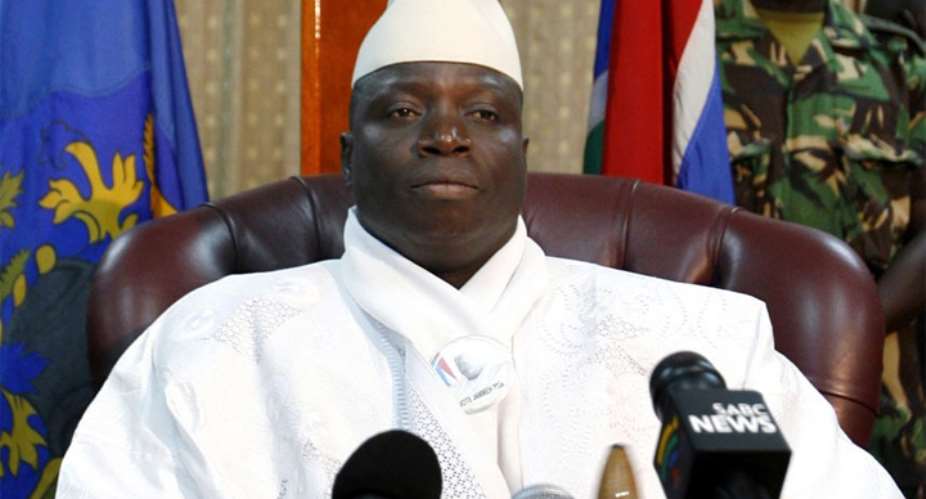
There are some people who should never be allowed near state power.
One of these was Idi Amin Dada of Uganda. Another was Emperor Jean-Bedel Bokassa of the Central African Republic. The two men were not only personally wicked but their lack of understanding of what the machinery of government should used for in a modern state made them completely unsuitable to the position of head of state.
Their ruthlessness was matched, in recent years, by that of Yahya Jammeh, who strutted around the Gambia as its head of state for 22 years (1994-2016) till he was defeated in an election held on 1 December 2016.
Before the election, he arrested one of his main opponents, Ousainou Darboe of the United Democratic Party. He got Darboe and other opposition leaders sentenced to three years imprisonment for merely staging pro-democracy protests. Yet, when it suited him, Jammeh claimed that the judiciary in the Gambia was free and independent.
Breathing fire, he described protesters as “opportunistic people supported by the West.” Not satisfied with using that hackneyed phrase, he told the Gambian people: “I will bow to only Allah and my mother. I will never tolerate opposition to destabilize this country.”
Because of his intolerance of opposition, The Gambian people were surprised when after the Electoral Commission had announced that Jammeh had been defeated by a little-known politician called Adama Barrow, Jammeh conceded victory to Barrow.
But it was apparently a ruse. Aware that if he opposed the result of the election outright, there would be a public outcry against him, Jammeh bided his time for one week, and then suddenly announced that the Election Commission had made a mistake and had given Adama Barrow thousands of votes that should not have gone to him! Jammeh said he was going to file an election petition.
The trouble was that there was no properly-constituted Supreme Court in the Gambia to hear the petition. This was excellent news for Jammeh. By the time a Supreme Court would have been constituted and the case taken to court in May 2017, many Gambians would have forgotten about Adama Barrow, Jammeh reckoned. He would use every opportunity to stall. In Africa, holding the reins of power was enough to ensure that one stayed in power – if only one knew how to manipulate public and international opinion!
But Jammeh had reckoned without the new determination of the people in many African states not to cower before a dictatorship. Adama Barrow maintained that he was the elected president and that if Jammeh had an election petition to file, he should do so within the time limit specified in the Gambian constitution. Meanwhile, he, Barrow should be sworn in.
This was deadlock of the sort which normally enables an African dictator to manipulate events. Neighbouring countries would be recruited to “advise” the contestant to embrace a peaceful settlement and “reconcile” himself to defeat. He must accept any good grace (usually in the form of cash) that the incumbent would proffer as a sign of goodwill.
(Jammeh’s Gambian opponents accuse him of amassing wealth to the tune of $1.2 billion, at the expense of the Gambian people – though given the puny resources of The Gambia, that is hard to credit. The Jammeh opponents also claim that Jammeh owns a US$3.5 million mansion in an affluent suburb near Washington, DC, in the USA, as well as equally expensive homes in Europe and the Middle East).
Jammeh was probably using the time during which he was in secret talks with the Presidents of Guinea and Mauritania to negotiate an amnesty for himself and his collaborators, as well as protection for the wealth they have amassed abroad. But his blatant disregard for the deadlines set by ECOWAS left a sour taste in the mouths of many Gambians. At the time of writing, Jammeh was still in Banjul and Adama Barrow in Dakar. No-one knew exactly how events would finally pan out. What is clear is that the ‘brotherhood’ of African heads of state – once described by President Yoweri Museveni of Uganda as “ a trade union” – had been effectively deployed to protect an African ex-ruler whose ruthlessness in power did not merit his being treated with kid gloves, once his 22-year reign had come to an ignominious end.
So the man with the toupee who was once best known for yelling “You are fired!” to trembling business apprentices on TV who did not match up to his standards of cunning and greed, has been sworn in as President of the United States? It looks like a bad joke, doesn’t it?
Who would have thought that a prejudiced person like Donald Trump would win a presidential election in a country that had previously chosen a black man to head its affairs?
During the election campaign, Trump had not hidden the fact that he was xenophobic. He wouldn’t allow Muslims to be given visas to go to the United States, he said. He would build a wall to prevent Mexicans from illegally entering the United States. And he would make the Mexicans pay for it. He would take on China about trade. He would also ask the European members of NATO to pay more for their own protection. And so on and so forth.
Layer by layer, Trump tore into the fabric of US foreign policy developed over years of analysis and practical experience. Yet the voters preferred him to Hillary Clinton. It may well be that Clinton’s campaign was badly hurt by Russian cyber activity. But even so!
Well, some Americans think that the Office of President will so awe Trump that he will “sober down” and stop frightening the people of the world with his eccentric policies. But it is said that if an animal won’t bite you, it doesn’t bare its teeth at you. So we can only hope that Trump’s bite at international norms won’t be as rabid as the barks he emitted during the election campaign. If not, then God help our poor Planet Earth!
www.cameronduodu.com
By Cameron Duodu

 Dozens dead of thirst after truck breaks down in Niger desert
 CTN-SPN reintroduction will cost Ghanaian shippers between €187.2 million and €3...
 Razak Opoku questions Sulemana Braimah’s consistent claims on NLA-KGL partnershi...
 “Do we sell tomatoes here?” — says Judge as accused seeks bail reduction in poli...
 Students struggle with word problems in 2026 WASSCE core mathematics
 How guests wade through floodwaters after Longji Hotel submerges in Tarkwa
 Questions raised over claims of budget releases to MOFA
 Finance Ministry releases GH¢1.677bn to agriculture sector under AgriConnect Pro...
 Minority says NDC can't rewrite Anti-Gay Bill it demanded assent in 2024
 Four Kumasi Academy WASSCE candidates arrested over alleged threats to burn scho...


