




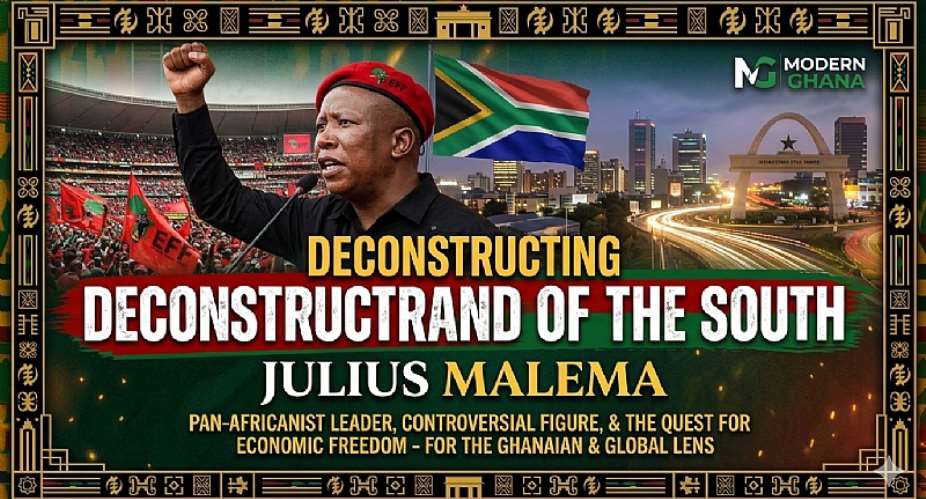
The Paradox of Modern Pan-Africanism
In an era where Africa seeks economic liberation alongside political stability, few figures command as much continental attention as Julius Sello Malema, the Commander-in-Chief of South Africa’s Economic Freedom Fighters (EFF). To the Ghanaian observer, raised on the uncompromising, foundational Pan-Africanism of Osagyefo Dr. Kwame Nkrumah, Malema often sounds like a familiar echo from history. He speaks with the thunderous radicalism of a borderless continent, fiercely advocating for total economic emancipation, land redistribution, and an end to neo-colonial dominance. Yet, beneath the red beret lies a deeply complex, highly controversial, and polarizing figure. As Ghana and the wider international community watch his political maneuvers, the critical question remains: Is Julius Malema the authentic, fearless vanguard of the African youth, or is he a masterful political illusionist navigating a maze of personal ambition?
The Two Faces of Julius Malema: Key Dimensions
To fully understand Malema, the international community must weigh his political contributions against his severe structural criticisms:
The Catalysts for His Continental Appeal
- Uncompromising Pan-African Advocacy: Malema remains a vocal proponent of a United States of Africa, repeatedly calling for the eradication of colonial borders and full economic integration.
- Relentless Anti-Corruption Crusade: In parliament, Malema and the EFF have successfully utilized the legal system to challenge institutional complacency, notably dragging executive corruption scandals before the Constitutional Court.
- A Voice for the Marginalized: He masterfully channels the profound economic despair, structural poverty, and systemic unemployment experienced by Black South Africans.
- Rejection of Xenophobic Politics: Unlike many of his contemporary political peers who resort to anti-immigrant scapegoating for easy electoral gains, Malema consistently defends foreign African nationals.
The Fault Lines and Criticisms
- Racial and Social Polarization: Critics frequently accuse him of employing highly aggressive, racially charged language that threatens social cohesion in a fragile post-apartheid landscape.
- Persistent Legal and Criminal Scandals: Malema’s career has been dogged by a string of high-profile legal issues, including hate speech charges and a 2026 firearm discharge conviction.
- Fringe Economic Polices: Opponents argue that his radical demands for the immediate nationalization of mines and banks, paired with land expropriation without compensation, mimic unstable economic models.
The Champagne Socialist: Ideological Purist or Self-Seeking Opportunist?
The most striking contradiction within Julius Malema lies in the vast disparity between his radical Marxist rhetoric and his personal lifestyle.
The Lifestyle Paradox: While preaching the gospel of the dispossessed and commanding an army of workers clad in domestic overalls, Malema leads a highly affluent, ultra-luxury lifestyle. He is frequently spotted wearing high-end designer clothing, sporting luxury Swiss timepieces, and residing in elite, exclusive suburban enclaves.
For many international analysts and working-class voters, this blatant contradiction points toward performative populism. Critics argue that his aggression serves as a strategic smokescreen—a protective shield designed to recast his personal corruption allegations, luxury indulgages, and financial investigations as politically motivated attacks by state elites.
However, his loyal support base views this defense as fundamentally flawed. They maintain that an African leader does not need to wear rags to effectively fight poverty. In their eyes, his luxury lifestyle does not invalidate his political efficacy; rather, it proves that a Black child from the townships can conquer both political and economic echelons. Whether viewed as an opportunistic "tenderpreneur" or a modern-day tactical warrior, his dual identity remains his greatest weapon.
Strategic Recommendations for Ghana and the International Community
As West Africa observes South Africa's evolving political landscape ahead of the local government elections, Ghana should adopt a measured, analytical approach to Malema's brand of politics:
- Prioritize Diplomatic Institutionalism Over Rhetoric: Ghana must remain cautious of sweeping Pan-African declarations. Malema’s recent sharp criticism of Ghana’s diplomatic repatriation of its citizens during South African immigration tensions underscores that his borderless ideology can clash with practical, sovereign state actions.
- Engage with the Message, Vet the Messenger: Ghanaian youth and political pressure groups who find inspiration in Malema's anti-corruption stances should adopt his aggressive demand for institutional accountability, while strictly rejecting the highly polarizing, racially divisive tactics that accompany it.
- Analyze Economic Feasibility: Policymakers in Accra and across the African Union must critically evaluate Malema’s economic propositions. Structural transformation requires sustainable fiscal policies, transparent governance, and industrial growth, rather than sudden, wholesale nationalization which risks capital flight.
The Verdict on a Modern Revolutionary
Julius Malema cannot be easily written off as a mere political opportunist, nor can he be completely romanticized as a flawless Pan-African savior. He is a direct product of South Africa's unresolved socio-economic inequalities—a loud, necessary wake-up call to an political establishment that has left millions behind. For Ghanaians and the international community, Malema serves as a living masterclass in modern political communication. His career demonstrates that while fiery rhetoric and performative anger can successfully break bureaucratic silence and mobilize millions, it takes rigorous economic policy, personal integrity, and constructive diplomacy to build a truly prosperous, united Africa.
✍️By A Concerned Retired Senior Citizen
For and on behalf of all Senior Citizens of the Republic of Ghana 🇬🇭
Teshie-Nungua
[email protected]

 Razak Opoku questions Sulemana Braimah’s consistent claims on NLA-KGL partnershi...
 “Do we sell tomatoes here?” — says Judge as accused seeks bail reduction in poli...
 Students struggle with word problems in 2026 WASSCE core mathematics
 How guests wade through floodwaters after Longji Hotel submerges in Tarkwa
 Questions raised over claims of budget releases to MOFA
 Finance Ministry releases GH¢1.677bn to agriculture sector under AgriConnect Pro...
 Minority says NDC can't rewrite Anti-Gay Bill it demanded assent in 2024
 Four Kumasi Academy WASSCE candidates arrested over alleged threats to burn scho...
 80 Suspects Grabbed as Police Storm Upper East in Massive Anti‑Crime Sweep
 BoG Mops Up GHS 11.28bn in Fresh Liquidity Sweep as 14‑Day Bill Auction Records ...


