




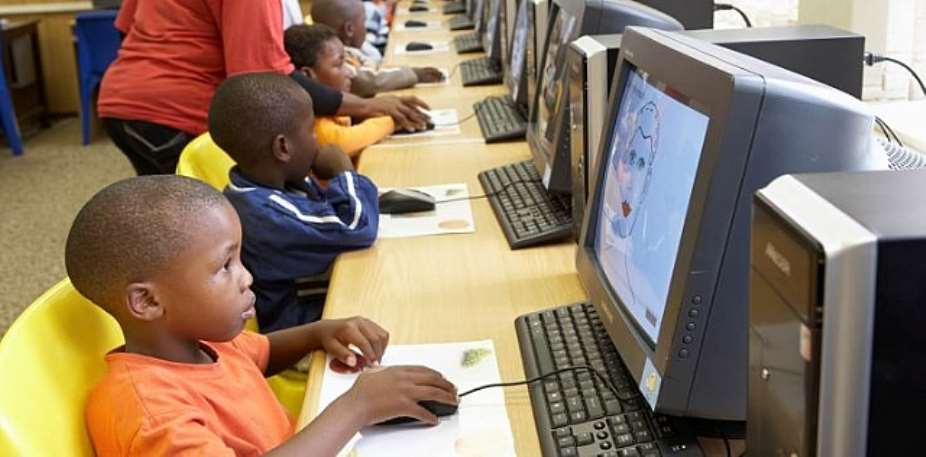
These days without internet and the creative ways in which Ghanaians use to experience life has slowly becoming a thing of the past; making way for a generation of Ghanaians who may never be able to comprehend the value, importance and the impact that the internet has had on our lives.
Internet use in Ghana and globally is expanding rapidly. It is changing the way people live their lives and how they interact with one another. It is a powerful tool which can be used for virtually anything from research and information, to recreation and communication.
Whilst the internet is revolutionizing our lives and helping the process of globalization, it can also be a potential source of danger to users and particularly to children and young people. Concerns about the safety on line use of the internet by children and young people in Ghana are increasing in line with their increased access to the internet and digital TV with the help of internet enabled devices.
Ghanaian parents are willing and ready today to pay extra for their children to receive an education at a school equipped with computers and access to the internet. Some of the schools now make use of other devices and Information Communication Technology is now a taught subject in the classroom even at the basic level.
The last place anyone thought the internet would end up was the classroom. When the internet was first introduced in Ghana, its usage was limited to government agencies, large business and a few rich families who could afford it. In classrooms today, especially in the universities, tertiary institutions and private schools, you do not just find a room occupied by a teacher, blackboard, chalk, tables, chairs and textbooks but also a room equipped with a computer and most probably access to the internet.
Learning platforms such as online educational videos, virtual classrooms, webcasting and an array of access to research, all compiled on the internet provides convenience for both students and lecturers and this, in its own way, has reinvented the way Ghanaians view education.
According to the National Communication Authority, there are over 24 million SIM subscriptions and 26% of people have access to internet usage. The digital migration will therefore make it easy for more people to be connected to the internet while also increasing internet speed.
Children and young people are more technologically competent than adults in use of internet-enabled tools however the ICT for Accelerated Development (ICT4AD) Policy which Ghana is implementing, speaks nothing on protecting children from vices on the internet such as pornography.
I understand the commemoration of the Day of African Child (DAC) which falls on Monday 16 June every year is to draw the attention of all stakeholders on children's rights including government ,non-governmental and international entities as well as present to them issues affecting children for their reflection.
JI, an NGO wants to emphasize that in an attempt to promote a child friendly, free compulsory education, there is the need to protect children's digital rights. JI wishes to cease the opportunity to present the following steps and policy actions to government and other stakeholders in ensuring the attainment of the child friendly ,free compulsory education in Ghana;
· Government should review the ICT policy by taking into consideration the interest of the children and young people; self-consciousness among children and young people on how to stay safe online.
· Children's Acts and ICT4AD policy should be reviewed to include 'Internet child pornography' and other facilitating actions including ratings for music and videos.
· Equip the relevant unit responsible for child protection including the security services on how to deal with cases of child online abuse.
· Facilitate putting in place an interactive 'hotlines' by the Ghana Police Service (cybercrime unit) with respect to the reporting of abuse of children and young people online.
· ISPs should be required by law to install special devices which can indicate that transmitted content is illegal and harmful for children and young people in the network services they offer. We have available software in the market that can monitor the content using key words.
· ISPs should be asked by the law to offer protective services (parental control tools, filters), either for free or charge a small fee.
· There should be public education on how to activate and use the features by both parents and young people themselves to protect their digital footprint.
· Mobile companies should provide filters for children and young people who may use mobile phones and Internet service within different settings and making them available.
· There are just a couple of tools suitable for game consoles, tablets and mobile phones - the devices increasingly used by children to go online - and there are no solutions for users who access content on mobile phones or tablets using an application and not a browser. With public education, the dangers should be minimal.
· School ICT teachers should be trained and refreshed occasionally with the emerging trends. Training should be extended to kindergarten personnel as well about the risk of child pornography generally and Internet child pornography specifically.
· The curriculum of schools in relation to ICT should be updated regularly and expanded on the Internet child protection and this should not be pegged the regular five year stated in the textbook policy for schools because the rate of transformation is faster.
· A day should be set aside for awareness campaigns on Internet security and other emerging issues and school should be allowed to have their own sessions depending on their need.
· The Cybercrime unit should include more IT experts who would have their own IT forensic.
· The General Prosecution should have a special section on cybercrime and prosecutors trained with issues of Internet child pornography among other related offences.
· Courts should have special judges dealing with cybercrime offences and cases dealt with swiftly.
· A possible an agreement should be initiated among all law enforcement agencies as well as agencies dealing with cases related to children and internet and reporting system made less cumbersome to enable people to report.
· Powers of National Communication Authority (NCA) should be extended to license, monitor and supervise cyber cafes. A relationship should be created between ISPs and internet and cafes to help check the safety standards and also to let GISPA also monitor from source.
· Powers of NCA could include monitoring selling points of used computer whether they are certified from abroad to ensure that they do not contain illegal content.
There is no need to wait until things get out of hand, the best way to protect children and young people who use the internet and ICT Tools is to educate them by providing the knowledge and tools they need to safeguard themselves while they are within the cyberspace. Ghanaians have collective responsibility for the welfare of children and young people.
To enable them to live happy and healthy lives in an increasingly digital and technological age there is the need to promote and ensure the positive, creative and safe use of the internet. Parents and schools have a crucial role to play and also to provide opportunities for these groups to learn about online safety as well. These actions will raise awareness of the dangers of internet use and enable all concerned with the health and welfare of children and young people to take appropriate action to keep them safe.
It is incumbent on stakeholders in Ghana to take action on child online security hence this action point from the African Children Cyber Safety Initiative: 'All concerned stakeholders need to help bridge the existing gap between the parents and children on one hand and the teachers and students on the other. This should be done with a view to providing the much needed avenue through which the activities of children and young people on the Internet can be monitored and controlled. Imperative to this is the need for parents and teachers to develop their IT skills.' - ITU
There is the need to make the child protection within the cyberspace a priority and put in place system which will protect the children of Ghana by extension Africa as we commemorate the African Union Day of the African Child (DAC)-2014.
 Ukraine launches fresh drone attack on St. Petersburg region on final day of ‘Ru...
 US Ebola facility in Kenya fuels anger in a country with no cases
 Ghana considering legal action against South Africa over xenophobic attacks — Ab...
 There's no acrimony between Agric and Finance Ministers — Dafeamekpor
 Finance and Agric Ministries clash could create COVID-like effect — Bryan Acheam...
 Allow people to do their things in their rooms — Senyo Hosi on anti-LGBTQ bill
 Disregard news of ministerial reshuffle — NDC urges Ghanaians
 Awutu Senya East NDC Branch elections face uncertainty amid register controversy
 Flooding is now a festival in Ghana, we have it every year – Kamal-Deen Abdulai
 Mother, son arrested over alleged murder of husband at Nsawam-Adoagyiri


