




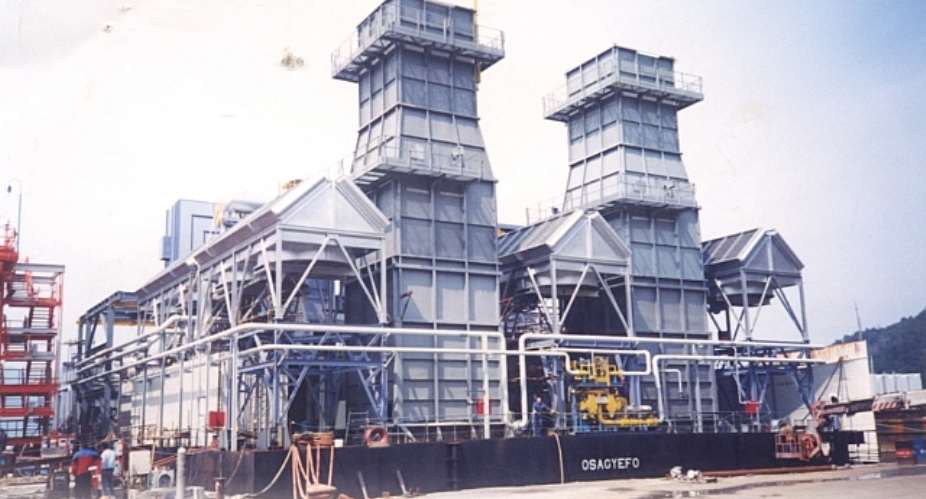
The government is uncertain over the fate of the controversial US$110 million Osagyefo Power Barge meant to generate and add about 125-megawatts of power to the national grid.
The barge has been neglected for almost nine years because of a protracted and tortuous legal tussle between the government and Balkan Energy Company.
The tussel is, therefore, rendering the Osagyefo Barge idle as it wastes away at Effasu in the Western Region.
The Communications Manager at the Ministry of Energy, Mr Edward Bawa, told the GRAPHIC BUSINESS that until the resolution of the dispute, currently pending at the Court of Arbitration at The Hague, The Netherlands, the barge could not be fired.
'It's a long and complex case between the government and Balkan Energy because the two parties could not agree on certain terms', he said.
The Balkan Energy Company (BEC), which signed the 20-year contract agreement with the government in 2007, was expected to equip, refurbish and commission the barge as well as its associated facilities within a 90-day period at a cost of US$40 million.
Attempts by the Ministry of Energy to carry out a financial and technical audit to assess the requirements necessary to bring it on-stream ended up in litigation between the company and the Government of Ghana.
The contract was part of policy options pursued by the Ghana government to ameliorate the power shortages in the country at the time.
Built in Italy with a Japanese loan of US$110 million, the thermal plant sat at an Italian Port for two years, attracting a fee of US$10 million before being moved down to the Sekondi Naval Base, where it remained for yet another two years because the landing bay at Effasu, its previous final destination, was silted.
Mr Bawa explained that the Power Purchase Agreement was to be reviewed every five years and that Balkan would make a yearly lease payment of US$10 million to the government from the beginning of the sixth year to the 20th year.
This, he said "underscores the government's commitment to see the power problem solved and allow normal operations of business in the country".
Issues under contention
The twist and turns of the prolonged litigation was due to the Balkan Energy's insistence on auditing the country's entire power lines before firing the power barge and full details of the facility's component, while the government had also demanded to know whether or not the barge was ready to generate power.
Balkan Energy turned down the government's request on the grounds that Ghana was not ready to distribute the power that would be produced from the barge due to an unsuccessful demand it made for an audit of the country's power lines before firing the facility.
The government's contention was that the lines to receive power from the barge were already set and so there was no need to audit the system before firing the plant.
The government and officials of Balkan Energy were deadlock on the terms, thus compelling the two bodies to send the issues for arbitration in The Hague.
'At the moment, the Osagyefo Barge at Effasu has its doors shut and many of the staff laid off, with only a few at post. The project has stalled, pending the resolution of the case in The Hague,' it indicated,'
The barge was purchased by the Ghana government in 1999 and was conveyed to the country in 2002.
But before the dispute travelled to The Hague, Balkan Energy had contested the legitimacy of the Power Purchase Agreement that leased the Osagyefo Power Barge to it in 2007 to operate.
Under the Power Purchase Agreement, 125-megawatts Osagyefo Barge was leased to Balkan Energy Ghana, wholly owned by Balkan Energy Company LLC, to commission within 90 days of an effective date defined in the agreement, repair, rehabilitate the barge.
However, the contract did not go through Parliament, which violated Article 181 of the Constitution, which principally deals with Parliamentary ratification of loan agreements.
Supreme Courts takes over trial
During the trial, the State, led by Mr Martin A.B.K. Amidu, then Attorney-General, raised two constitutional issues and prayed the Commercial High Court to refer the issues to the Supreme Court for interpretation but the court declined the request.
What were the two???
However, the Supreme Court (SC) on November 2, 2011 ruled that by the Lower Court's refusal to refer the issues to the SC for interpretation, it 'usurped the jurisdiction of this court' and breached Article 130 (2) of the constitution.
It said the Lower Court missed the point when it presumed that there was no cause for the matter to be referred, adding that, the Lower Court ought to have referred the issues to the SC to avoid usurpation of its powers.
The Supreme Court consequently in a unanimous decision, ruled that the power purchase agreement (PPA) between the government of Ghana and Balkan Energy Ghana over a lease agreement on the Osagyefo Power Barge in July 2007 was an international transaction not enforceable as infringing on Article 18 (5) of the Constitution.
The ruling brought closure to the long legal tussle between the two parties in which the Attorney-General (AG) sought a relief praying the court to declare the agreement as constituting an international business transaction, since it did not go through parliamentary approval, to which the Balkan Energy Ghana, the second defendant in the case, disagreed, hence the arbitration at the Hague.
Energy mix and challenges
Problems with the West African Gas Pipeline and seasonal low water levels in dams have combined to create power supply crisis in the country. Recent infrastructure being put in place to harness associated gas from the Jubilee field cannot come soon enough.
The national gas project and the West Africa Gas Pipeline were hailed as the panaceas to the country's economic energy success. With the rising cost of crude oil, thermal installations including the Osagyefo power badge were expected to draw from the pipeline to generate power.
Significant gas resource were expected to reduce the cost of producing electricity considerably and thus place the country in a position to maximise the gains of the resource to further its development imperatives.
Analysts estimate that 7,000 cubic feet of gas cost between US$28 to US$30 compared to a barrel of oil that cost almost US$110 in terms of firing a thermal plant.
Presently, about 45 kilometres of the gas pipeline for the Ghana Gas Company project at Atuabo has been completed. Seventy per cent of the onshore project has also been concluded.
The current challenge that the country faces in the energy sector is as a result of shortage of generation capacity, which the government is diligently working to solve the problem in the short and long term.
Ghana currently has a generating capacity of 2,255 Megawatts and peak demand is around 1,750 Megawatts.
The country has a major problem with the West African Gas Pipeline that mired the production of some 200 megawatt of electricity from the Suno Asogli Thermal Plant, creating an energy deficit.
This led to the load management exercise by the Electricity Company of Ghana between early 2012 and first quarter 2013.
At the moment, the government says it is assiduously engaging stakeholders to guarantee the flow of gas through the pipeline and with other interventions aimed at adding about 264 megawatts from the T3 thermal plant at Takoradi and the Bui hydro project.
By Suleiman Mustapha/Graphic Business/Ghana
 Anti-LGBTQ Bill is duly passed, I believe it is too late in the day to reverse i...
 Here are areas to face power outages over maintenance works today
 RNAQ ex-wife petitions court to restrict Hajia4Reall’s closeness to her children...
 One dead, two children trapped after three storey building collapse at Adenta
 Obuasi Circuit Court jails farmer 8years over violent mining site attack at Obua...
 Health Minister summons KATH CEO over emergency centre closure
 Unauthorised structures demolished at Haatso
 Fire guts shops opposite Accra Central Police Station
 Stephen Yeboah appointed new registrar of Sunyani Technical University
 Abandoned 250-bed Sewua Regional Hospital rots as KATH battles congestion


